Identifying Mixed Repeating Blocks
Introduction
Welcome back to Mastery of Repeating Decimals! In the first lesson, we learned how bar notation works: the overline marks the exact digits that cycle, any digits before the bar form a non-repeating prefix, and even a small shift in bar placement changes the number entirely. With that foundation in place, you are ready for this second lesson.
Here we sharpen one specific skill: looking at a decimal expansion written out with trailing dots and figuring out exactly which digits repeat and which do not. This is trickier than it sounds, especially when several non-repeating digits appear before the cycle kicks in. By the end, you will be able to decompose any mixed repeating decimal into its two parts and write the correct bar notation with confidence.
Why Mixed Expansions Deserve Extra Attention
Some repeating decimals are straightforward. In , the pattern is obvious: the digit repeats right away, and we simply write . But many fractions produce decimals where the repeating cycle does not begin immediately. Consider — is the repeating block , or , or just ? The trailing dots alone do not always make the answer obvious at first glance.
These "mixed" expansions — with a quiet stretch of non-repeating digits followed by a repeating tail — are the ones that cause the most errors in practice. Getting comfortable with them now will pay off in the next two lessons, where we convert repeating decimals back into exact fractions. A wrong split between the prefix and the repeating block leads straight to a wrong fraction, so the decomposition skill we build here is essential groundwork.
The Two-part Structure of a Mixed Expansion
Every repeating decimal can be broken into two pieces:
- Non-repeating prefix: the digits right after the decimal point that appear only once.
- Repeating block: the group of digits that cycles endlessly after the prefix.
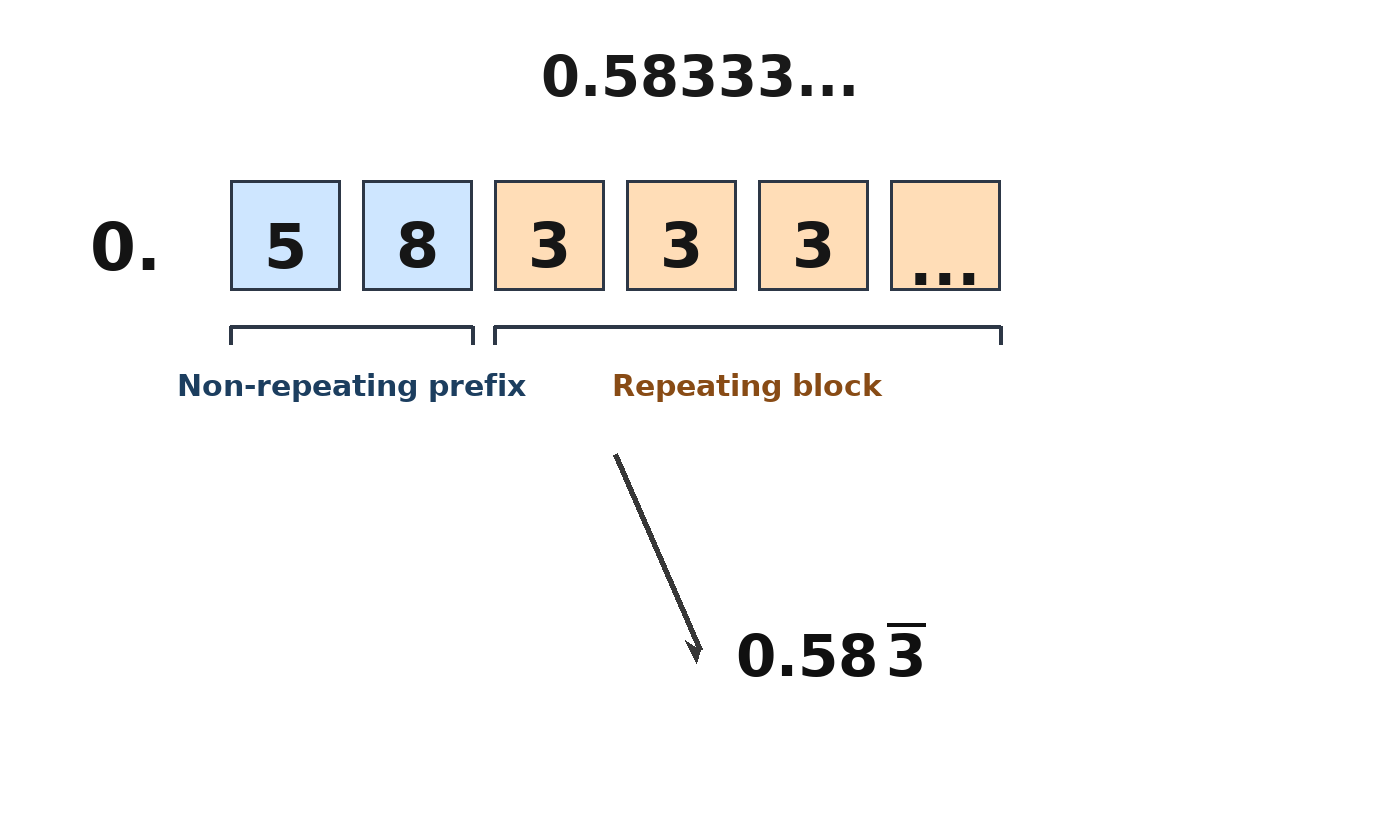
For a decimal like , the prefix is 58 and the repeating block is 3, giving us in bar notation. When there is no prefix at all, the repeating block starts immediately — for example, represents The challenge we tackle in this lesson is always the same question: where exactly does the prefix end and the cycle begin?
A Reliable Strategy for Finding the Repeating Block
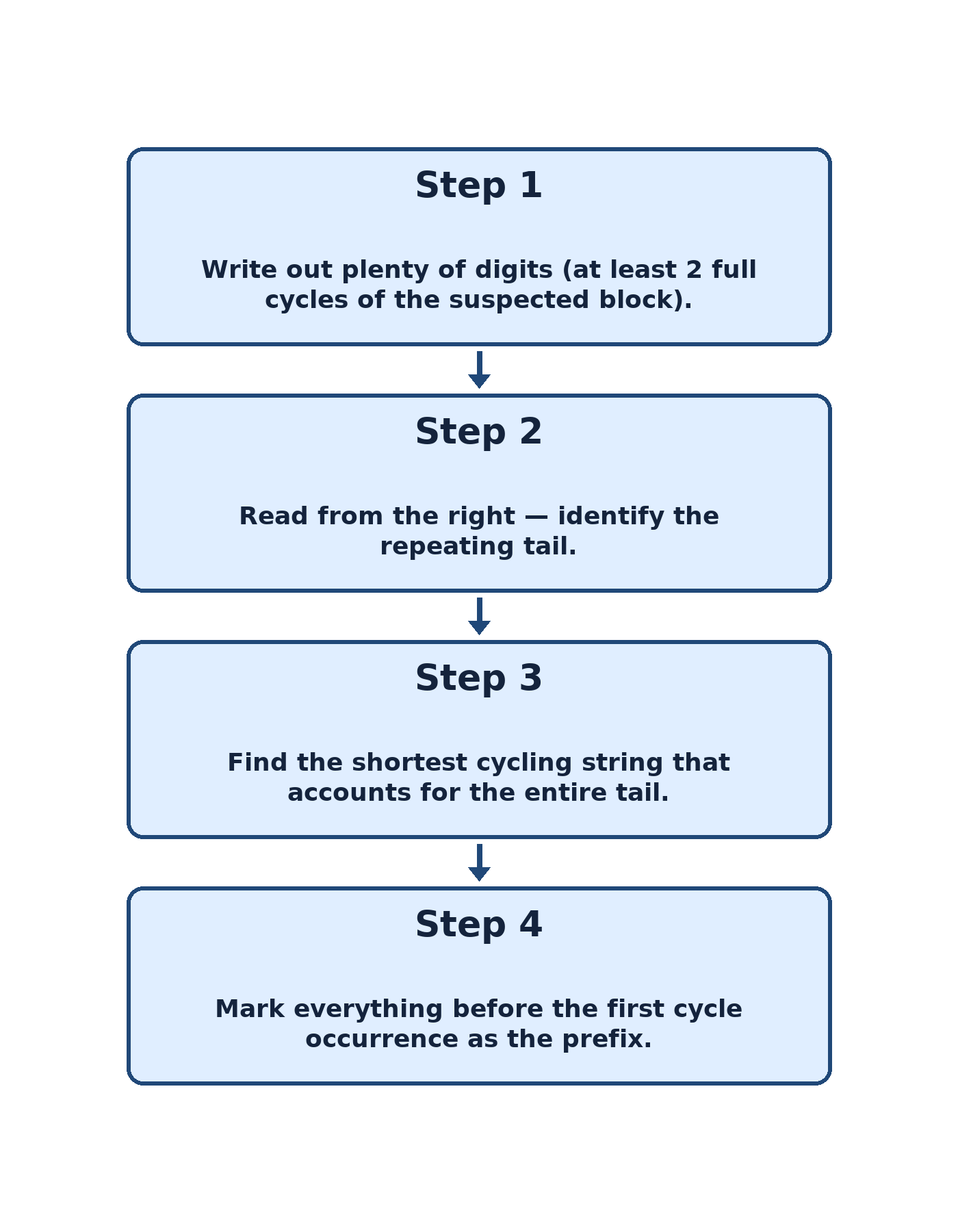
Here is a step-by-step method you can apply to any mixed decimal:
- Write out plenty of digits. Make sure you have enough to see the pattern clearly — at least two full cycles of the suspected block.
- Read from the right side of the expansion. The cycle is most visible in the trailing digits.
- Identify the shortest string that keeps repeating. The repeating block is the smallest group of digits whose repetition accounts for the entire tail.
- Mark everything before the first occurrence of that cycle as the prefix.
Let's apply this to Working from the right, we see , so the repeating digit is clearly . The first in the cycle appears in the thousandths place. Everything before it — namely — does not participate in the cycle. Therefore the prefix is 08 and the repeating block is 3, giving us:
Walking Through Common Mixed Decimals
Let's work through a few more examples at a comfortable pace. Each time, we will identify the prefix and the repeating block, then write the bar notation.
Example 1:
The trailing digits are , so is repeating. The digit in the tenths place appears only once. Prefix: 1, repeating block: 6.
Example 2:
Again the tail shows , so the repeating block is . Before the cycle we see . Prefix: 41, repeating block: 6.
Example 3:
The tail is , so the repeating block is . The digits come before it. Prefix: 28, repeating block: 3.
Notice a pattern across these examples: several well-known fractions — , , and — produce decimals whose repeating block is just a single digit, but the non-repeating prefix varies in length. The prefix length is what makes each decimal unique, and it is exactly the part that requires your careful attention.
Longer Prefixes and Multi-digit Repeating Blocks
Things get more interesting when the prefix is longer or the repeating block contains more than one digit. The same four-step strategy still applies; you just need to be a bit more patient with the pattern-spotting.
Example 4:
Reading the tail, we see . The two-digit string 85 is cycling. Its first occurrence starts at the third decimal place, so the digits before it are . Prefix: 23, repeating block: 85.
Example 5:
The tail shows , so the repeating block is 27. Before the first we find , which is the non-repeating part. Prefix: 10, repeating block: 27.
In both cases, the temptation is to sweep some prefix digits under the bar because they happen to share a digit with the repeating block. Resist that temptation by always checking: does the suspected block, when repeated from its starting position, reproduce the entire tail of the decimal?
Pitfalls to Watch For
Below are the two most common mistakes learners make when splitting a mixed expansion. Keeping them in mind will save you time and frustration.
| Pitfall | What Goes Wrong | How to Avoid It |
|---|---|---|
| Bar too wide | Non-repeating digits get placed under the overline, e.g., writing instead of for | Verify that repeating the block reproduces the tail: does not match |
| Bar too narrow | Only part of the true cycle is marked, e.g., writing instead of for | Check at least two full cycles: does not match |
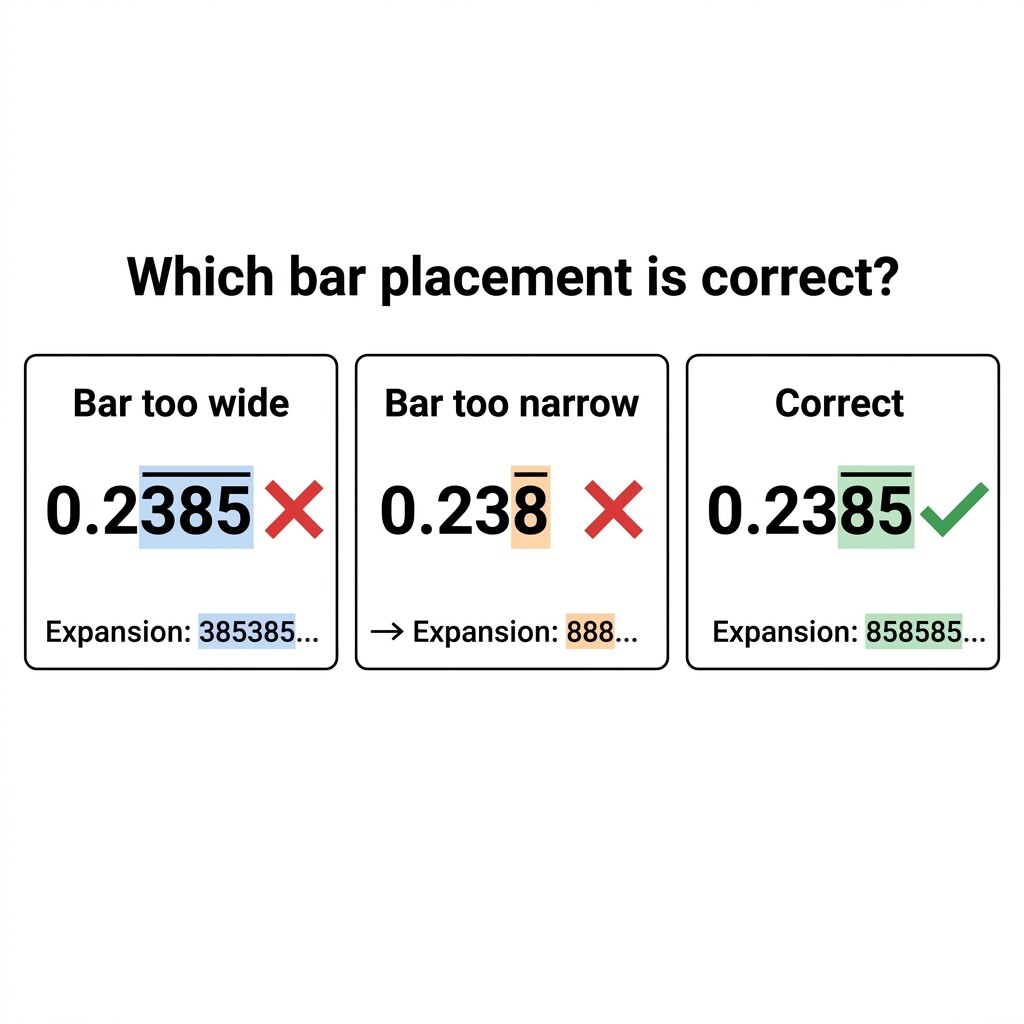
A quick verification trick: after writing your bar notation, expand it back into digits. If the expansion matches the original string, your notation is correct. If not, adjust the split and try again. Think of it like proofreading — you are simply reading your own answer back to yourself to make sure it says what you intended.
Conclusion and Next Steps
In this lesson, we focused on decomposing mixed repeating decimals into their non-repeating prefix and repeating block. We built a reliable four-step strategy — write enough digits, read from the tail, find the shortest cycling string, and mark everything before it as the prefix — and we saw why expanding your bar notation back into digits is the simplest way to catch errors.
Up next, you will put this skill to work in a set of hands-on practice exercises. You will identify non-repeating and repeating parts in mixed decimals, fill in decomposition statements, and write precise bar notation for increasingly tricky expansions. Let's see how sharp your pattern-spotting eye has become!
