Writing Resonant Emails
Write Resonant Emails ✉️
Imagine you send your manager a thoughtful question and all you get back is a single word: "No." You might wonder—are they upset, did you say something wrong, or are they simply swamped with work? As Andrew Brodsky reveals in the HBR Guide to Emotional Intelligence, one of the most persistent challenges both employees and managers face is trying to communicate emotional or sensitive issues over email. This challenge becomes even more critical for people managers, who must navigate team dynamics, deliver feedback, and maintain relationships—all while not having the normal cues for relaying emotion, such as tone of voice and facial expressions.
The reality is that email remains unavoidable in modern workplaces. You can't always schedule a meeting for every conversation, and remote work has made written communication even more essential. The key isn't to avoid email but to master it—to understand how your messages land with others and to craft communications that convey not just information but also the right emotional tone. Throughout this lesson, you'll discover strategies that transform email from a potential minefield of misunderstandings into a powerful tool for building trust and clarity with your team.
Understand What Drives How Emails Are Interpreted 🧠
The first step in avoiding miscommunication is realizing that people don’t read emails in a vacuum. They bring their own emotions and expectations to every message, no matter what you meant. For example, imagine you write to a coworker, “Nice work on the draft, but let’s see if we can make it even better.” If this comes from a teammate, it usually feels encouraging and collaborative. But if it comes from a manager, the same message might feel critical or even a bit intimidating. The words are identical, but how they’re received depends a lot on who’s sending them and the relationship you have.
Several contextual factors shape how your emails are perceived, and understanding these can transform your communication effectiveness:
- Relative position: Messages from people in positions of authority are often read as more negative, even if that’s not what you intended.
- Length of the relationship: If you know someone well, your emails are less likely to be misinterpreted because there’s more shared context.
- Emotional history: If previous interactions have been tense, even neutral emails can come across as unfriendly or critical.
- Recipient’s personality: Some people naturally interpret messages more negatively, regardless of your actual intent.
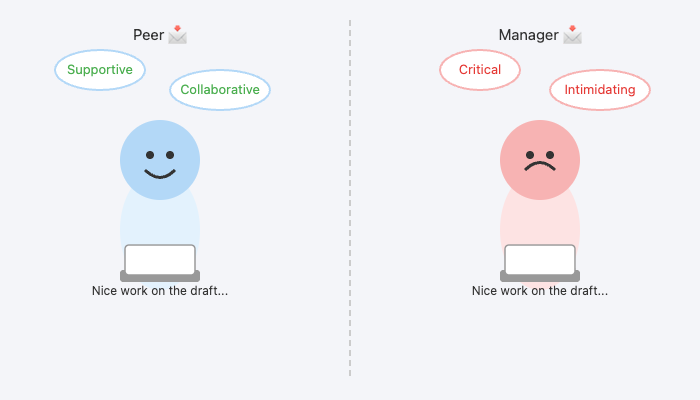
This means you need to stand in your recipient's shoes before hitting send. When you're writing to someone who reports to you, remember that your position of power already primes them to read your message more negatively. If you're addressing someone who's had a difficult week or who tends toward pessimism, they're more likely to interpret ambiguity as criticism.
The solution isn't to avoid all potentially sensitive communications via email—rather, it's to be intentional about how you craft your messages. Before sending any email that could be emotionally charged, pause and ask yourself: "How is this person likely to interpret my message given their current state, our relationship history, and their personality? What assumptions might they make about my tone or intent?" This mental shift from focusing on what you want to say to considering how it will be received can prevent countless misunderstandings and help you maintain stronger relationships with your team.
Build Rapport and Clarity 🤝
One of the most effective strategies for building rapport and ensuring clear communication through email is behavioral mimicry: adapting your communication style to match that of the person you're writing to. This doesn't mean being inauthentic; rather, it's about speaking the other person's language to create connection and understanding.
The key to successful mimicry is observing and matching elements like emoticons, word choice, formality, and use of slang or jargon. If a colleague uses exclamation points and smiley faces, responding with similar enthusiasm shows you're on the same wavelength. With a client who writes in formal, complete sentences, matching that formality demonstrates respect and professionalism. You wouldn’t send a smiley face to a formal client, just as you wouldn’t use stiff language with a close colleague you usually joke with. This process builds trust because people feel understood when their style is reflected back. It shows you’re paying attention and making an effort to connect on their terms.
However, mimicry should feel natural and appropriate to the context. If you suddenly start using slang that feels forced or emoticons that seem out of character, it can backfire and seem patronizing. The goal is to find the sweet spot where you're adapting enough to create resonance while still maintaining your authentic voice. Pay attention to patterns in how different people communicate with you, and gradually adjust your style to create better alignment. Over time, this conscious practice becomes second nature, allowing you to fluidly adapt your communication style to connect more effectively with anyone in your organization.
While mimicking behaviors can build rapport, it still leaves room for emotional ambiguity. The simplest and most direct solution is to explicitly state the emotion you want to convey in your email. This might feel uncomfortably direct at first, especially if you're used to relying on subtle cues, but research shows that people are consistently overconfident in their ability to accurately relay emotions through email. What seems obvious to you as the sender is often completely misread by the recipient.
Here's how two managers recently discussed this very issue after a team misunderstanding:
- Nina: I can't believe Victoria thought I was angry about her presentation. I just wrote Interesting approach. Let's discuss tomorrow.
- Jake: I can see why she might have worried. Without any emotional context, "interesting" can sound sarcastic.
- Nina: But I genuinely thought it was innovative! How should I have written it?
- Jake: Try being explicit about your emotions. Next time, try I'm excited about your innovative approach. Let's discuss tomorrow so I can learn more.
- Nina: That does sound completely different. I guess I assumed she'd know I was impressed.
- Jake: We usually always think our tone is obvious, but the reader fills in the blanks with their own anxieties.
Notice how Jake helps Nina understand that what felt like a neutral, even positive message to her could easily be misinterpreted without explicit emotional signaling. By adding phrases like I'm excited and so I can learn more, the entire tone shifts from potentially threatening to clearly supportive.
As a people manager, stating your emotions becomes even more crucial because your team members are often trying to read between the lines of your messages, looking for hidden meanings or signs of displeasure. When you write Thanks for the update, they might wonder if you're genuinely grateful or passive-aggressively pointing out that the update was late. But when you write Thanks for the update. I really appreciate you keeping me in the loop even though I know you're swamped, you eliminate the guesswork. This transparency might feel vulnerable initially, but it builds trust and prevents the kinds of misunderstandings that can derail relationships and productivity. Remember, in email communication, clarity trumps subtlety every single time.
Mastering resonant email communication comes down to three key skills: understanding the context and perspective of your recipient, adapting your style to build rapport, and clearly stating your emotions to avoid misunderstandings. As you move on to the next set of writing exercises, you’ll put these strategies into practice with realistic workplace scenarios—helping you build stronger relationships and communicate with greater clarity and emotional intelligence.
