Staying Grounded in Stressful Moments
Stay Grounded in Stressful Moments 🌳
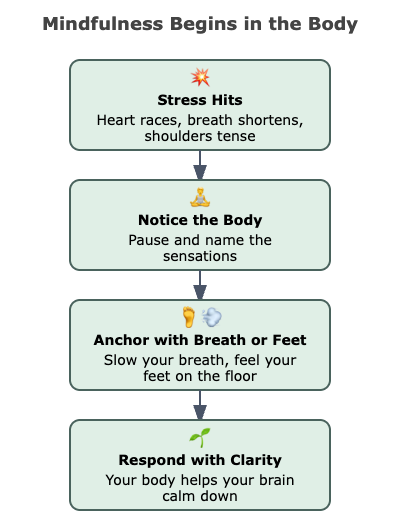
After learning how to communicate effectively over email, it's time to focus on a different kind of challenge: managing stress in the moment. Unlike email, where you have the luxury of time to craft your response, real-life workplace situations often require you to react on the spot. Imagine walking into a meeting to deliver bad news, being called into your boss’s office unexpectedly, or having a colleague challenge your idea in front of others. In these situations, your body often reacts before your mind—your heart races, your shoulders tense, and your breath becomes shallow. As Leah Weiss explains in the HBR Guide to Emotional Intelligence, the key to handling these high-pressure moments isn’t to ignore your body’s reactions, but to use them as anchors that bring you back to the present.
Most managers view stress management as a mental exercise, telling themselves to calm down, trying to think positively, or simply pushing through discomfort. However, mindfulness is just as much a physical practice as a mental one. When your mind is overwhelmed, your body is often the last thing you pay attention to. By focusing on your body, you can find your quickest and most reliable path back to clarity and composure, even when the sensations are uncomfortable. In this lesson, you'll learn how to turn your body from a source of stress signals into a powerful tool for staying grounded, managing emotions, and connecting with others during workplace challenges.
Anchor in the Body and Acknowledge Emotions ⚓
When stress hits, your mind often goes into overdrive by replaying past failures, imagining worst-case scenarios, or scrambling for solutions. This mental spiral only amplifies stress, especially when your attention drifts away from the present moment. The solution lies in a practice called anchoring—bringing your attention into your body and noticing, rather than avoiding, the physical sensations you're experiencing. This might be the tension in your shoulders, the rhythm of your breathing, or simply the feeling of your feet on the floor.
When you feel stressed, your body reacts automatically: your muscles tense, your breathing speeds up, and your heart rate increases, even in response to something as simple as an unpleasant email. These physical changes can make your mind believe the situation is even more threatening, creating a cycle where stress feeds on itself. Anchoring interrupts this cycle by shifting your focus away from anxious thoughts and onto the physical sensations in your body.
For example, imagine someone who gets anxious before important meetings. Their mind races with worries about what could go wrong, making it hard to think clearly. By taking a moment to breathe deeply, they can move from feeling panicked to feeling more steady and prepared. Sometimes, just a single intentional breath is enough to pause the mental spiral and help your body settle, giving you a fresh perspective on the situation.
Here's how this might play out between two colleagues in a real workplace situation:
- Ryan: You look tense. The board presentation is in five minutes, isn't it?
- Matt: I can't stop thinking about all the ways this could go wrong. What if they hate our proposal?
- Ryan: Before you spiral further, let’s just take a couple of deep breaths together.
- Matt: Okay... but my mind keeps racing about the budget questions they'll ask.
- Ryan: That’s normal. Let’s just breathe in slowly... and out. One more time. In... and out.
- Matt: Actually... I feel a bit steadier. My breathing is slowing down too.
Notice how Ryan doesn't try to talk Matt out of his anxiety or offer reassurance about the presentation's outcome. Instead, he simply invites him to pause and take a couple of deep breaths, helping him shift from mental catastrophizing to physical awareness. This simple intervention takes less than a minute but can completely transform someone's state of mind.
While anchoring helps you return to the present, the next step involves learning to acknowledge the emotions you discover there. Your body serves as an early warning system for emotions, allowing you to notice emotional signals before they take over your thoughts and behavior. That tight feeling in your chest might signal anxiety about an upcoming presentation. The heat rising in your face could indicate frustration with a colleague's comment. The heaviness in your shoulders might reveal the burden of overwhelming responsibilities. By tuning into these physical sensations, you gain crucial information about your emotional state while you still have the capacity to choose your response. If you wait until emotions have completely taken over, it becomes much harder to respond thoughtfully.
Practicing emotional acknowledgment through your body can become a natural part of your workday with conscious effort. Here’s how you can do it:
- Notice physical tension. Pay attention to sensations like tightness, heaviness, or discomfort in your body.
- Pause and check in. Ask yourself: "What emotion is present in this sensation?"
- Name the emotion. Identify it simply and without judgment (for example: anxiety, frustration, or disappointment).
- Breathe and allow. Instead of immediately trying to fix or change the emotion, just breathe and let it be present for a moment.
- Create space. This brief acknowledgment often gives the emotion enough space to naturally subside, allowing you to respond from a place of choice rather than reaction.
As you develop this practice, you’ll find that emotions become less like ambushes and more like informative signals, offering valuable data about what matters to you and what needs your attention.
Build Empathy Through Shared Physical Experiences 🤍
When you’re frustrated with a colleague or feeling impatient with your boss, your physical experience can actually help you find empathy. Everyone deals with hunger, fatigue, discomfort, and the need for rest—these are universal experiences that can soften even the most challenging professional relationships when acknowledged. For example, imagine two coworkers who are both dealing with physical limitations. Instead of focusing on what’s difficult, they find common ground in what they can still do, like moving their hands or sharing a laugh. This shift in perspective is a reminder that, beneath workplace frustrations, we’re all human beings with bodies that have needs, limits, and moments of comfort. When you remember that your colleague might also get tension headaches, your boss might be just as tired after a long day, or your team member might feel the same physical weight of stress, it becomes easier to respond with patience and understanding.
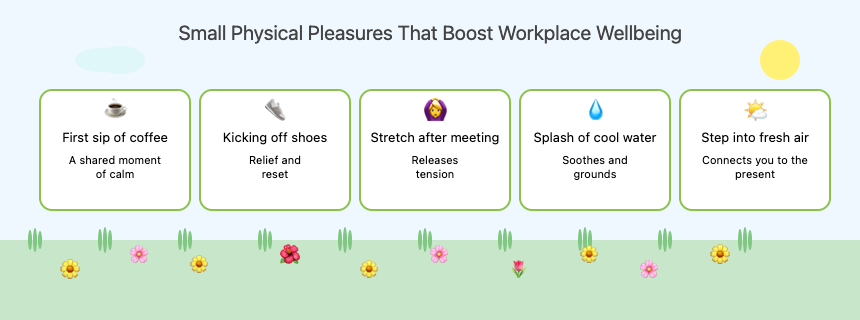
Another important aspect of workplace wellbeing is noticing and sharing small physical pleasures. The first sip of coffee in the afternoon, the relief of slipping off uncomfortable shoes, or the stretch after a long meeting are not just personal comforts but opportunities to connect with others. When you acknowledge these shared experiences, such as saying, “That first stretch after a long meeting feels amazing, doesn’t it?” you create small moments of connection that help build a sense of team and shared humanity.
As a manager, you can leverage this body-based empathy in practical and meaningful ways. When a team member seems stressed, instead of immediately jumping to solutions, try acknowledging the physical reality: "These long days are exhausting, aren't they?" During particularly intense periods, explicitly encourage physical self-care by suggesting, "Remember to stand up and stretch" or "Let's make sure everyone gets a proper lunch break today." These acknowledgments might seem simple, but they communicate a profound message: you see your team members as whole human beings, not just producers of work. This recognition of shared physical experience creates psychological safety and strengthens the bonds that make teams resilient through challenging times.
In the upcoming exercises, you'll have the opportunity to practice these grounding techniques through realistic scenarios, learning to guide others through stressful moments while managing your own physical and emotional responses with greater skill and awareness.
