Make Your Emotions Work For You
Welcome to the Course 📣
Welcome to Mastering Self-Management! In this course, you'll learn how to work with your emotions and what that looks like in everyday situations. As a people manager, your emotional responses shape not only your own performance but also your team's morale, productivity, and trust in your leadership. Instead of suppressing your emotions or letting them take over, you'll discover how to interpret them as signals, align them with your values, and use them to guide purposeful action. This approach transforms emotions from potential obstacles into powerful tools for authentic and effective leadership.
You’ve probably heard advice like “control your emotions” or “keep your feelings in check” at work. But according to Susan David in the HBR Guide to Emotional Intelligence, that’s the wrong approach. Strong emotions aren’t the enemy of good leadership—they’re actually valuable data that can help you make better decisions. In this lesson, you’ll learn how to develop emotional agility: the ability to mine even your most difficult emotions for insights that can strengthen your leadership and improve your team dynamics.
Interpret Emotions as Valuable Data 📊
You can think of emotions as a signaling system, alerting you to something important about your environment, your needs, or your values. The key is learning to decode these signals accurately. For example, when you feel frustrated in a team meeting, anxious about an upcoming presentation, or disappointed after a project setback, these emotions are providing valuable information that deserves your attention.
To extract data from your emotions, you need to ask yourself fundamental questions:
- What is the function of this emotion?
- What is it trying to signal?
For instance, if you're feeling resentful when a team member gets promoted, that emotion might be signaling that you value recognition and growth. This is valuable information that can guide your next career conversation with your manager. Similarly, if you feel overwhelmed when delegating tasks, it might signal a need for control or a fear of being seen as less valuable. These insights can help you work on building trust and letting go.
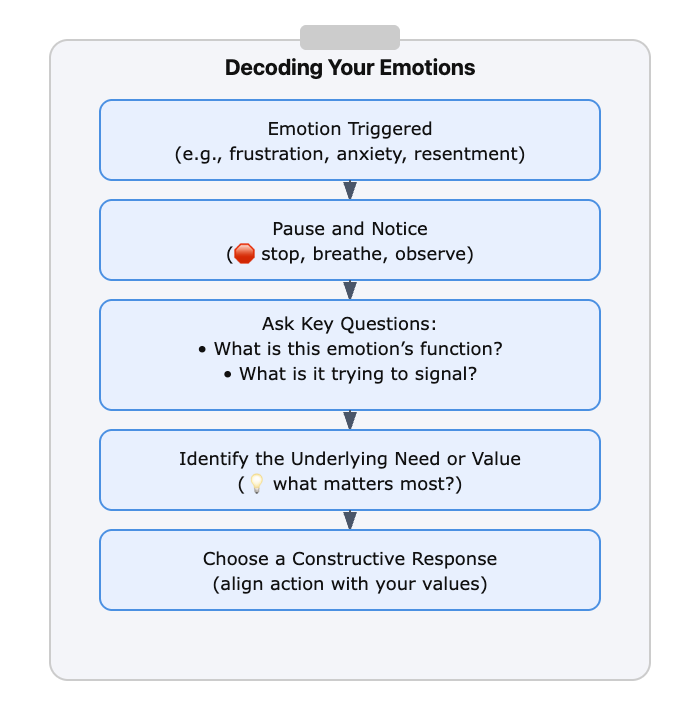
In a management setting, this skill becomes even more critical. When an employee's behavior triggers irritation, that emotion might be signaling that a boundary has been crossed, that expectations aren't clear, or that you're feeling unsupported in your role. Rather than reacting immediately or suppressing the feeling, you can use this emotional data to identify what needs to be addressed constructively. This approach transforms every emotional response into an opportunity for deeper understanding and more effective leadership.
Align Emotional Reactions with Your Values 🧭
Understanding your emotions is just the first step—the next crucial phase is ensuring your response aligns with your deeper values rather than your immediate impulses. Our emotions can help us understand what matters most to us: love for family, ambition at work, fulfillment from helping others succeed, or peace from personal achievements. The challenge lies in focusing on these underlying values rather than getting swept away by surface-level emotional reactions.
Consider a common scenario that many managers face: you notice yourself feeling frustrated when a team member consistently arrives late to meetings. Instead of reacting immediately or ignoring the feeling, you pause to examine the frustration through the lens of your values. You might realize that respect and reliability are important to you, and the repeated lateness feels like a violation of those values. The key insight here is that addressing the issue directly, rather than letting your frustration build up or making passive comments, is a way to honor your values. By connecting to what matters most to you, you can move past the initial frustration and have a constructive conversation that supports both your team’s culture and your own integrity as a leader.
Let's observe how this concept plays out in a real conversation between two managers:
- Jessica: I'm so frustrated with myself. I completely lost it when Ryan questioned my decision in front of the whole team today.
- Victoria: That sounds tough. What do you think set you off?
- Jessica: I just felt so disrespected! Like he was undermining my authority.
- Victoria: I get that. But thinking about it, what do you usually want for your team in situations like that?
- Jessica: Honestly, I want people to feel comfortable sharing their perspectives, even if they disagree with me.
- Victoria: Maybe next time, you could find a way to encourage that openness, even if it feels uncomfortable in the moment.
Notice how Victoria helps Jessica move from her immediate emotional reaction to identifying her underlying value of collaboration. This shift allows Jessica to see that her defensive response actually moved her away from what she values most—creating an environment where team members feel safe to share different viewpoints.
This values-based approach helps you avoid the trap of short-term emotional satisfaction at the expense of long-term alignment. Think about these common misalignments that plague many managers: snapping at someone who annoys you when you value compassion and collaboration, staying silent in a meeting when you value transparency and honesty, or micromanaging your team when you value trust and empowerment. Each of these reactions might feel justified in the moment, but they move you away from the leader you aspire to be.
When you feel a strong emotion arising, the most powerful practice is to pause and ask yourself: "What value is underneath this feeling?" and "How can I respond in a way that honors that value?" This simple yet profound practice transforms emotional reactions from potential liabilities into opportunities for values-driven leadership.
Apply Emotional Agility Strategies 🌊
Emotional agility, or the ability to unhook from unproductive emotions and act according to your values, is what separates reactive managers from intentional leaders. This approach is not about eliminating emotions or forcing positivity. Instead, it is about creating space between feeling and action, allowing you to choose responses that serve you and your team better. This skill becomes a powerful tool for navigating the complex emotional landscape of modern leadership.
The first step in developing emotional agility is recognizing when you are hooked by an emotion. Here’s how you can do this:
- Notice physical signs: Pay attention to signals like tension in your shoulders, a racing heart, or a clenched jaw.
- Observe your thoughts: Look for patterns such as “They always do this” or “I can’t handle this anymore.” These are clues that you are caught in an immediate emotional response rather than acting from your values.
- Acknowledge the emotion: Recognition is powerful because it shifts you from an unconscious reaction to a conscious choice.
Once you recognize you are hooked, try these strategies to create space for a more intentional response:
- Name what you are experiencing: For example, say to yourself, “I’m feeling defensive right now,” or “I notice I’m getting anxious about this deadline.”
- Labeling the emotion: This simple act creates psychological distance between you and the feeling. It helps you move from being someone who is angry to someone who is experiencing anger, which opens up new possibilities for action.
- Treat emotions as temporary visitors: Remind yourself that emotions are not permanent. You can acknowledge their presence without letting them drive your behavior. For example, you might think, “Hello, frustration. I see you’re here. You’re telling me something feels unfair. Thank you for that information. Now, what action aligns with my values?” This approach allows you to be informed by your emotions without being controlled by them, helping you maintain your agency even in emotionally charged situations.
Your emotions are not obstacles to effective leadership—they're your natural guidance system providing valuable information about what matters to you and what needs attention. By developing the skills to interpret, align, and work with your emotions rather than against them, you become a more authentic, effective, and resilient leader who can navigate any challenge with grace and purpose. In the upcoming tasks, you'll have the opportunity to practice these emotional agility skills in realistic workplace scenarios, helping you move from understanding these concepts to applying them confidently in your daily leadership challenges. These exercises will solidify your ability to transform emotional responses into values-driven actions that benefit both you and your team.
