Effective Conflict Mediation
Effective Conflict Mediation
In the previous lesson, you learned how to deliver individual feedback using the SBI framework and Radical Candor. But what happens when the problem is not between you and a team member, but between two team members? Suddenly, you are no longer the feedback-giver; you are the person in the middle. Conflict between colleagues is one of the most common and most mishandled challenges People Managers face. Left unaddressed, it poisons team culture, tanks productivity, and drives your best people out the door. Handled well, however, conflict can actually strengthen relationships and produce better outcomes than if the disagreement had never happened. Throughout this unit, you will learn to diagnose what type of conflict you are dealing with, walk through a structured five-step mediation process, and develop the discipline to stay neutral while guiding both parties toward a resolution that sticks.
Distinguishing Task Conflict from Relationship Conflict
The single most important diagnostic question you can ask when two team members are at odds is: Is this about the work, or is this about each other? The answer determines everything — your approach, your tone, and the kind of resolution you should aim for. Organizational psychologists draw a clear line between task conflict and relationship conflict, and confusing the two is one of the fastest ways to make things worse.
Task conflict is a disagreement about what to do or how to do it. It involves competing ideas, differing priorities, or clashing approaches to a shared goal. Think of two engineers debating whether to build a feature in-house or use a third-party tool, or two marketing leads disagreeing on which campaign strategy will yield better results. Task conflict, when managed well, is actually healthy. Research consistently shows that teams with moderate levels of task conflict make better decisions because they are pressure-testing ideas rather than defaulting to groupthink. The friction is productive — it is about the problem, not the people.
Relationship conflict, on the other hand, is personal. It involves feelings of dislike, frustration, or distrust directed at the other person rather than at the work itself. You will recognize it when the language shifts from "I disagree with that approach" to "They never listen to anyone" or "I can't work with someone who operates like that." Relationship conflict is almost always destructive. It consumes emotional energy, breeds resentment, and rarely resolves on its own.
Here is where it gets tricky for you as a People Manager: task conflict that goes unmanaged frequently mutates into relationship conflict. Two colleagues start by disagreeing about a project timeline. Neither feels heard. The disagreement festers over weeks. Now one says "She doesn't respect my expertise" and the other says "He's impossible to collaborate with." What began as a legitimate professional disagreement has become a personal grievance. Your job is to intervene early enough to keep task conflict productive and to recognize when a dispute has crossed the line into personal territory so you can adjust your mediation strategy accordingly. When you are dealing with task conflict, your focus should be on clarifying goals, surfacing assumptions, and helping both parties evaluate options on their merits. When relationship conflict is in play, you will need to address the emotional undercurrent first — because no amount of logical problem-solving will work if both people feel personally attacked.
The Five-Step Mediation Process
Once you have identified the nature of the conflict, you need a reliable process to guide the conversation toward resolution. Winging it is tempting but almost always backfires — you end up either taking sides, letting the loudest voice dominate, or arriving at a superficial truce that falls apart within days. The Five-Step Mediation Process gives you a structured path through even the most heated disputes.
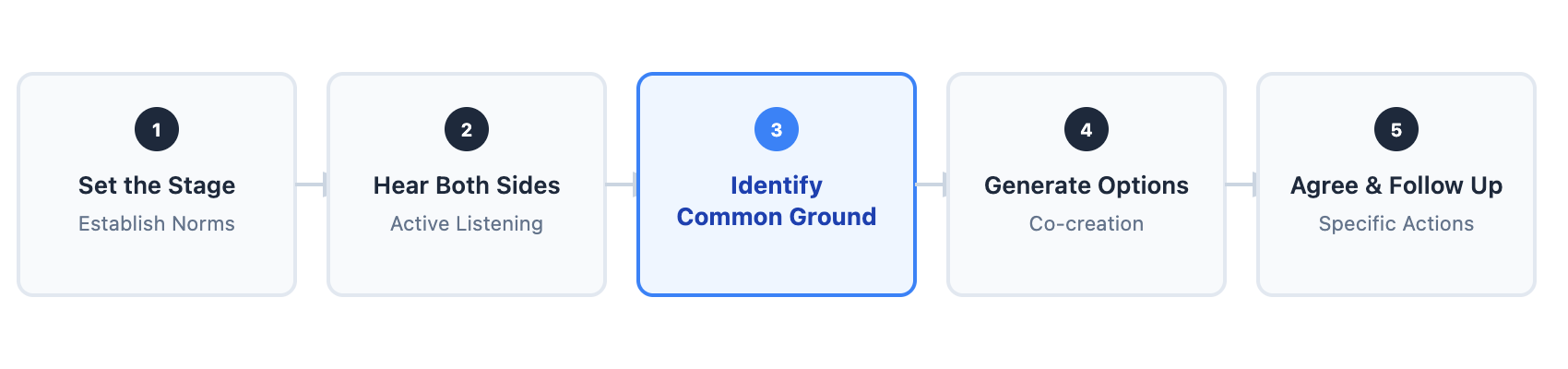
The process begins with setting the stage. Before any productive dialogue can happen, you need to establish ground rules. Meet with both parties and explain your role clearly: you are not a judge, and you are not there to decide who is right. You are a facilitator whose goal is to help them find a workable path forward together. Set explicit norms for the conversation, such as "Each person will have uninterrupted time to speak" and "We will focus on behaviors and impacts, not character judgments." This step may feel overly formal, but it creates the psychological safety both parties need to be honest rather than combative.
With the ground rules in place, you move to the second step: hearing both sides. Give each person uninterrupted time to share their perspective. This is where you practice deep, active listening — not just waiting for them to finish, but reflecting back what you hear. This is not about agreeing with their interpretation; it is about making sure they feel heard. People who feel heard become dramatically more willing to listen in return.
The third, and most crucial step is to identify common ground. After both perspectives are on the table, your job is to surface what both parties share. This is often more than they realize. They may both want the project to succeed, both care about the team's reputation, or both feel frustrated by unclear roles. Naming this shared foundation reframes the conflict from me versus you to us versus the problem.
From there, you move to the fourth step: generating options. With common ground established, guide both parties to brainstorm potential solutions. Resist the urge to propose your own answer. Instead, ask questions like "What would need to change for this to work for both of you?" If you hand down a verdict, you become the enforcer; if they co-create the agreement, they become its co-owners.
Finally, the fifth step is to agree and follow up. Once a solution emerges, make it concrete. Vague agreements like "We'll communicate better" are meaningless. Push for specifics: "Starting Monday, you will both attend the client prep meeting together and align on talking points before the call." Document the agreement, even if informally, and schedule a follow-up check-in (typically one to two weeks out) to see whether the changes are holding.
To see how several of these steps come together in practice, consider the following exchange where Natalie, a People Manager, mediates a dispute between Jake and Jessica over ownership of a key client deliverable.
- Natalie: I want to be clear about my role here — I'm not going to decide who's right. I'm here to help you both find a way forward. Jake, let's start with you. What's been going on from your perspective?
- Jake: I've been leading the data analysis for this deliverable from the start, and last week Jessica sent a revised version to the client without even looping me in. It felt like my work was just overwritten.
- Natalie: So you felt bypassed when the revision went out without your input. Jessica, what's your side of this?
- Jessica: The client needed a faster turnaround, and I couldn't wait two days for Jake's review. I wasn't trying to override him — I was trying to keep us from missing the deadline.
- Natalie: It sounds like you both care about delivering quality work to the client on time — you just have different views on how to protect that. Jake, you want to make sure your analysis is represented accurately, and Jessica, you want to make sure deadlines are met. What if we figured out a workflow that accomplishes both?
- Jake: Yeah, that would help. If I knew there was a tight turnaround, I could prioritize the review. I just need to be in the loop.
Notice how Natalie sets the stage by clarifying her neutral role, gives each person uninterrupted space to share their perspective, reflects back what she hears without taking sides, and then names the common ground — both care about the client outcome — before pivoting to generate options. Jake's final response shows the shift that happens when someone feels genuinely heard: defensiveness gives way to problem-solving.
Maintaining Neutrality and Facilitating Win-Win Agreements
The Five-Step Process gives you the what of mediation. But the how — specifically, how you carry yourself throughout — is equally important. The moment either party perceives that you have taken a side, the entire process collapses. Neutrality is not just a nice ideal; it is the structural foundation that makes mediation work.
Maintaining neutrality starts with your language. Avoid evaluative statements like "That was wrong of you" or even subtle cues like "I understand why that upset you" directed at only one person. Instead, use balanced phrasing that validates the experience without endorsing the conclusion. Something like "I can see this situation has been frustrating for both of you" acknowledges emotion without assigning blame. Moreover, watch your body language carefully — making more eye contact with one person, nodding more vigorously at one account, or physically angling your chair toward one party all send signals that undermine your credibility as a neutral facilitator.
One of the hardest moments for neutrality comes when one person is clearly more at fault than the other. You may know that one team member has been consistently difficult, and everything in you wants to say so. However, the mediation room is not the place for that verdict. If there is an individual performance issue that needs addressing, handle it separately using the feedback tools from the previous lesson — SBI and Radical Candor. In the mediation itself, your role is to help both parties move forward, not to relitigate the past.
Your ultimate goal is a win-win agreement — an outcome where both people feel they have gained something meaningful, not just made concessions. This does not mean splitting everything down the middle in a forced compromise. A true win-win often comes from discovering that the two parties actually want different things, and both can be satisfied simultaneously. For instance, one team member might care most about receiving public credit for their contributions, while the other cares most about having final decision-making authority on technical choices. These are not competing needs — they are complementary ones. Your job as mediator is to surface these underlying interests beneath the surface-level positions. Perhaps that underlying interest is recognition, autonomy, or professional development. Ask why something matters, not just what they want, and you will find far more room for creative resolution.
Consequently, remember that your role does not end when the two parties shake hands. A win-win agreement is only as good as its follow-through. Circle back in the days and weeks after mediation to observe whether the agreed-upon changes are actually happening. If they are, acknowledge it. Reinforcement matters. If they are not, you have an early signal that a deeper intervention may be needed before the conflict reignites.
Coming up next, you will put these mediation skills into practice in a role-play session where you will step into the mediator's seat between two team members with competing grievances. This is your opportunity to apply the Five-Step Process in real time — diagnosing the conflict type, hearing both sides without bias, and guiding the conversation toward an agreement that both parties can own.
