Delivering Hard News
Delivering Hard News
In the previous lessons, you developed the skills to give tough individual feedback and mediate conflict between team members. Now you are stepping into territory where that is not always the case. As a People Manager, some of the hardest words you will ever say are the ones that announce a loss — a canceled project, a restructured team, a role that no longer exists. These moments define your credibility as a leader more than almost anything else. People will not remember every piece of praise you gave them, but they will remember exactly how you told them their six-month project was dead. Throughout this unit, you will learn communication strategies for major disruptions, how to manage the deep psychological resistance that bad news triggers, and how to structure your message so that people can process the loss and move forward with clarity.
When a project gets canceled, a team gets restructured, or roles shift significantly, the stakes are not just operational — they are deeply personal. People invest their identity, energy, and ambition into their work. Telling someone that effort has been rendered moot, or that their professional world is about to look very different, requires more than a well-worded email. It requires a deliberate communication strategy built on a few essential principles.
The first principle is tell them before you tell everyone. Whenever possible, the people most directly affected should hear the news from you in a private, one-on-one or small-group setting before any broader announcement goes out. Learning that your project has been canceled from an all-hands meeting or a company-wide message is jarring and it may feel disrespectful. It signals that you did not consider the human impact enough to give them a heads-up. Even if you only have a few hours' lead time, use it.
Equally important is the principle of being direct and not burying the lead. When managers are uncomfortable, they tend to ramble — padding the conversation with context, caveats, and qualifiers before getting to the point. This is agonizing for the listener, who senses that something is wrong and spends the entire preamble bracing for impact. Instead, name the news clearly within the first few sentences. Directness is not coldness; it is a form of respect for the other person's ability to handle the truth.
Once you have been direct, it is critical to separate the decision from the discussion. In most cases, the decision to cancel a project or reorganize a team has already been made above your level. Be honest about that. Pretending there is room for negotiation when there is not creates false hope and erodes trust. Your role in these conversations is not to defend the decision as if it were your own personal preference, but to communicate it with honesty and then help people navigate the aftermath.
Furthermore, you should always plan the logistics before you deliver the message. One of the most common mistakes managers make is delivering bad news without being prepared to answer the immediate, practical questions that follow: "What happens to my role?" "When is this effective?" "What about the work we've already done?" If you cannot answer these questions, the uncertainty compounds the emotional blow. Before you sit down with anyone, make sure you have clarity — or at least honest transparency about what is still being determined — on timelines, next steps, and how affected individuals will be supported. Preparation does not eliminate the pain of the news, but it prevents the chaos of an information vacuum from making things worse.
Managing the Loss Aversion Response in Employees
Understanding why people react strongly to bad news lies in a principle called loss aversion: humans experience the pain of losing something roughly twice as intensely as the pleasure of gaining something new. This often triggers denial and bargaining, where employees may ask to "at least finish phase one" to avoid registering the loss. Your role is to validate the emotion without reversing the decision. You might say, "I understand the instinct to find a way to save it—that shows how much this meant to you. The decision is final, but I want to talk about how we carry the best of this work forward."
Loss aversion also causes a disproportionate focus on what is being taken away rather than future opportunities. In the immediate aftermath, resist the urge to pivot to "silver linings" or premature pep talks, which can land as dismissive while someone is still processing. Instead, give them space to sit with the news. A simple "I know this is a lot to take in—we don’t have to figure everything out right now" is far more effective than trying to force a positive outlook before they are ready.
Finally, be aware that loss aversion can trigger risk-averse behavior in the long term. Employees who have lost a project may become reluctant to invest in the next one, fearing it will also be taken away. Rebuilding stability takes time and consistent follow-up. Over the following weeks, demonstrate through your actions that you value their contributions and that the loss of one project does not diminish their standing. Trust is rebuilt through steady, supportive behavior rather than a single reassuring conversation.
Creating Clear Narratives: The "Why," "What," and "How" of Change
Once you understand the emotional landscape you are operating in, you need a narrative structure that helps people make sense of the change. Vague or poorly sequenced communication during times of upheaval does not just confuse people — it actively breeds anxiety and conspiracy theories. When people do not have a clear story, they invent one, and the story they invent is almost always worse than reality. The "Why, What, and How" framework gives you a simple, powerful structure for delivering change messages that people can actually absorb.
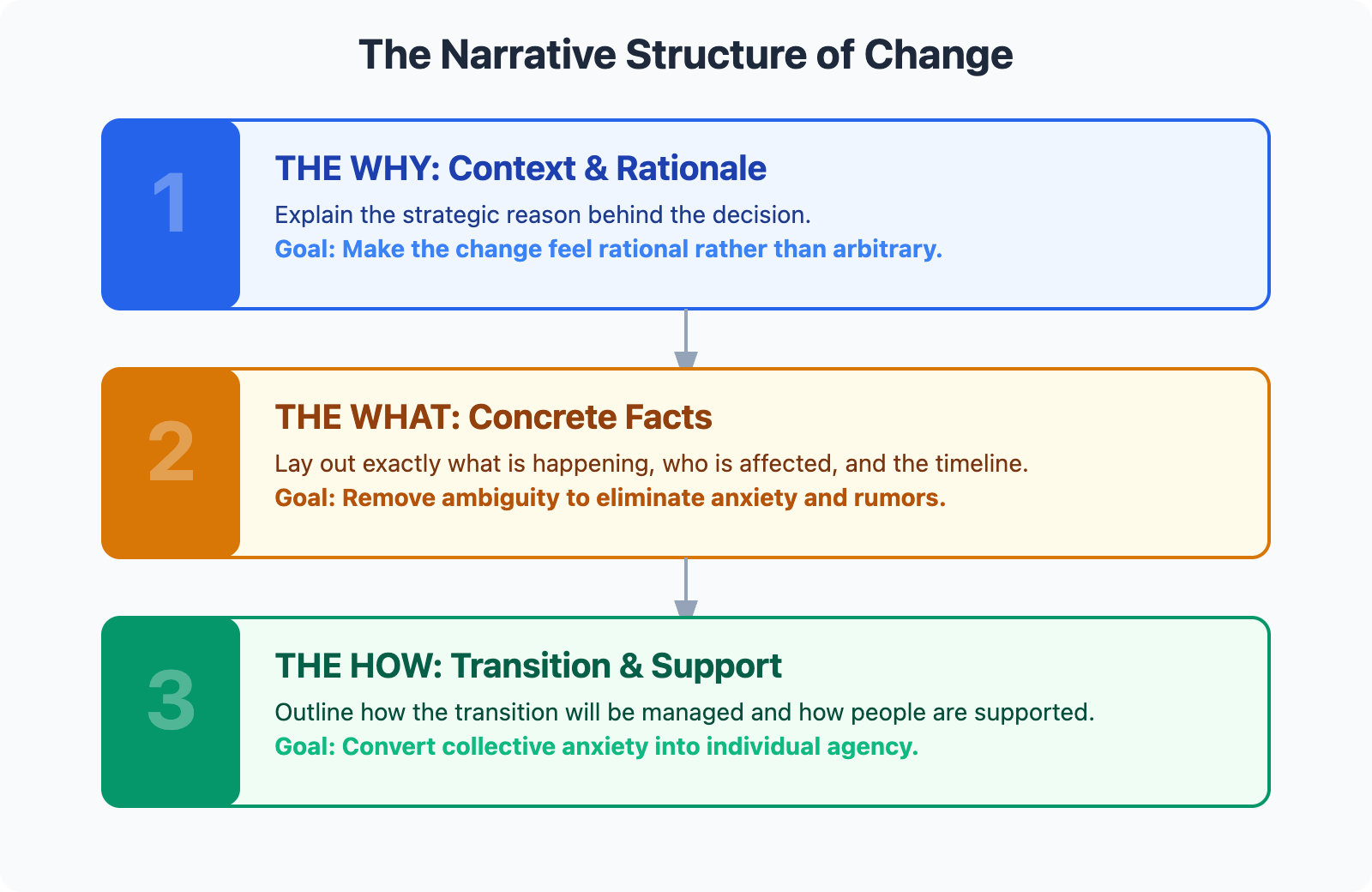 To see the full "Why, What, and How" framework in action, consider the following exchange where Natalie, a People Manager, delivers the news of a project cancellation to Dan in a private one-on-one.
- Natalie: Dan, thanks for meeting with me. I wanted you to hear this from me directly before it's shared more broadly. Over the past quarter, leadership has seen a major shift in our customer base toward enterprise clients, which means the company is reallocating resources to meet that demand. As a result, the decision has been made to discontinue the Atlas project, effective at the end of this month.
- Dan: Wait, Atlas is done? We just hit our beta milestone last week. Can't we at least finish the current phase?
- Natalie: I hear you, and that milestone was a real achievement — it shows how much quality work you and the team put in. The decision is final, but I don't want that work to disappear. What I'd like to do is sit down with you this week to map out how your skills and the insights from Atlas can feed directly into one of the enterprise initiatives. I've also arranged for everyone on the team to have a one-on-one with me by Friday to discuss reassignment preferences.
- Dan: I appreciate you telling me first. I'm frustrated, but at least I understand why.
Notice how Natalie leads with the "Why" — the strategic shift toward enterprise clients — before stating the "What" — the Atlas project is being discontinued. When Dan pushes back with a bargaining response, she validates his emotion and the team's accomplishment without reopening the decision. She then moves into the "How" by outlining concrete next steps: a meeting to discuss his path forward and scheduled one-on-ones for every affected team member. Dan's final response illustrates the power of this sequence — he is still frustrated, but he has context and a clear path ahead, which is exactly the outcome you are aiming for.
One important note: the "Why, What, and How" framework applies whether you are speaking to one person in a private meeting or addressing an entire department in a town hall. The sequence stays the same — always lead with "Why" — but you will adjust the level of detail and the emotional tone based on your audience. In a one-on-one, you have more room to pause, check in emotionally, and let the person respond. In a group setting, you need to be more structured and should plan for a Q&A period where people can voice concerns.
Coming up next, you will step into a role-play scenario where you deliver the news of a project cancellation directly to an affected employee. This is your chance to practice leading with the "Why," managing the emotional response in real time, and demonstrating the kind of honest, empathetic communication that earns lasting trust — even when the message itself is hard to hear.
