The Feedback Framework
Welcome to the Course
Welcome to Mastering Difficult Conversations, a course designed to give you the communication "operating system" you need to handle the toughest interpersonal challenges with clarity, empathy, and confidence. As a People Manager, the conversations you dread most are usually the ones that matter most. Whether it is telling a high performer that their behavior is alienating colleagues, mediating a heated dispute between two team members, announcing a project cancellation, or pushing back on an unrealistic directive from above — these moments define your leadership far more than any strategy deck ever will.
Throughout this course, you will begin by learning a structured feedback framework that lets you deliver even the most uncomfortable critiques without triggering defensiveness. From there, you will master the art of conflict mediation, learning to distinguish between types of conflict and guide your team toward resolution. You will then develop strategies for delivering hard news and managing change, addressing the very real emotional responses that come with loss and uncertainty. Finally, you will sharpen your ability to navigate upward influence — advocating for your team's needs and presenting difficult truths to senior leadership without losing credibility.
Understanding the "Amygdala Hijack" During Difficult Critiques
Before you can deliver effective feedback, you need to understand what happens in the brain of the person receiving it. When someone hears something that feels like a personal attack, this can lead to what is known in the psychology field as an "amygdala hijack." The amygdala's job is to detect threats and trigger a fight-or-flight response, and critically, it does not distinguish between a physical danger and a social one. A phrase like "You're not being a team player" can set off the same neurological alarm as a genuine threat, flooding the body with cortisol and adrenaline.
When an "amygdala hijack" occurs, the person you are speaking with essentially loses access to their prefrontal cortex — the part of the brain responsible for rational thought, perspective-taking, and problem-solving. Consequently, no matter how logical or well-intentioned your feedback is, it simply will not land. The person is no longer listening to understand; they are listening to defend. You will recognize this in the moment when their arms cross, their jaw tightens, they interrupt with "But that's not what happened," or they go completely silent and shut down.
Understanding this neurological reality shifts your responsibility as a feedback-giver. Your first job is to reduce the threat level of the conversation before you deliver the substance of your message. This starts with how you frame the opening. Compare these two approaches: "We need to talk about your performance" versus "I'd like to share an observation and get your perspective." The first triggers alarm bells, the second signals collaboration. Small language shifts like these keep the amygdala quiet and the prefrontal cortex engaged.
Beyond your choice of words, you should also pay close attention to when and where you deliver feedback. Pulling someone aside immediately after a visible mistake in front of the whole team can amplify the threat response considerably. Choosing a private, calm setting and allowing a brief buffer of time gives both of you a far better chance at a productive exchange.
The SBI Framework and Radical Candor for Non-Judgmental Language
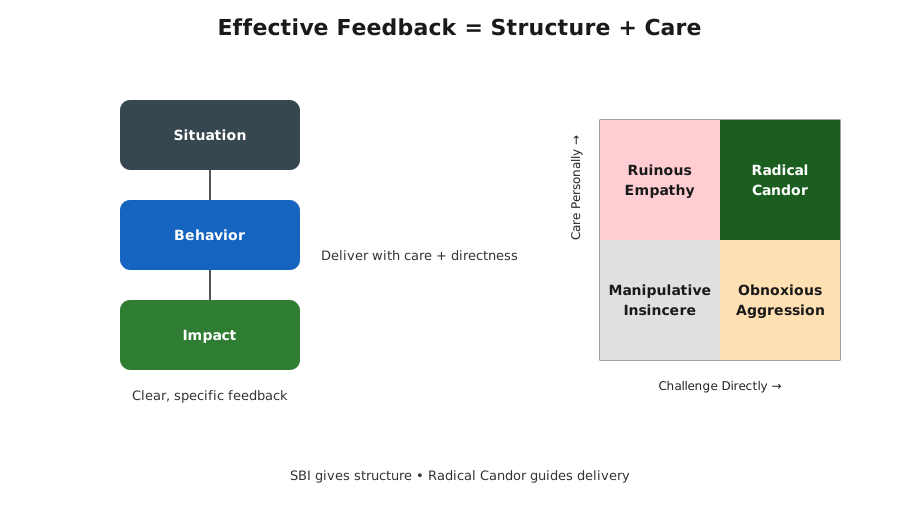
Now that you understand the neuroscience of why feedback goes wrong, you need a reliable structure to get it right. The SBI Framework — which stands for Situation, Behavior, Impact — is one of the most effective tools available to People Managers for delivering feedback that is specific, objective, and free of judgment.
The framework has three components that work together in sequence. Situation refers to the specific context — the when and where — which anchors the feedback in a concrete moment rather than a sweeping generalization. Behavior describes the observable action, meaning what the person actually did or said, not your interpretation of their character or motives. Impact then explains the effect that behavior had — on you, on the team, on the project, or on the individual themselves.
Structure alone is not enough. You can deliver a technically perfect SBI statement and still have the conversation fall flat if the other person does not believe you genuinely care about them. This is where the concept of Radical Candor becomes essential. Radical Candor sits at the intersection of two dimensions: caring personally and challenging directly. As a People Manager, your job is to do both at the same time when delivering difficult feedback.
The Radical Candor framework maps these two dimensions into four quadrants, and understanding all four helps you see where conversations go wrong. When you challenge directly without caring personally, you fall into Obnoxious Aggression — think of a manager who says "That presentation was terrible" and walks away. When you care personally but fail to challenge directly, you slip into Ruinous Empathy — this is the manager who thinks "I don't want to hurt their feelings" and says nothing, allowing poor performance to continue unchecked. When you neither care nor challenge, you land in Manipulative Insincerity, or feedback that is vague, political, and ultimately unhelpful. The goal is the upper-right quadrant, Radical Candor itself, where you are honest because you care.
In practice, this means leading with relationship before correction. Before delivering tough feedback, ask yourself: Does this person know I am invested in their success? If the answer is no, you may need to build that foundation first. Furthermore, Radical Candor demands that you be immediate and specific. Stockpiling feedback for a quarterly review is a form of Ruinous Empathy in disguise. If something needs to be said, say it close to when it happened, using the SBI structure you have already learned.
To see what this looks like in practice, consider the following exchange between a manager and a direct report the day after a client meeting went sideways.
- Natalie: Ryan, thanks for making time to chat. I wanted to share something I observed yesterday because I think it's important for your growth, and honestly, I know how much you care about this account.
- Ryan: Sure, what's up?
- Natalie: During yesterday's client call, when the client raised concerns about the timeline, you responded by saying their expectations were unrealistic and moved on to the next slide. After that, the client went quiet for the rest of the presentation.
- Ryan: I didn't mean it that way. I was just trying to keep us on track.
- Natalie: I hear you, and I know your intent was to stay focused. But the impact was that the client felt dismissed — they actually emailed me afterward asking to reschedule. I think you're one of the strongest people on this account, and I'd love to work with you on how to acknowledge concerns in the moment without losing momentum.
- Ryan: That makes sense. I didn't realize they took it that way. Yeah, I'd be open to that.
Notice how Natalie opens with genuine care and a specific reason for the conversation, rather than a vague "We need to talk." She then uses the SBI structure — naming the situation (yesterday's client call), the behavior (dismissing the client's concern and moving on), and the impact (the client went silent and later requested a reschedule). When Ryan becomes slightly defensive, Natalie does not back down or soften the message into Ruinous Empathy. Instead, she acknowledges his intent while holding firm on the impact, and closes by reinforcing her belief in his ability.
Coming up next, you will put these concepts into action in practice exercises where you will use the SBI framework and Radical Candor to address a recurring behavioral issue with a high-performing team member. This is your chance to practice delivering feedback that is both direct and deeply respectful.
