Building Actionable Customer Personas
Building Actionable Customer Personas
You've now got three layers of insight on your segment: who they are, why they buy, and what they actually do. The catch is that nobody on your creative team can write an ad to a spreadsheet. This unit turns those layers into a single person your designers, copywriters, and channel planners can picture and act on. Let's start with why that translation step earns its keep.
Turning Abstract Segments into Usable Profiles
Here's the move: stop handing your team a segment and start handing them a person. A segment is a statistical group ("frequent buyers, 28 to 40, sustainability-minded, reorder every season"). Accurate, but no copywriter writes a headline to a percentage. A persona collapses that group into one believable individual with a name, a face, and a story, so everyone making creative decisions is picturing the same human.
That's the entire value: a persona is a shared decision-making shortcut. When a designer asks "would she click this?" or a media buyer asks "which platform is she on?", the persona answers faster and more consistently than the raw data ever could. It doesn't replace your evidence; it packages it into something a team can rally around.
Synthesizing the Three Layers into a Single Persona
The synthesis step is where most personas go wrong, so slow down here. Your job is to weave demographic, psychographic, and behavioral signals into one internally consistent person, not to staple three lists together. Demographics give the frame, psychographics give the motivation, and behavior gives the proof.
The hard part is conflict. The layers often disagree: your psychographic research says "budget-conscious, resents overpriced gear," but your behavioral data shows premium repeat purchases. You can't include both as written. You have to make a call.
- Nova: The survey says they're price-sensitive, but the purchase data shows they buy the premium tier every time.
- Ryan: So which is it? We can't write "frugal" and "pays top dollar" on the same persona.
- Nova: Behavior wins when it conflicts with stated attitude. People say they're frugal, then pay for what they actually value.
- Ryan: So the call is "value-driven, not cheap": she'll spend, but only once she's convinced it's worth it.
- Nova: Right. That's one consistent person, and it tells the copywriter to lead with proof of worth, not discounts.
Notice they didn't average the two signals. They resolved them into a single trait and named the implication for the creative. When you make a call like that, jot down the reasoning, so the persona stays defensible later.
Designing a Complete Persona: Goals, Pain Points, and Buying Behavior
To form a complete persona, start with a name and snapshot. This is a real first name and a one-line summary that fixes the person in everyone's mind. Then their goals, or what they're trying to achieve. Then pain points, meaning what frustrates or blocks them. And finally, buying behavior: how they research, what triggers a purchase, where they buy, and what brings them back.
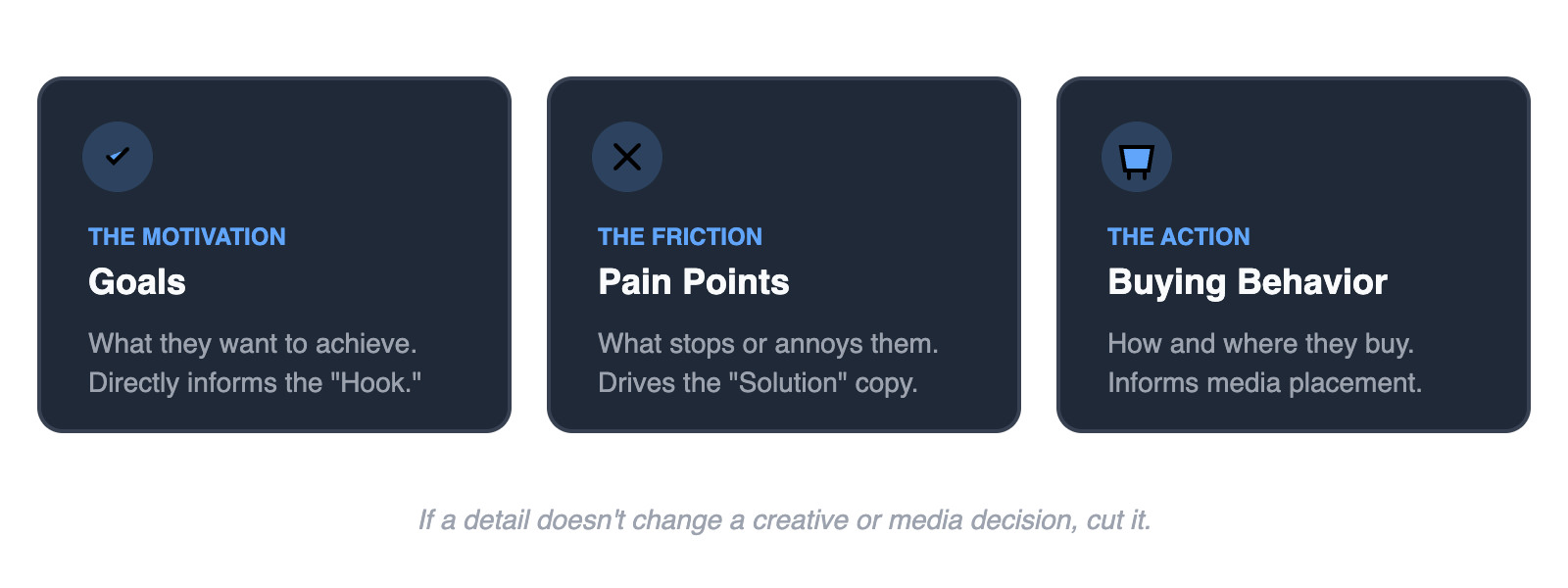 Run every line through one discipline test: does this detail change a creative or media decision? "Loves the outdoors" is decoration. "Obsessively compares gear weight before buying" tells a copywriter exactly what to lead with and a media buyer which reviewers to court. If a detail doesn't move a decision, cut it, however charming it sounds.
The takeaway is that the strongest persona isn't the most vivid one; it's the one where every detail traces back to evidence and points to an action. Three practices sit ahead: a quick self-check on what actually makes a persona usable, a live build session where you synthesize the three layers and resolve the conflicts in real time, then a one-page persona you can hand straight to creatives. As you work through them, keep asking the question that keeps personas honest: "what decision does this detail help someone make?"
