Conducting Market Research
Conducting Practical Market Research
Every persona and segment you've built so far rests on one thing: evidence. Until now you've been working with insight that already existed somewhere. This unit is about where that insight actually comes from, and how to gather it yourself when the answer you need isn't sitting in a dashboard. Get the research right and your personas hold up under scrutiny. Get it wrong and you've built a confident, polished profile of a customer who doesn't exist.
Knowing When You Need Primary or Secondary Research
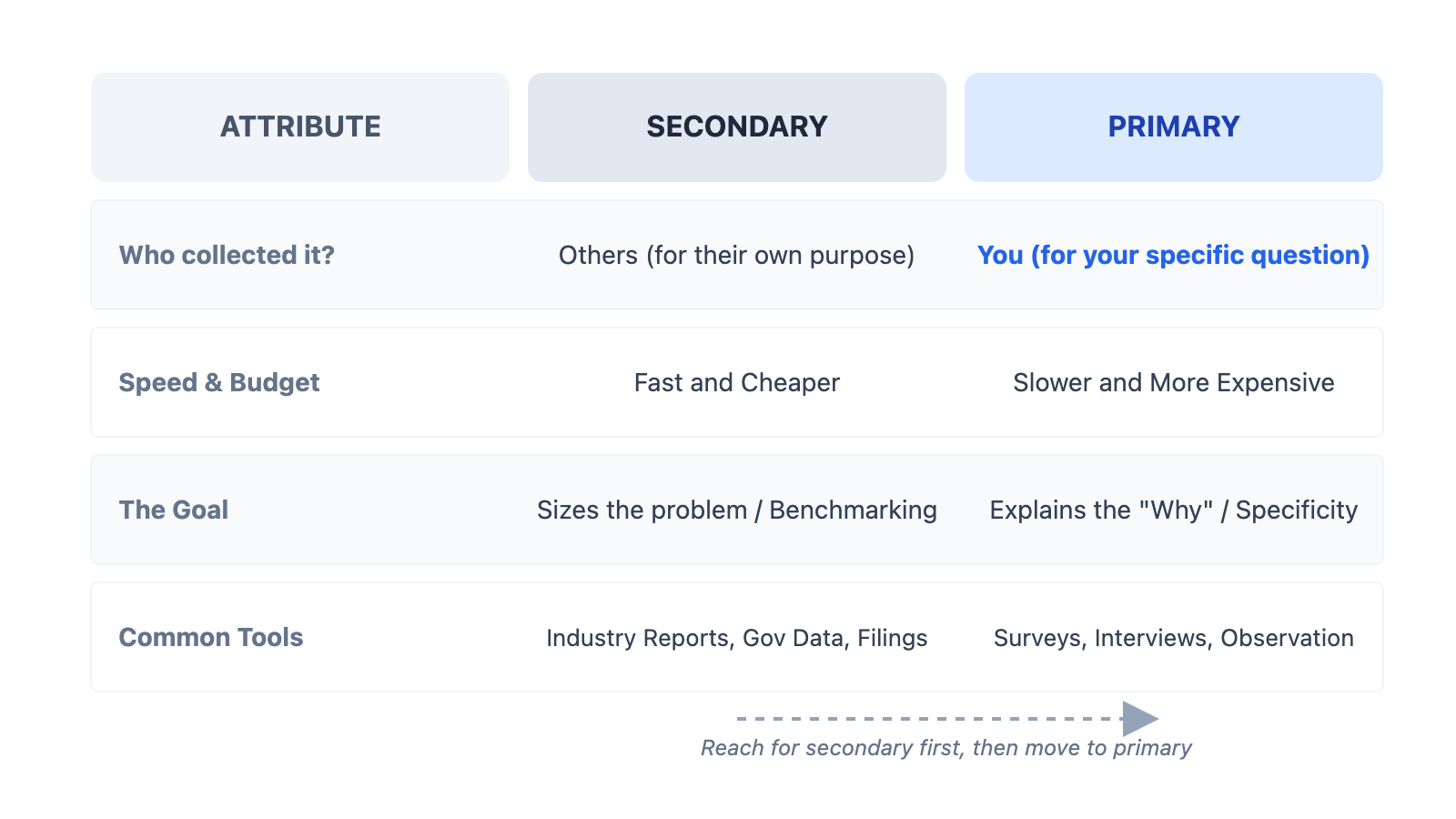
Start with the practical decision, because it controls your time and budget. Secondary research is data someone else already collected for their own purpose: industry reports, government datasets, competitor filings, analyst write-ups. Primary research is data you collect yourself, for your specific question: surveys, interviews, observation. That difference (who collected it, and for what) is the whole distinction.
The working rule is simple: reach for secondary first, because it's faster and cheaper, then move to primary only when existing data can't answer your exact question. Say your cart abandonment rate just spiked. A benchmark report (secondary) tells you the industry average and whether you're an outlier. But it will never tell you why your checkout in particular is leaking. For that you need primary: a one-question exit survey to abandoners, or session recordings of people bailing. Secondary sizes the problem; primary explains your version of it.
Asking Questions That Don't Steer the Answer
When you do run primary research, whether a survey, an interview, or watching a user navigate your site, the entire value depends on one discipline: don't hand people your hypothesis. Friendly respondents want to be helpful, so if your question implies an answer, they'll happily confirm it, and you'll walk away with a "finding" you invented.
The fix is to strip the assumption out of the question. "Did our fast shipping make you buy?" pre-loads the answer; you'll get a yes even from people who never noticed shipping. "Walk me through what made you decide to buy" lets the real reason surface on its own.
- Chris: I drafted the post-purchase survey. First question is "How much did our fast delivery influence your purchase?"
- Nova: That already assumes delivery mattered. You'll get a number even from people who didn't care about it.
- Chris: So what do I ask instead?
- Nova: Open it up: "What was the main reason you chose us over other options?" Let them name delivery, or not.
- Chris: And if they don't mention it, that's the actual signal.
- Nova: Right. A clean question tells you what's true, not what you were hoping to hear.
Notice the fix wasn't gentler wording; it was removing the embedded assumption entirely. That's the test to run on every survey line and interview prompt before it ships.
Pressure-Testing Secondary Sources Before You Trust Them
Secondary research is fast, but not all of it is worth trusting, so weigh each source before you lean on it. Run three checks: relevance (does it speak to your actual question?), reliability (who produced it, and do they have an angle?), and recency (is it current enough to matter in a fast-moving channel?). An industry report gives you market sizing and trends but may be broad or vendor-sponsored. Government data is reliable and unbiased but rarely specific to your niche. Competitor analysis reveals what rivals emphasize but is filtered through their marketing spin. Above all, separate genuinely actionable insight from data that's merely interesting: if a figure wouldn't change a single decision, it doesn't earn space in your analysis.
The real power comes from using secondary data to confirm or challenge what your primary research surfaced. If three customer interviews suggest people choose you for weight savings, and an industry report shows weight as the fastest-growing purchase driver, you've got triangulation, two independent sources pointing the same way. When they disagree, you've found exactly the question worth digging into next.
This is where it gets concrete. You'll start with a quick sort to lock in the primary-versus-secondary distinction by pattern, then step into a live discovery interview where your only job is to ask questions clean enough that the customer's real reasons surface uncoached, and finally write an evaluation that weighs three secondary sources against what that interview turned up. The habit to carry into all three: before you accept any finding, ask whether you discovered it or whether you fed it to yourself.
