Connecting Marketing to Growth
Connecting Marketing to Business Growth
In the last unit, you saw marketing as the discipline that decides what value to create and for whom. This unit asks the next question: how does creating that value actually translate into business growth, and what forces decide whether a given marketing move pays off or backfires?
How Marketing Decisions Drive Growth
A marketing decision earns its keep when you can trace it to one of three linked outcomes. The most immediate is revenue, the money a campaign, price change, or promotion brings in this quarter. The second is customer acquisition, the rate and cost at which you bring new buyers in.
The third outcome, and the easiest to neglect, is long-term growth: the compounding value of retention, repeat purchase, and brand equity that pays out over years, not weeks. The discipline is distinguishing decisions that buy short-term revenue from those that build durable growth. A deep discount might spike this month's revenue while training customers to wait for the next sale, quietly eroding margin and loyalty. Brand investment does the reverse: little immediate revenue, but lower acquisition cost and stronger retention down the line. Sound marketing judgment holds all three levers in view at once. For you, this is the gap between reporting that a campaign "got clicks" and explaining that it lowered cost per acquisition while feeding a retention flow that lifts lifetime value.
Reading the Marketing Environment
No marketing decision happens in a vacuum. The Marketing Environment framework sorts the forces shaping any decision into two groups: internal forces (the resources and constraints inside your company) and external forces (the conditions outside it that you don't control).
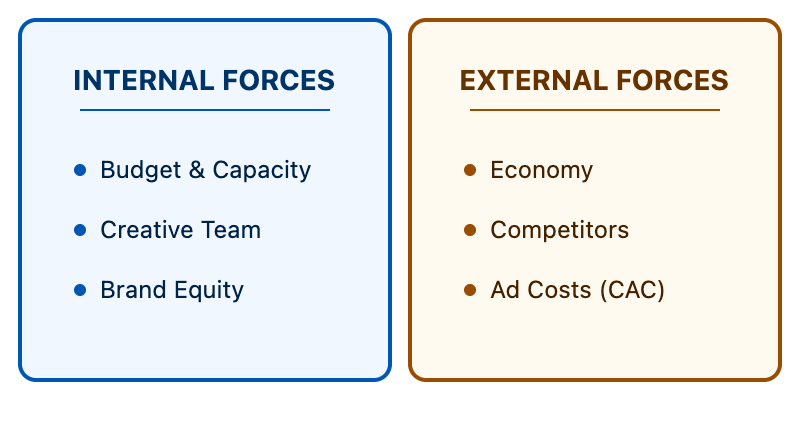
Internal forces include budget headroom, the size and skill of your creative team, your brand equity, and your tech stack. External forces include economic conditions, competitor moves, shifting customer behavior, rising channel costs, and regulation. A spend increase that's smart with a healthy budget and a calm economy can be reckless with a thin team and a looming downturn.
To see how these forces collide in practice, consider this strategy session where Matt, a Marketing Lead, evaluates a proposed budget increase with Nova, the Head of Operations:
- Nova: Leadership wants to push acquisition spend up 40% next quarter. Are we for it?
- Matt: Depends on the forces. Internally, do we have the budget headroom and the creative capacity to actually use it well?
- Nova: Budget, maybe. The creative team is two people.
- Matt: Then the external side matters even more. If acquisition costs are climbing and a recession is signaling, we'd be paying more to reach buyers who are spending less.
- Nova: So the same number could be smart or dangerous depending on what's around it.
- Matt: Right. We scan both sides before we commit, not after.
Notice that the decision isn't yes or no on its own. It's the read of internal capacity against external conditions that produces the answer.
Spotting Opportunities and Threats
Once you can name the forces, the strategic payoff is reading them as opportunities and threats. The same trend can be either, depending on your position. Growing category demand is an opportunity if your brand equity lets you capture it, and a threat if new entrants get there first. Rising acquisition costs are a threat to a thin budget, but an opportunity to lean on retention and referral while rivals overspend on ads.
Scanning is a habit, not a one-off: sweep both internal and external forces regularly, then translate each into a strategic implication, what to lean into and what to defend against. An opportunity with no action attached is just an observation, and a threat you name but never plan for is just anxiety.
The takeaway to carry: marketing drives growth only when decisions are read against the full environment, internal capacity and external conditions together, and then converted into opportunities to seize and threats to manage. Next you'll pressure-test that judgment in a quick self-check on which marketing decisions most credibly drive growth, draft a memo that applies the Marketing Environment framework to a real spend decision, and finally defend your read of the opportunities and threats in a live strategy conversation. The thinking is simple to state; the arc ahead is where it earns its weight.
