Building Marketing Value
Building the Marketing Mix and Customer Value
The last lesson left you reading the marketing environment and converting forces into opportunities and threats. Once you decide to act on one, you reach for a toolkit. This unit is about that toolkit: the levers you actually pull to create customer value, and the kind of value those levers produce.
The 4Ps as Coordinated Tools
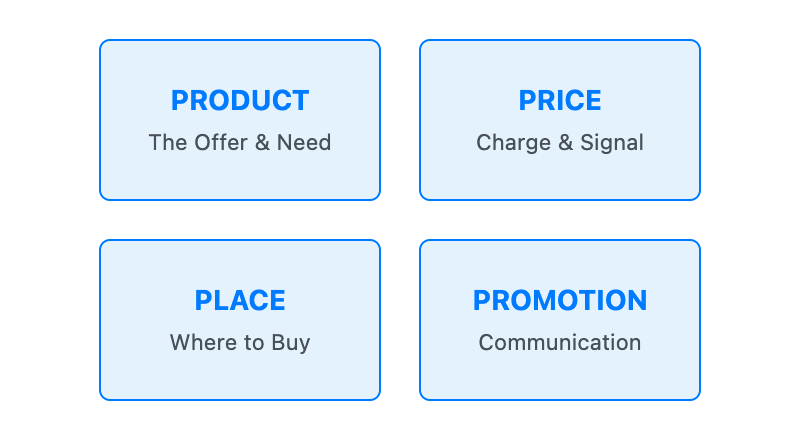 The 4Ps (Product, Price, Place, Promotion) are the four decisions every marketer controls. Product is what you offer and the needs it meets. Price is what you charge and what that figure signals. Place is where and how customers can buy. Promotion is how you communicate and persuade. Individually they're familiar. The point that matters is that they only create value when they're coordinated, when each P tells the same story as the other three.
A premium product priced too low confuses buyers. A polished brand sold through a clunky checkout breaks the promise the ads made. As a Digital Marketing Manager you rarely own all four outright, but your promotion sits downstream of the other three, so you feel every misalignment first.
Effective marketing requires seeing how all four elements interact rather than focusing on a single channel. In the following scenario, Natalie, a lead strategist, helps Chris diagnose why a high-budget campaign isn't performing as expected.
- Chris: The new ad set is converting badly. Should I rewrite the copy?
- Natalie: Maybe, but what are we sending people to?
- Chris: A "luxury" landing page, then a checkout that tacks on a surprise shipping fee.
- Natalie: That's the leak. Our Promotion promises premium, but Price contradicts it at the last step. New copy won't fix a story the other Ps undercut.
- Chris: So the problem isn't the ad, it's the four pieces not agreeing.
Notice the diagnosis runs across the mix, not inside a single channel. That cross-P reading is the skill.
Functional, Emotional, and Social Benefits
The 4Ps are how you deliver value; benefits are the value itself. Customers buy benefits, not features, and those benefits come in three layers. Functional benefits are the practical job done: time saved, a problem solved, a need met. Emotional benefits are how the purchase makes someone feel, whether confident, reassured, or less guilty.
Social benefits, the third layer, are what a purchase signals to others: the identity or status the choice projects. Most products deliver all three, and the higher-margin ones lean on the emotional and social layers, because those are harder for a competitor to copy and easier for a customer to pay a premium for. A meal kit that merely saves time competes on price. One that also makes a busy parent feel like a capable, health-conscious provider, and signals that identity to friends, can charge more. For your campaigns, this is why a feature list rarely persuades: it speaks only to the functional layer and ignores the two that actually move people.
Mapping Benefits to Features
Putting it together, the analytical move is to ask, for any feature, "what does this let the customer do, feel, or signal?" That question turns a spec sheet into a value map. A feature on its own is a fact; the benefit is the reason anyone cares.
Take three quick examples. "Pre-portioned ingredients" is a feature; the functional benefit is less waste and zero meal-planning effort. "Chef-designed recipes" links to an emotional benefit, the confidence of serving something impressive without the risk. "Recyclable packaging" maps to a social benefit, the identity of someone who shops responsibly. Same product, three distinct benefit types, each a different angle for copy and targeting. When you can label which benefit a feature delivers, you stop writing about the product and start writing about the customer.
The single idea to carry from this unit: the 4Ps are the coordinated tools, and the value they create is read in functional, emotional, and social benefits, which is what customers actually buy. Next you'll pattern-match concrete decisions to the right P to confirm the mix really is coordinated, then coach a colleague through the three benefit types live, and finally build a benefits-to-features map your copywriters can pull from directly.
