Mapping Customer Journeys
Mapping the Journey and Earning Trust
You've now got the tools (the 4Ps) and the value those tools create (functional, emotional, and social benefits). What's missing is time. Customers don't decide in a single moment; they move through stages, and your benefits land differently depending on where someone is in that movement. This unit maps that movement, pinpoints where you can actually influence it, and adds the constraint that separates a brand people trust from one they unsubscribe from.
Mapping the customer journey and its touchpoints
The standard model is the Customer Journey: Awareness → Consideration → Purchase → Retention → Advocacy. It's a sequence of mindsets, not a funnel of clicks. In Awareness, someone first realizes a need exists, or that your brand does. In Consideration, they're actively comparing options and weighing whether you fit. Purchase is the transaction itself. Retention is everything that keeps them buying again. Advocacy is when a satisfied customer recommends you to others, becoming a channel in their own right.
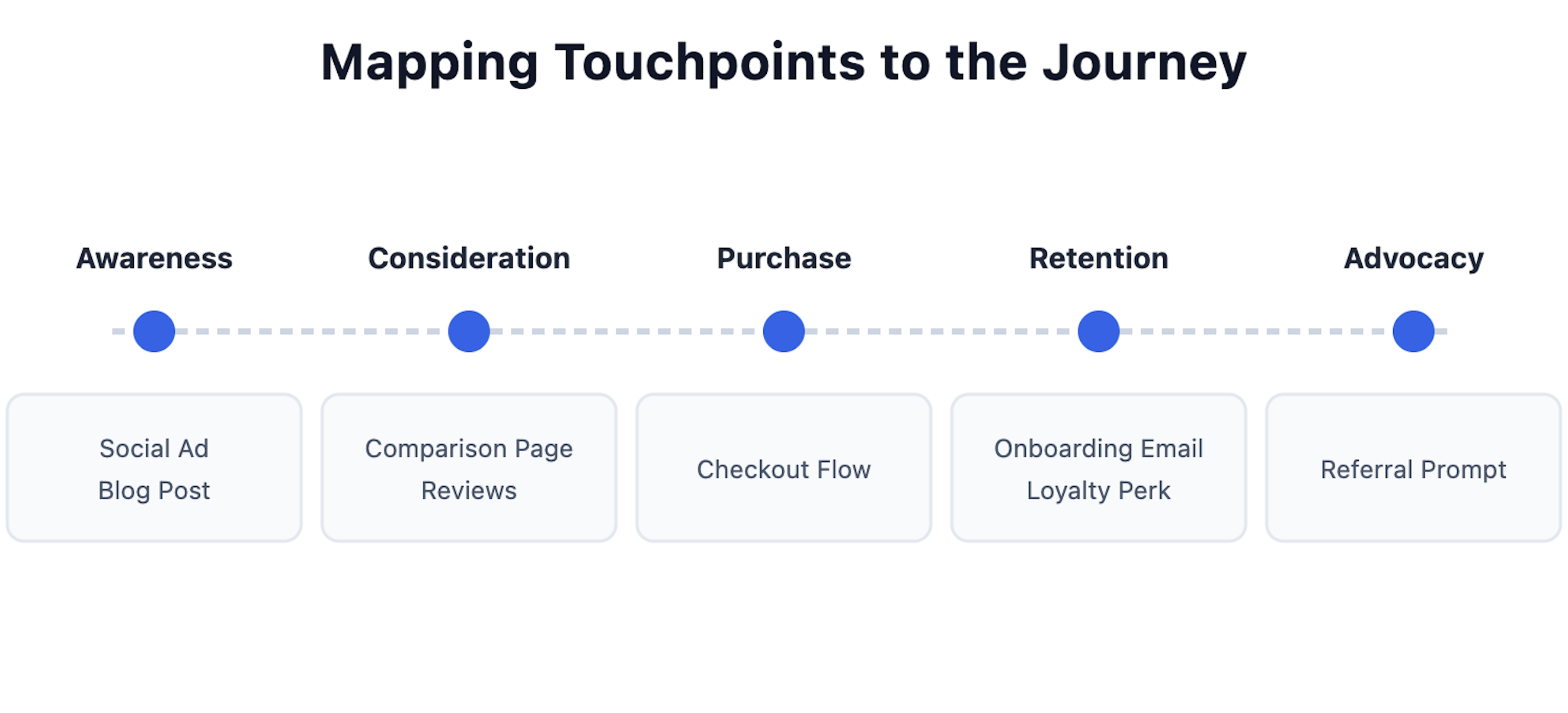
Each stage shows up through touchpoints: the concrete moments where a customer meets your brand. A social ad or blog post in Awareness; a comparison page or review during Consideration; the checkout flow at Purchase; an onboarding email or loyalty perk in Retention; a referral prompt that fuels Advocacy. Mapping the journey simply means listing your touchpoints and tagging each to the stage it serves. Done well, it exposes gaps: stages with no touchpoint at all, or moments doing the wrong job for where the customer's head actually is.
Identifying where marketing can influence decisions
Here's the part that matters for your budget: touchpoints are not equally influenceable. Marketing's leverage is highest where a customer is genuinely undecided and actively seeking input, which is why the Consideration stage usually rewards investment most. A well-built buying guide or comparison page meets someone mid-decision and can tip it. By contrast, pouring spend into pure Awareness reach, or at a customer already loyal in Retention, often moves the needle far less per dollar.
So the analytical move is to ask two questions of every touchpoint: which stage is the customer in, and how much can a marketing decision actually change the outcome here? High influence plus an active decision equals a place to invest.
Natalie, the Head of Growth, is reviewing the quarterly spend with Jessica, the Lead Strategist. They are trying to determine if their current focus on top-of-funnel reach is the most effective use of their remaining budget.
- Natalie: Everyone's on TikTok right now, I think we throw budget at a big awareness push.
- Jessica: Maybe, but where are people actually getting stuck? Most of our drop-off is at consideration, people comparing us to two competitors.
- Natalie: So awareness isn't the leak.
- Jessica: Right. A comparison guide at that stage probably changes more decisions per dollar than reach at the top.
- Natalie: Okay, so we prioritize the stage where we can actually tip the choice.
Notice the reasoning never starts with the channel. It starts with the stage and the size of the influence available there.
Evaluating touchpoints for honesty, privacy, and trust
Influence carries an obligation. A touchpoint can convert well in the short term and still corrode the relationship, so every one you build should pass three tests. Honest communication asks whether the claims and urgency are true: an "only 2 left!" banner that never changes is a dark pattern, not persuasion. Data privacy asks whether you collect only what you need, with clear consent, and use it as promised; burying a marketing opt-in inside a pre-checked checkout box fails this.
The third test is trust itself, the cumulative result of the other two: does the experience leave someone feeling respected or manipulated? These tests aren't just ethics, they're economics. Retention and Advocacy, the most profitable stages, depend entirely on trust earned earlier. A manipulative tactic that lifts one conversion can quietly kill the repeat purchase and referral that were worth far more.
The single idea to carry from this unit: the journey tells you where a customer is, influence tells you where your money works hardest, and trust decides whether the value you create compounds or leaks away. Next you'll pattern-match real touchpoints to their journey stages, then debate live where limited budget should go, and finally pressure-test a single touchpoint against the honesty, privacy, and trust lenses before it ships.
