Marketing as Value Creation
Welcome to the Course
Marketing gets mistaken for the visible stuff, the ads, the posts, the promotions, but those are just the surface. As a Digital Marketing Manager, your real leverage comes from understanding marketing as the discipline that decides what value to create, for whom, and why that creation pays off. This first course gives you the conceptual foundation everything else in your role rests on.
By the end of this course, you'll be able to:
- Distinguish marketing as a customer-focused, value-creating philosophy from advertising and sales
- Connect marketing decisions to revenue, customer acquisition, and long-term growth
- Apply the 4Ps (Product, Price, Place, Promotion) as coordinated tools that create customer value
- Analyze what customers truly buy by mapping benefits to features
- Map the customer journey and evaluate touchpoints for honesty, privacy, and trust
This first unit starts at the root: what marketing actually is, the core customer need it satisfies profitably, and how to translate that into language that leads with value rather than features.
Marketing Is More Than Advertising and Sales
Here's the distinction that trips up most teams. Advertising is a single promotional tactic, paying to put a message in front of an audience. Sales is the act of converting existing interest into a transaction. Both are real, both matter, but both sit downstream of something larger.
Marketing is the customer-focused philosophy that decides which customer to serve, what value to create for them, and why doing so earns the business a profit. Advertising and sales are tools marketing directs, not substitutes for it.
The logic holds because of sequence. You cannot advertise your way out of building the wrong thing for the wrong person. When marketing is treated as a value-creating orientation, it shapes the product, the price, and the channels long before a single ad runs. When it is treated as "the team that makes the ads," the company optimizes the message while ignoring whether the underlying offer is worth wanting.
To see how this distinction works in practice, consider this conversation between Chris, a colleague from the product team, and Nova, a Digital Marketing Manager:
- Chris: Marketing's basically running the ads and the social calendar, right?
- Nova: That's part of it, but ads are one tool. Marketing is the bigger call: who we're for and what value we create for them.
- Chris: So where does that actually start?
- Nova: Before any campaign. We decide which customer need we solve better than anyone, then advertising and sales carry that message out.
Notice how Nova moves the starting point upstream, from "what do we post" to "what value do we create." That shift is the whole philosophy in miniature.
Finding the Core Need You Profitably Satisfy
If marketing begins with value, the first question is: value for what? Customers do not buy products for their own sake. They buy them to resolve a need, a job they are trying to get done. The core customer need is the single underlying problem your product solves better than the alternatives. A meal kit is not bought for its recipes; it is bought because someone wants to eat well without the planning and effort that usually demands.
The word that makes this a marketing question, not just a customer-service one, is profitably. Satisfying a need only counts as marketing when the business can do it at a margin. Plenty of needs exist that you cannot serve profitably, and plenty of features delight customers who will never pay enough to cover their cost. The discipline is finding the intersection: a real need, felt strongly enough that people pay a premium, that you can meet at a cost that leaves a margin.
For you as a Digital Marketing Manager, this matters because the core need becomes the anchor for every downstream decision. Your keywords, your ad headlines, your landing-page promise, your email subject lines all sharpen when they speak to one clearly named need. When the need is fuzzy, the messaging sprawls and conversion suffers.
Reframing Features into Customer Value
Once you can name the core need, the final move is translating it into how you communicate. Most product-led copy reads as a feature list because features are what the people who built the product are proudest of. But customers do not scan a homepage asking "what is this made of." They ask "what does this do for me." A customer value statement flips the order: it opens from the customer's need, names the benefit plainly, and demotes the features to proof points that back the claim.
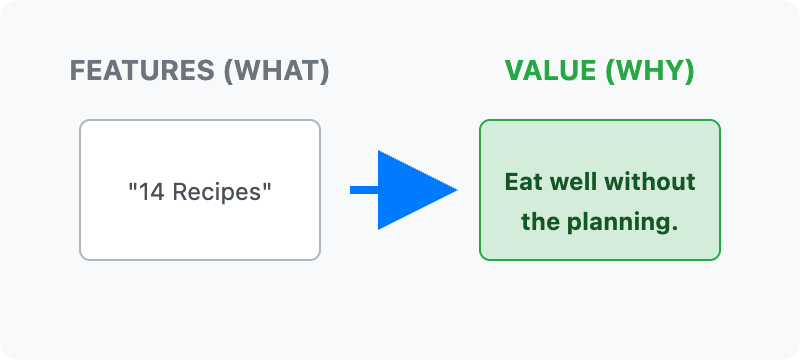
The reframe is simple to state and hard to do. Take a line like "14 recipes, recyclable packaging, chef-designed." Each item is a feature. The value version leads with the outcome ("eat well all week without the planning") and then deploys the chef and the recipes as evidence that the promise is credible. Same facts, different lead. The features earn their place by supporting the benefit, not by being the headline.
The through-line of this unit is one idea: marketing creates and communicates customer value, and advertising and sales only deliver on the value marketing has already defined. Carry that distinction into the next steps. A quick sorting exercise will let you pattern-match concrete activities into advertising, sales, or the broader marketing philosophy. From there you'll move into a live conversation to pin down a single core need, and then put it to work by rewriting a feature-heavy pitch into a value statement you could actually ship.
