Understand Your Boss’s Decision-Making Style
Understand Your Boss’s Decision-Making Style 🧩
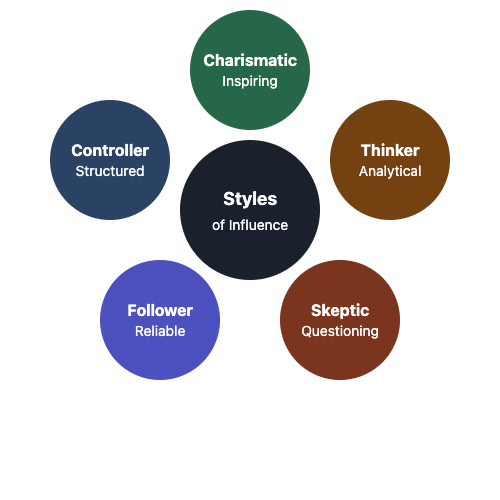
Have you ever watched a brilliant proposal crash and burn, despite your flawless logic and passionate delivery? The problem might not be your idea—it could be that you're using a one-size-fits-all approach to persuasion. In the HBR Guide to Managing Up and Across, Gary A. Williams and Robert B. Miller share research findings on five distinct decision-making styles for executives (Charismatic, Thinker, Skeptic, Follower, Controller). Each of these styles requires a fundamentally different persuasion strategy. The executives studied weren't even aware of their own decision-making styles, yet these patterns profoundly influenced which proposals succeeded and which failed.
Identify and Adapt to Charismatic Decision-Makers ✨
Charismatic decision-makers are the visionaries who get energized by bold ideas and breakthrough thinking. They're typically enthusiastic, captivating talkers who pride themselves on their ability to quickly grasp new concepts. Think of leaders like Richard Branson, Oprah Winfrey, or Steve Jobs—executives who could absorb information rapidly and make decisions that seemed to come from their gut. However, while Charismatics appear to make instinctive decisions, they're actually driven by a balanced focus on bottom-line results. They want to move fast, but they also want to win.
When presenting to a Charismatic boss, you must:
- Lead with the most critical information
- Fight the urge to build up slowly to your conclusion
- Start with your bottom line
- Don't drown them in details
Remember that visual aids are essential for this style. Charismatics process information best when they can see it, not just hear it. They want compelling graphics, simple charts that tell a story, and visual mockups that make the future tangible. Your visuals should be simple but powerful, focusing on results and competitive advantage rather than methodology.
Here's how this might play out in a real conversation between two managers preparing for a presentation:
- Ryan: I've prepared a detailed 40-slide deck for Nova's review tomorrow, walking through all the implementation phases.
- Jessica: Wait, Nova's your boss, right? She's definitely a Charismatic. You'll lose her by slide five.
- Ryan: But I need her to understand all the complexities involved, the risk mitigation strategies, the phased rollout plan, and more.
- Jessica: Start with the end result instead. What's the big win here?
- Ryan: Well, we'll capture $2 million in new revenue and beat our competitor to market.
- Jessica: Lead with that! Show her a visual of us dominating the market. Save the implementation details for a backup slide if she asks. Trust me, she wants to see the victory, not the battle plan.
Notice how Jessica coaches Ryan to completely flip his approach—from methodical build-up to immediate impact. This is the fundamental shift required when presenting to a Charismatic decision-maker.
Work with Thinker and Skeptic Styles 🧠
Thinkers and Skeptics might seem similar at first—both want substantial data before making decisions—but their underlying motivations are vastly different.
Thinkers are the cerebral, intelligent, logical people who pride themselves on being methodical and precise. Often academicians or former consultants who read voraciously and enjoy intellectual challenges, they include leaders like Michael Dell and Bill Gates. Thinkers want comprehensive data because they genuinely enjoy processing it. They need time to work through all the variables. When presenting to a Thinker:
- Provide all pertinent data
- Organize the data meticulously
- Incorporate market research, case studies, cost-benefit analyses, and risk assessments
- Help them understand your methodology as much as your conclusions
Skeptics, on the other hand, are suspicious by nature and highly aggressive in their questioning. They challenge every data point not because they enjoy the intellectual exercise, but because they're looking for flaws and hidden agendas. Think of leaders like Larry Ellison or Tom Siebel—executives known for their tough, almost confrontational style. Skeptics are primarily influenced by the credibility of the person making the proposal, not just the proposal itself. They need to hear endorsements from people they trust. If you're presenting to a Skeptical boss, you must:
- Establish your credibility first
- Draw on endorsements
- Reference trusted sources
- Consider co-presenting with colleagues they respect
The key difference in approaching these two styles lies in their fundamental needs. Thinkers want to be intellectually engaged as thinking partners, while Skeptics want to be convinced that you and your sources are credible. With Thinkers, you can admit uncertainty and work through problems together. With Skeptics, however, such uncertainty could be fatal to your proposal. You need to project confidence and have answers ready for their aggressive challenges. Both styles will take time to decide—Thinkers because they're processing, Skeptics because they're investigating—so never pressure them for immediate answers.
Engage Follower and Controller Types ⚖️
Followers and Controllers represent the most risk-averse decision-making styles, but they manage their caution in distinctly different ways.
Followers make decisions based on how similar initiatives have worked in the past. These responsible, cautious, brand-conscious executives like Peter Coors or Douglas Daft want proven methods and trusted brands. They rarely embrace anything that feels like a breakthrough innovation. When presenting to a Follower boss, you must:
- Use testimonials
- Present proven innovations
- Provide case studies and references from companies they admire
Controllers are the analytical, unemotional, detail-oriented, and accuracy-obsessed decision-makers. Think of individuals like Jacques Nasser or Ross Perot—leaders who are fiercely independent and often distrustful of data they didn't personally verify. What makes Controllers unique is their fear of feeling out of control, especially regarding information. When working with a Controller boss:
- Don't present polished conclusions
- Provide structured raw data
- Let them draw their own conclusions
- Include detailed spreadsheets they can manipulate
- Share multiple scenarios they can evaluate
The challenge with both styles is that they can be frustratingly slow to decide. Followers need time to check references and see how others have fared, while Controllers need time to personally verify every number. Both of these styles value structure and predictability, but there's an important distinction—Followers want the comfort of precedent while Controllers want the comfort of personal verification.
In the upcoming role-play sessions, you'll have the opportunity to practice adapting your persuasion approach to different decision-making styles. You'll experience firsthand how the same proposal can succeed or fail based entirely on how you present it, learning to recognize the subtle cues that reveal whether you're dealing with a Charismatic, Thinker, Skeptic, Follower, or Controller—and adjusting your strategy accordingly.
