Get to Know Your Boss’s Boss
Get to Know Your Boss's Boss 🏛️
Have you been focusing so intently on managing up to your direct boss that you've overlooked a crucial relationship—the one with your boss's boss? In the HBR Guide to Managing Up and Across, Priscilla Claman makes a compelling case that this oversight could be limiting your career opportunities. Your boss's boss possesses a broader perspective on the organization, seeing strategic shifts and opportunities that neither you nor your direct boss can fully anticipate.
In this lesson you'll explore a framework for building visibility and credibility with your boss's boss while maintaining respect for the chain of command. This is about ensuring that a key decision-maker in your career knows your capabilities, understands your contributions, and has you in mind when opportunities arise.
Build Visibility Through Direct Interactions 👥
Building visibility with your boss's boss starts with the simplest of gestures—actually interacting with them when opportunities arise. Many people duck and run when a powerful person enters their work area, but this is precisely the wrong approach. A better approach is to create intentional touchpoints including:
- Tap them for advice. E-mail them to ask for input on courses you’re thinking of taking, professional organizations you’re considering joining, and other career development related topics.
- Reach out to congratulate them. If they get a promotion or award, send them a congratulatory e-mail that demonstrates your awareness of organizational achievements.
Here are some additional tactics for building visibility:
| Tactic | Example/How-To |
|---|---|
| Volunteer for cross-functional | Join project team, offer to take/distribute notes |
| Pass along praise | Forward customer compliments |
| Strategic invitations | Invite to relevant presentations/guest speaker events |
Here's how this might play out in a real conversation between two managers:
- Jessica: I want to ask our EVP for advice about my development, but I don't want to look like I'm going around my boss.
- Ryan: Smart thinking. Have you talked to your boss about it first?
- Jessica: Not yet. Should I?
- Ryan: Absolutely. I made that mistake once and it really damaged trust with my manager. Now I always say something like, "I'd like to get some career advice from Sarah—would you be comfortable if I reached out to her?"
- Jessica: And if my boss says yes?
- Ryan: Then make sure you mention your boss's name in the email to the EVP. Something like "Tom suggested I reach out to you for your perspective on leadership development programs." It shows you're not trying to bypass anyone.
- Jessica: That makes sense. It actually strengthens the request because it shows my boss supports my development too.
Notice how Ryan emphasizes both getting permission first and then explicitly mentioning the boss's support when reaching out. This maintains transparency while building the relationship with senior leadership.
Step Up by Doing More 💪
Stepping up means taking initiative in ways that naturally bring you to your boss's boss's attention while adding genuine value to the organization. Here’s how different actions can increase your visibility with your boss’s boss:
Visibility Ladder: How to Step Up Your Impact
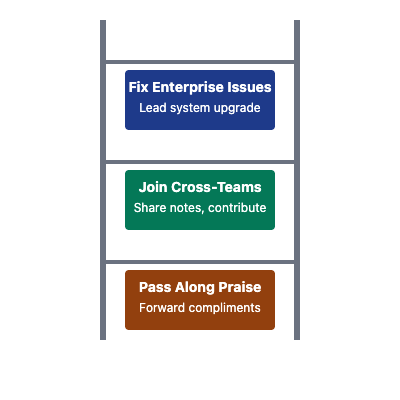
The most powerful visibility builder is fixing problems that matter at the enterprise level. Consider the example of an administrative assistant at a global nonprofit who discovered the organization's customer-tracking system was inaccurate and difficult to use. Rather than just complaining, she researched alternative systems and worked with friends in accounting to develop a cost-benefit analysis. She then presented her proposal to both her boss and her boss's boss, ultimately gaining funding for the project and earning a new leadership role overseeing the conversion. The lesson is clear: when you identify a problem that furthers a business objective or supports a corporate value, develop a solution and share the results up the chain.
Volunteering for cross-functional teams is particularly effective because it demonstrates your ability to work beyond your immediate silo. When you join such teams, offer to take notes and distribute them—a task most people see as drudgery but which she reframes as an opportunity for visibility. Here’s how different actions can increase your visibility with your boss’s boss:
Passing along praise represents another subtle but effective way to build visibility while strengthening relationships. When you receive complimentary emails from colleagues or customers, forward them to your boss, who will likely send them to his boss since your success reflects well on him too. Customer compliments are particularly valuable, whether from internal or external clients, as they provide third-party validation of your team's impact.
Extend Strategic Invitations ✉️
Strategic invitations represent a sophisticated way to build relationships with your boss's boss while adding value to your work. The approach begins with simple questions to your direct boss: "Should I invite your boss to this presentation?" or "We have an interesting guest speaker coming next week—would your boss be interested?" Whether she attends or not, the invitation itself signals that you're thinking about the bigger picture and want to keep senior leadership informed. This is particularly effective when you're presenting something innovative or hosting external experts who bring fresh perspectives to the organization.
When extending invitations, the framing makes all the difference. Instead of offering a generic "You're welcome to attend our team meeting," try something more value-focused like "We'll be discussing three approaches to the customer retention challenge you mentioned in the town hall—your perspective would be invaluable." This positions the invitation as an opportunity for her to contribute rather than an obligation to fulfill.
In the upcoming role-play sessions, you'll practice these visibility-building techniques through realistic scenarios. You'll craft strategic communications to your boss's boss, volunteer for cross-functional initiatives in ways that add value, and present solutions to enterprise-level problems—all while maintaining appropriate respect for organizational hierarchy and your direct boss's position.
