Regression and Recovery
Regression and Recovery
In the last lesson, you learned how to navigate resistance when a team member pushes back against a style shift. But there's another, more painful scenario every people manager eventually faces: a person who was thriving—operating confidently as a Performer or Achiever—suddenly slips backward. Deadlines are missed, quality dips, energy fades. This isn't a transition you're choosing; it's a regression you're responding to. And how you respond in the first two weeks will determine whether the person rebuilds quickly or spirals into a longer slump. Throughout this unit, you'll learn to read regression accurately, step back in without crushing morale, and engineer a clear path back to autonomy.
Identifying Causes of Regression
Regression is what happens when a team member who previously demonstrated high competence and commitment for a task suddenly performs at a lower development stage. A reliable S4 starts behaving like an S2. A confident S3 starts hesitating like an S1. The instinct many managers have is to interpret this as a character problem—"They've gotten lazy" or "They've checked out." Almost always, that interpretation is wrong, and acting on it makes things worse.
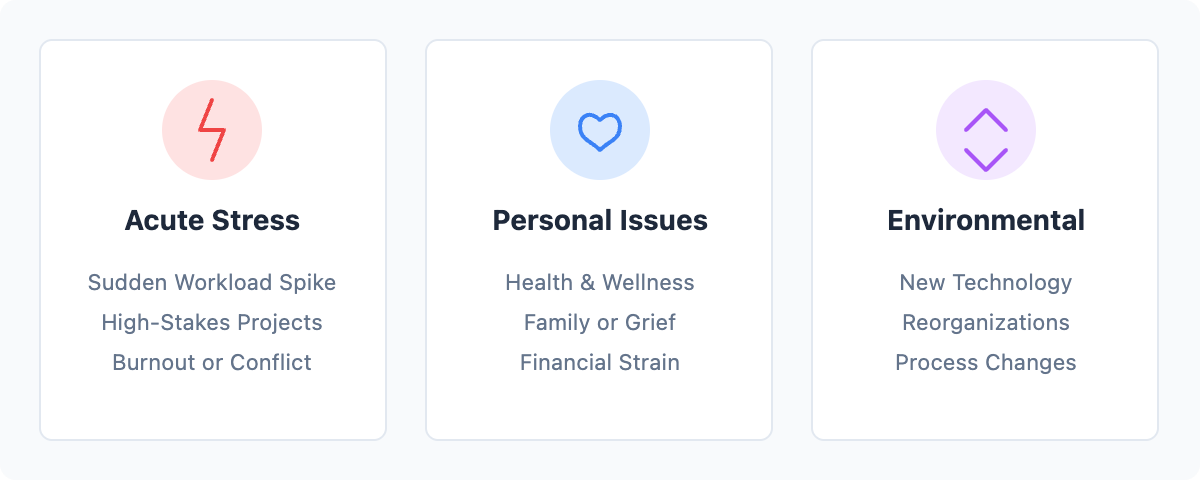
The real causes of regression typically fall into three broad categories.
- The first is acute stress, often triggered by a sudden spike in workload, a high-stakes project, conflict with a peer, or burnout from a long stretch of overperformance. Stress narrows focus and erodes judgment, so even highly skilled people start making errors they normally wouldn't.
- The second cause is personal issues—a health problem, a family crisis, financial strain, or grief. These don't appear on a status report, but they consume the cognitive bandwidth a person needs to operate at their peak.
- The third is environmental disruption, most commonly a new technology rollout, a reorganization, a process change, or the arrival of a new stakeholder. When the ground shifts, even an Achiever effectively becomes a Beginner on the changed portion of the work, and that uncertainty often bleeds into their confidence on adjacent tasks.
The diagnostic skill here is to ask "What changed?" before you ask "What's wrong with them?" If a normally crisp performer is suddenly turning in sloppy work, look at their environment first: Did the tooling change? Did their workload double? Did a trusted peer leave? Regression is rarely random—it's almost always a response to something. It's also worth remembering that competence is task-specific, so what looks like a global decline is often a localized one. A senior analyst might still be excellent at stakeholder communication while struggling badly with a new analytics platform. Treating the whole person as "regressed" misses the point; the goal is to find the specific task where the wheels came off.
A few behavioral indicators can help you spot regression early. You may notice increased hesitation on decisions they used to make instantly, more hedging language like "I think maybe..." where they used to be definitive, missed details on work they previously got right the first time, withdrawal from team discussions, or a noticeable drop in initiative. None of these in isolation means much, but when two or three appear together in someone who's been steady, that's your signal to step in—before the errors compound.
The Rapid Re-entry Protocol
When you spot regression, the temptation is either to ignore it (hoping it passes) or to react harshly (treating it as a performance problem). Neither works. What does work is the Rapid Re-entry protocol: a structured, temporary return to higher direction without demoting the person. The whole approach hinges on a single principle—you are increasing structure, not reducing trust.
Rapid Re-entry moves through four steps that work best in sequence. The first step is to acknowledge openly, not diagnose silently. Quietly adding more oversight without explaining why almost always backfires; the person notices, fills in the worst-case story, and disengages further. Instead, name what you're seeing in neutral, factual terms, with something like "I've noticed the last two reports had some gaps that aren't typical for you. I want to check in." Notice the framing—not typical for you. That phrase signals that you still see them as the high performer they are.
From there, the second step is to investigate the cause collaboratively. Use open questions like "What's been getting in the way?" or "What's changed in your world recently?" and resist the urge to jump to solutions. The goal is to identify whether you're dealing with stress, a personal issue, a skills gap from new technology, or some combination of these. The cause dictates the fix, since rebuilding skills on a new platform looks very different from giving someone breathing room during a personal crisis.
The third step is to temporarily increase direction on the specific task that's faltering. This is where many managers get queasy because it feels like demotion. Reframe it for yourself: you're scaffolding, not supervising. You might say "For the next two weeks, let's do a 15-minute check-in each morning to walk through what you're tackling that day. This is just while we get past this patch—it's not the new normal." The two non-negotiables here are that the increased direction must be time-bound and task-specific. You're not putting them back on training wheels for everything; you're stabilizing one wobble.
Finally, the fourth step is to define the off-ramp. Before you increase direction, decide and communicate what ending the increased direction will look like, perhaps with "Once we've had three clean weekly reports in a row, we drop back to the old rhythm." This single move transforms the entire experience for the team member. Without an off-ramp, increased oversight feels like a punishment; with one, it feels like a temporary support structure they can earn their way out of—which is exactly what it should feel like.
To see all four steps come together, consider how a manager might handle a senior performer whose work has slipped after a new platform rollout:
- Victoria: Hey Dan, do you have a few minutes? I wanted to check in—I noticed the last couple of client reports had some data inconsistencies, which honestly isn't typical for you.
- Dan: Yeah, I saw those too. I don't know, I've just been off my game lately.
- Victoria: What's been getting in the way? Is it the workload, the new analytics platform, something outside of work?
- Dan: Honestly, the new platform. I'm spending so much mental energy just navigating it that I'm missing things I'd normally catch in my sleep.
- Victoria: That makes sense, and it's a fair reaction—the rollout was faster than it should've been. Here's what I'd like to try: for the next two weeks, let's pair on the reports together for thirty minutes before they go out. Once we've had three clean reports in a row, we drop the pairing and you're back to running it solo. Does that feel workable?
- Dan: Yeah, that actually takes a load off. Thanks for not making this a bigger deal than it is.
Notice what Victoria does. She acknowledges openly without diagnosing the person, investigates the cause with an open question, scaffolds direction that is both time-bound and task-specific, and defines a clear off-ramp—all in a single short exchange. Same increase in direction a less skilled manager might impose, completely different message.
Rebuilding Confidence After a Performance Setback
Performance setbacks don't just damage output—they damage self-perception. After a visible mistake, even a normally confident person starts second-guessing themselves. Their internal monologue shifts from "I've got this" to "What if I miss something again?" Left untreated, this confidence erosion can keep someone stuck in regression long after the original cause has resolved. So the final phase of recovery isn't really about skills; it's about rebuilding the person's belief in themselves.
The most effective tool here is engineered small wins. After a setback, don't immediately put the person back on the highest-stakes work and hope they bounce back. Instead, deliberately assign tasks slightly below their proven capability for a short period, where success is highly likely. Each clean execution rebuilds the muscle memory of competence, and you can gradually scale the complexity back up from there. This isn't coddling—it's the same principle a physical therapist uses after an injury: load the tissue progressively, not all at once.
Pair small wins with specific, behavioral recognition rather than generic praise. "Good job!" does almost nothing for a person rebuilding confidence and can even feel patronizing if they sense you're being deliberately encouraging. Instead, point to the specific thing they did well, with something like "The way you caught that data mismatch in the second draft—that's exactly the level of attention that makes your work reliable." Concrete recognition reconnects them to their actual capabilities in a way vague praise never can.
It also helps to normalize the setback without minimizing it. Senior performers often catastrophize a slip because they hold themselves to such high standards, and a simple acknowledgment like "Everyone hits a stretch like this at some point—it doesn't change what you've built here" can lift a surprising amount of weight. You're not telling them it didn't matter; you're telling them it doesn't define them.
Finally, return autonomy in visible increments. The off-ramp you defined during Rapid Re-entry should be communicated as a milestone when it's reached, not just allowed to happen quietly. A line like "Three solid weeks—you're back to running this solo, the way we used to. Nice work." is a small ceremony that closes the loop. It tells the person, and you, that the regression is over and the relationship is back to where it was. Without that explicit closure, the lingering shadow of the setback can keep both of you tentative for far longer than necessary.
A final reminder: regression is not a verdict on the person or on your leadership. It's a normal part of any working life, especially in environments where change is constant. Leaders who handle regression well don't avoid it—they spot it early, respond with structure and warmth, and engineer a clean return to autonomy. That capability alone will set you apart from managers who either panic or pretend nothing's wrong.
In the upcoming role-play session, you'll put this protocol into practice. You'll work with a normally high-performing team member who has made significant errors after a new system update, and your task will be to step back into a Coaching style without hurting their ego. Listen for the cause behind the errors, scaffold the right amount of direction, and—most importantly—define the off-ramp. Get ready to lead a conversation that protects both the person's confidence and their path back to full autonomy.
