Team Alignment and Manifesto
Team Alignment and the Leadership Manifesto
So far in this course, you've learned how to spot stage transitions, navigate resistance from individuals, and bring people back from regression. Each of those skills plays out in one-on-one moments. But adaptive leadership has a public dimension too, because the rest of your team is watching. They see you running daily check-ins with one person and barely touching base with another. They notice you giving detailed instructions to a new hire and asking open-ended questions of a senior peer. Without context, those differences can read as favoritism, inconsistency, or unfairness—even when your choices are perfectly calibrated to each person's needs. This unit is about closing that gap. Throughout this unit, you'll learn how to make your adaptive approach visible and legitimate to the whole team, build a culture where individualized development is the norm, and finalize a personal manifesto that anchors your leadership going forward.
Educating the Team on the Adaptive Model
The single biggest threat to adaptive leadership at the team level isn't your skill—it's perception. When team members don't understand why you're treating them differently, they fill in the blanks themselves, and the story they invent is almost never flattering. One person concludes you trust them less, another decides you've picked favorites, and a third quietly resents the colleague who seems to get more of your time. The antidote is proactive transparency: educating your team on the model before the differences become a source of friction.
The most useful framing is to redefine fairness. In a traditional model, fairness means treating everyone the same, but in an adaptive model, fairness means giving everyone what they need to succeed. The reframe from equal to equitable—does enormous work. It turns "different treatment" from a liability into a deliberate principle.
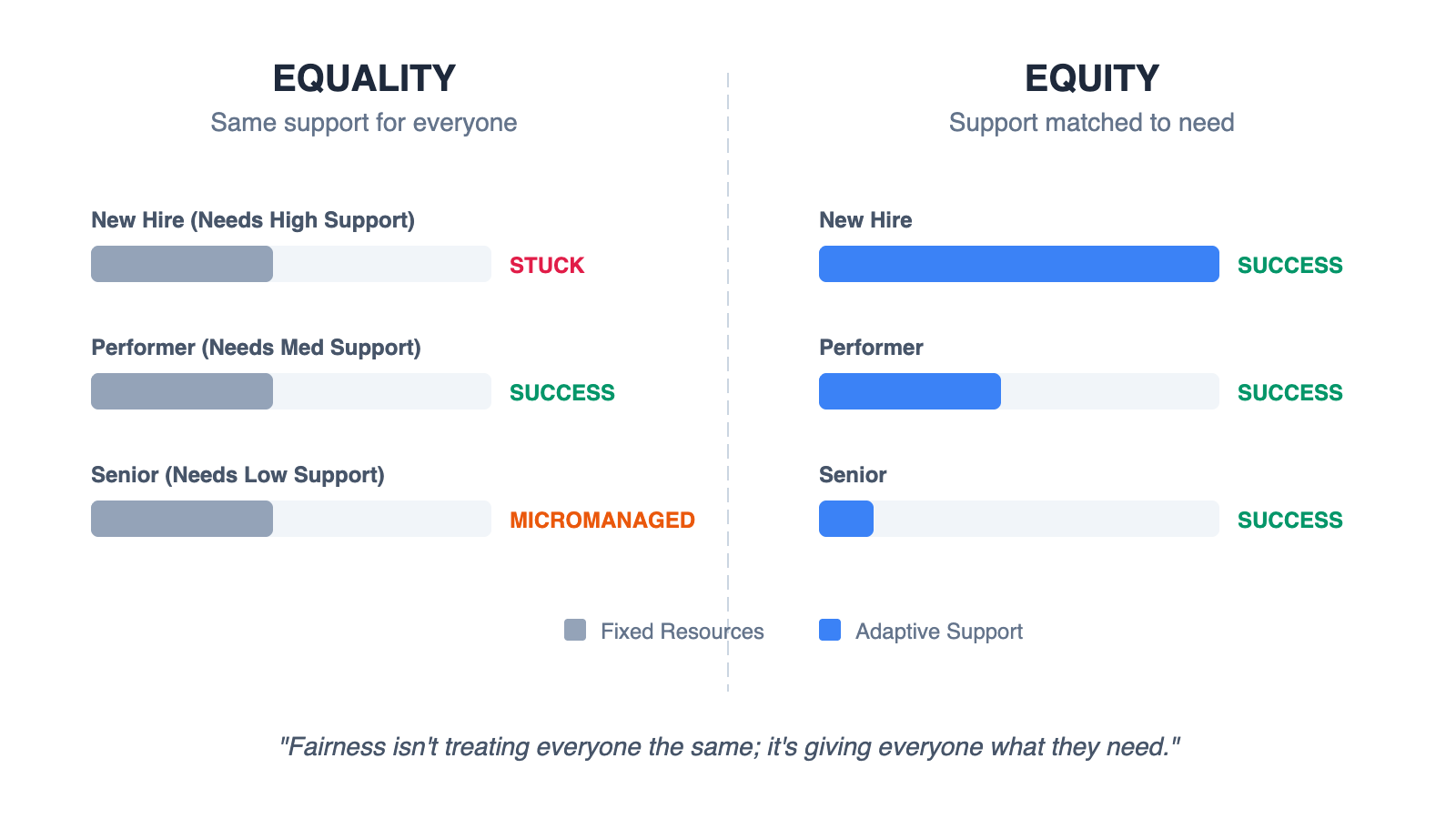
To see how this plays out when a team member raises the concern directly, consider how a manager might handle a question about fairness in a one-on-one:
- Jessica: Can I ask you something honestly? It feels like you're spending way more time with Ryan than with me lately, and I'm not sure what to make of it.
- Victoria: I appreciate you bringing that up directly. You're right that I'm in more sessions with Ryan right now—he's onboarding into the new reporting platform and the work calls for it. With you, I've stepped back because you've been running your accounts cleanly for months.
- Jessica: So it's not that you trust him more?
- Victoria: Not at all. If anything, the hands-off approach with you is a vote of confidence. When you hit something genuinely new, I'll lean back in—and when Ryan finds his footing, I'll lean out. The level of involvement is about the work, not about who I rate higher.
- Jessica: Okay, that actually makes sense. I think I just needed to hear it.
Notice what Victoria does. She doesn't get defensive, she doesn't apologize for treating people differently, and she doesn't label Ryan as a "beginner." Instead, she names the principle—involvement matches the work—and reframes her hands-off approach as a sign of trust rather than neglect. That's the conversation in miniature; the same logic scales to a full team meeting.
It also helps to make the logic of the model explicit. You don't need to deliver a lecture on development stages, but a simple version lands well: people who are new to a task need more direction, people who are experienced need more autonomy, and people who are stuck somewhere in the middle need coaching or support. When the team understands that your style is a function of the task and the moment—not your opinion of the person—the whole question of favoritism dissolves.
One subtle point worth flagging: be careful not to publicly label individuals by their development stage. Telling the team "Mahdi is an S2 right now" is humiliating and reductive. The model is for your use as a leader; what you share with the team is the philosophy, not the diagnostics.
Building a Culture of Individualized Development
Educating the team is the starting line. The longer-term goal is to build a culture where individualized development is simply how the team operates—where people expect their leader to flex, expect their own needs to evolve, and even start flexing for each other. Three habits, working together, make that culture take root.
The first is normalizing developmental conversations. In most teams, conversations about competence and confidence only happen during performance reviews, which makes them feel high-stakes and evaluative. In an adaptive culture, they happen casually and often. A quick "Where are you on this one—do you want me to walk through it with you, or do you have it?" at the start of a task signals that it's normal and expected to talk about how much support someone needs.
The second habit is to celebrate movement, not just outcomes. When someone graduates from needing direction to running independently, name it. A simple "Six months ago we were doing daily check-ins on this and now you're owning it end-to-end—that's a real shift" does two things at once: it recognizes growth in the individual, and it shows the rest of the team that progression is seen here.
The third habit is to invite the team into the model. Once they understand adaptive leadership, you can ask people to apply it to each other—senior team members coaching juniors, peers offering support to colleagues facing new challenges. This distributes the leadership load and, more importantly, it makes individualized development a shared value rather than a manager-only practice.
A culture like this also protects against a quieter danger: the perception that adaptive leadership is something you do to people. When the team understands and participates in the model, leadership becomes something done with them—which is exactly the shift this entire learning path has been building toward.
Finalizing Your Adaptive Leadership Manifesto
Everything you've learned across these courses—your DISC awareness, your bias safeguards, your task-specific assessments, your style-switching fluency, and your transition and recovery playbook—needs an anchor. Without one, the daily pressures of the job will pull you back toward whatever your default style happens to be. That anchor is your Adaptive Leadership Manifesto: a short, personal document that captures how you intend to lead and gives your team a clear window into working with you.
A useful manifesto has a handful of components that build on each other. It opens with your leadership philosophy, two or three sentences capturing what you believe about people and your role with them. Something like "I believe people grow fastest when they're met where they are, not where I wish they were. My job is to read each situation and provide the right mix of direction and support—nothing more, nothing less." This becomes the north star you return to when situations get murky.
From there, the manifesto names your non-negotiable values—the things that stay constant even as your style flexes. Maybe it's honesty, maybe it's respect, maybe it's a commitment that no one on your team is ever surprised by feedback. These are the elements of your leadership that don't adapt, and naming them publicly protects your authenticity. As you've learned, adaptability is about method, not values.
The next component is a "User Manual for Me" section: practical, candid information about how to work with you. This typically covers how you prefer to communicate, what your decision-making style looks like, what stresses you out, what you do well, and what your blind spots are. A line like "I tend to ask a lot of questions when I'm thinking—if I'm questioning your approach, it doesn't mean I disagree, it means I'm processing" saves your team from years of guesswork. The User Manual is a generous act, because you're letting people skip the trial-and-error phase of figuring you out.
Finally, the manifesto includes a commitment to the team, articulating what they can expect from you and what you'll ask of them in return. This is where adaptive leadership gets explicit: "I will adjust my style to your needs and the demands of the work. In return, I'll ask you to be honest with me about where you actually are, not where you think you should be." That two-way contract is what turns adaptive leadership from a private practice into a shared agreement.
Treat the manifesto as a living document. Revisit it every six months, and revise it as you learn. The leaders who get the most out of this work aren't the ones who write the perfect manifesto on day one—they're the ones who keep refining it as their experience deepens.
In the upcoming practices, you'll bring all of this together by presenting the concept of adaptive leadership to your team and fielding a direct question about why you don't treat everyone the same. Your task will be to cast a clear vision, reframe fairness as equity, and invite the team into the model without labeling individuals or sounding defensive. Get ready to lead the conversation that turns adaptive leadership from your private practice into your team's shared culture.
