Managing Style Resistance
Managing Resistance to Style Changes
In the previous lesson, you learned how to spot the subtle behavioral cues that signal a team member is transitioning between development stages. But here's a hard truth: even when you read the cues perfectly and time your shift well, the team member may push back. Style changes (whether toward more involvement or less) can feel disorienting, threatening, or even insulting to the person on the receiving end. This unit is about understanding why that resistance happens and what to do about it. Master this, and you'll prevent the most common breakdown in adaptive leadership: the moment a well-intentioned style shift damages the very trust it was meant to build.
Why Employees Resist "More" or "Less" Management
Resistance to style changes generally falls into two camps that sit at opposite ends of the same spectrum. The first is resistance to less management, when you try to step back and delegate but the team member clings to the old dynamic. The second is resistance to more management, when you try to increase direction or coaching and the team member feels micromanaged or demoted. Although they look like opposite problems, both are rooted in the same underlying instinct: a desire to preserve a familiar working relationship.
Resistance to less management often stems from what's called competence comfort. A team member who has been told what to do for months or years has built their identity around being a great executor of your vision. So when you suddenly say "I'd like you to own this end-to-end," they hear "I'm taking away the safety net." This often shows up as repeated check-ins for approval, statements like "I just want to make sure I'm doing what you want," or anxiety-driven over-communication. The deeper fear isn't laziness; it's the fear of being blamed for a wrong decision they were never previously authorized to make.
Resistance to more management, on the other hand, usually comes from people who interpret increased direction as a vote of no confidence. A high performer who hits a slump may bristle when you suddenly start asking detailed questions or scheduling more frequent check-ins. You might hear pushback like "I've been doing this for years, I don't need a step-by-step," or notice a quiet withdrawal where the person stops sharing openly because they feel surveilled. The deeper fear here is loss of status: they wonder, "Does my manager think I'm slipping?"
Recognizing which camp the resistance falls into is your first move. The same surface behavior—frustration, silence, or defensiveness—can come from very different roots, and treating them the same way will only deepen the friction.
Distinguishing Between Legitimate Concerns and Fear of Change
Not all resistance is irrational. In fact, some of the pushback you'll receive when changing your style will be legitimate feedback you need to hear. The skill, then, is learning to separate legitimate concerns from fear of change, because they require very different responses.
A legitimate concern tends to be specific, forward-looking, and solvable. For example, if you announce that you're delegating a project and the team member responds with, "I'm on board with owning this, but I don't have access to the budget approval system yet. Can we fix that first?", that's a legitimate concern. They're not resisting the autonomy; they're flagging a real obstacle to delivering on it. Likewise, "I want to take this on, but I haven't done a stakeholder presentation at this level before; can I shadow you on one first?" is legitimate. The person is engaging with the change and simply asking for the scaffolding to succeed.
Fear of change, by contrast, tends to be vague, backward-looking, and emotionally charged. It sounds like "I just don't think this is the right time," or "We've always done it the other way and it worked fine," or "I'm not sure why we're suddenly changing things." Notice that there's no specific obstacle being raised, just discomfort with the shift itself. This isn't a flaw in the person; it's a normal psychological response to a perceived loss of predictability.
A useful diagnostic question to cut through the ambiguity is: "What specifically would need to be true for this to work for you?" If the person can answer concretely, you have a legitimate concern to address. If the answer drifts back to general unease, you're dealing with fear of change, and the response there is not to argue them out of it. Instead, you acknowledge it, validate the discomfort, and offer reassurance paired with a small first step. Logic doesn't dissolve fear; experience does.
Strategies for Maintaining Trust During Style Shifts
The single biggest predictor of whether a style shift succeeds or backfires is transparency. When you change how you lead someone without explaining why, they fill in the blanks themselves, and the stories they invent are almost always worse than the truth. The antidote is what's often called a "Style Reset" conversation: a brief, honest framing of what you're changing, why you're changing it, and what it means for them.
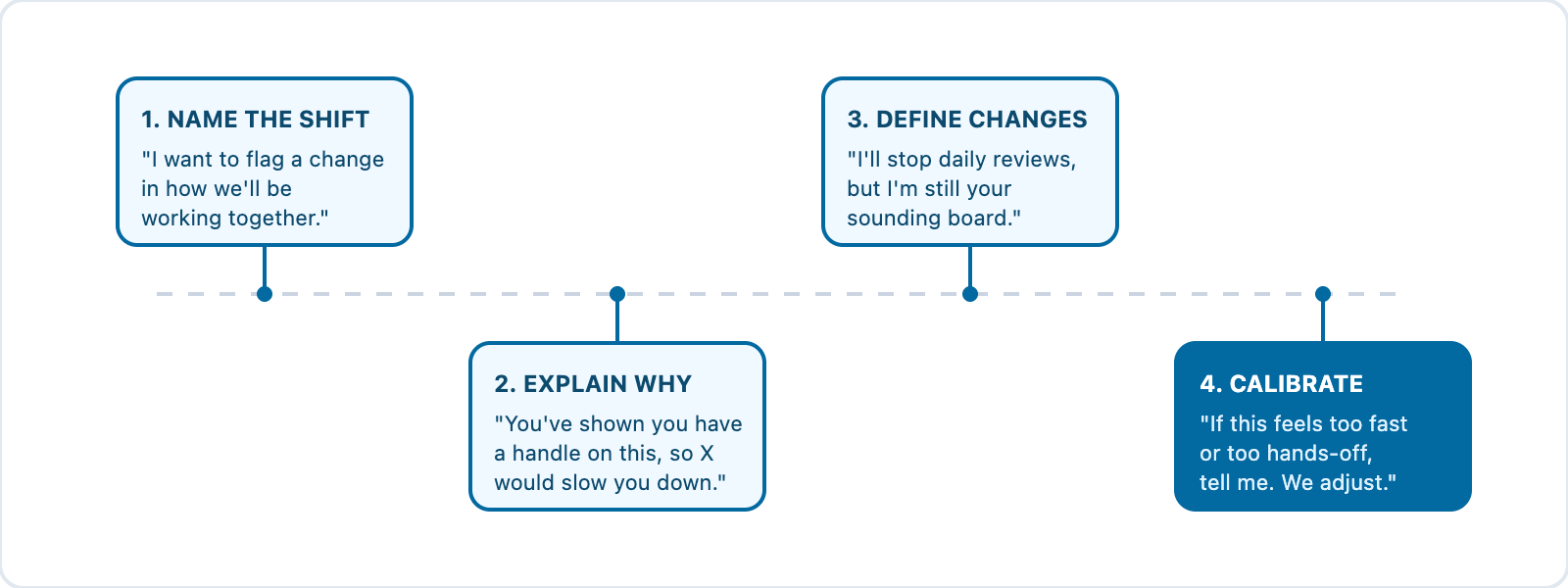
A strong style reset moves through four beats. You begin by naming the shift explicitly, with something like "I want to flag that I'm going to change how we work together over the next few weeks." From there, you explain the why in terms of their growth, not your preference: "You've shown me you've got a real handle on this, and continuing to check in the way we have been would actually start to slow you down." Next, you define what changes and what stays the same, perhaps with "I'll stop doing daily reviews, but I'm still your sounding board whenever you want one." Finally, you invite calibration by saying something like "If this feels too fast or too hands-off, tell me. We can adjust." This last beat matters enormously, because it reframes the shift as a partnership rather than a verdict.
 Consider how this plays out when a manager senses resistance from a long-tenured team member during a shift toward more autonomy:
- Victoria: I want to flag a change in how we'll be working together. You've fully owned the vendor process for months now, so I'm going to step out of the weekly approval loop and let you run it end-to-end.
- Ryan: Honestly, I'd rather keep the check-ins. What if I make a call you wouldn't have made?
- Victoria: Tell me more about what's behind that. Is there a specific decision you're worried about, or is it more the idea of not running things by me?
- Ryan: I guess... it's just that I've always had your sign-off. It feels weird without it.
- Victoria: That makes sense, and it's not a test. I'm still your sounding board anytime you want one; what's changing is that you don't need my approval to move. Let's try it for two weeks, and if it feels off, we recalibrate.
- Ryan: Okay. Two weeks I can do.
Notice what Victoria does here. She names the shift explicitly, then uses the diagnostic question to distinguish a legitimate concern from fear of change. When Ryan reveals it's the latter, she doesn't argue him out of it; she validates the feeling, reaffirms continued access, and offers a small, time-bound first step. That's the style reset in action.
Beyond the reset conversation itself, a few ongoing practices preserve trust during transitions. Consistency of access is critical: if you reduce direction, don't simultaneously reduce availability. People can handle less oversight as long as they don't feel abandoned. It also helps to reaffirm the relationship, not just the role: a quick "How are you feeling about how we're working together?" once a month catches small frictions before they become big ones. And critically, you must own your part if the shift was poorly timed. If a team member tells you, "Honestly, I wasn't ready for this much independence yet," the worst response is to defend your decision. The best response is "That's helpful. Let me dial back in for a bit until you feel solid, and then we'll try again." That kind of responsiveness signals that adaptive leadership isn't about you imposing a new model; it's a partnership that responds to real data.
Finally, remember that resistance is not a failure of your leadership; it's information. Every pushback, every hesitation, and every quiet withdrawal tells you something about where the person actually is, versus where you assumed they were. Leaders who treat resistance as a personal affront miss the signal. Leaders who treat it as feedback get sharper with every cycle.
In the upcoming role-play session, you'll practice handling a specific and common form of resistance: a long-tenured team member who is comfortable being told what to do and is pushing back against your move toward a Supporting style. You'll work on addressing their fear of failure without retreating into old patterns, and on holding the new style with both empathy and confidence. Get ready to listen for the difference between legitimate concern and fear of change, and to lead the conversation that rebuilds trust on the other side of the shift.
