Leading Stage Transitions
Welcome to the Course
Welcome to Managing Transitions and Resistance, the course where adaptive leadership truly comes alive. So far, you've built a strong foundation. You understand your own leadership DNA, you can diagnose development stages, and you can flex between Directing, Coaching, Supporting, and Delegating styles. But here's the truth most management books gloss over: people don't stay still. Your team members will grow, plateau, regress, and grow again, and every time they shift, your leadership must shift with them.
Throughout this course, you will learn how to spot the subtle signals that a team member is transitioning between stages, how to handle the resistance that inevitably arises when you change your style, and how to help someone recover when stress, new technology, or personal challenges cause them to regress. You'll also learn how to align your entire team around the adaptive model so that flexing your style isn't seen as "playing favorites" but as the gold standard of individualized development.
By the end of this course, you'll have your own Adaptive Leadership Manifesto—a clear declaration of how you lead and how your team can best work with you. This first unit focuses on the most foundational skill of transition management: identifying when a transition is happening and timing your response correctly. Get this wrong, and you frustrate high performers or abandon strugglers. Get it right, and you become the kind of leader people remember for life.
Cues That a Team Member Is Moving from S1 to S2 (The "Slump")
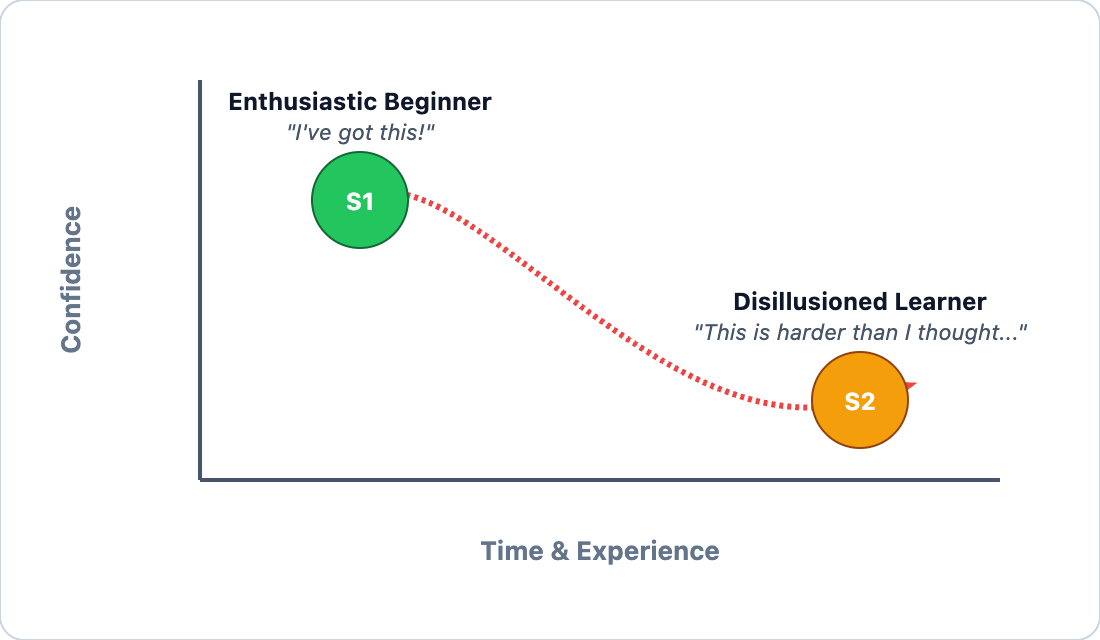
The journey from Enthusiastic Beginner (S1) to Disillusioned Learner (S2) is one of the most predictable—and most missed—transitions in management. When someone first joins a project or role, they ride a wave of optimism. Everything feels new and exciting. But as reality sets in, complexity reveals itself, and early mistakes pile up, that energy drains away. This is what's often called "The Slump."
The slump rarely announces itself. Instead, you'll see small behavioral shifts that, taken together, paint a clear picture. The most telling signals usually appear in language: an employee who used to say "I've got this!" now says "I'm not sure if I'm doing this right." Their questions also change in tone, becoming less curious and more anxious, shifting from "What should I try next?" to "Is this even the right approach?" Alongside this, you may notice a drop in engagement—meetings they once volunteered for now feel like burdens, and updates become shorter and more defensive.
 Consider the following check-in conversation between a manager and a team member who started a new role three weeks ago full of enthusiasm:
- Nova: Hey, just wanted to check in—how are things going with the client reporting work?
- Ryan: Yeah... it's fine. I mean, I'm getting through it.
- Nova: Last week you mentioned you were excited to try the new dashboard tool. How's that going?
- Ryan: Honestly? I don't even know if I'm building it the right way. Every time I think I've got it, something breaks. Maybe I'm just not seeing what everyone else sees.
- Nova: That sounds frustrating. It actually makes sense though—this is the point where the work gets more complex than it first looked. You haven't lost it; you're just hitting the part where most people need a different kind of support from me.
- Ryan: I thought I'd have figured it out by now.
- Nova: That's exactly the signal I needed. Let's not just talk about the what today—let's walk through the why together so this clicks.
Notice what Nova picks up on. Ryan's language has shifted from confidence to self-doubt ("I don't even know if I'm building it the right way"), his engagement has flattened, and he's comparing himself unfavorably to others. Rather than interpreting this as a motivation problem, Nova reads it as a classic slump and pivots her style on the spot—from Directing toward Coaching—by validating his experience and offering deeper context, not just instructions.
Other classic cues include increased apologizing, missed deadlines on tasks they previously handled with energy, withdrawal from team conversations, and a sudden focus on what isn't working. The danger here is that many managers interpret the slump as a commitment problem ("They're just not motivated anymore") when it's actually a competence problem hitting a confidence wall. Remember: the person hasn't lost their potential—they've simply discovered that the work is harder than they expected. Your job is to recognize this moment before it spirals into disengagement, and pivot from Directing to Coaching to give them both structure and encouragement.
Indicators of Readiness for Autonomy (S3 to S4)
The transition from Capable but Cautious Performer (S3) to Self-Reliant Achiever (S4) is just as critical, but it happens in the opposite emotional register. Where the slump is loud with frustration, the move to autonomy is quiet with confidence. And because it's quiet, many managers miss it entirely, continuing to "support" someone who has already outgrown the need for support.
The first indicator to watch for is self-initiated problem-solving. Instead of bringing you a problem and asking what to do, the person brings you a problem and a recommended solution. Phrases like "Here's what I'm thinking, but I wanted to run it by you" gradually evolve into "Here's what I did and the result." Closely connected to this is calibrated confidence: they're no longer fishing for reassurance, and when you ask "How do you feel about this?", they respond with grounded specifics rather than emotional uncertainty. A third sign is the emergence of strategic thinking, where they begin asking about the bigger picture—how their work connects to broader goals, what's coming next, and how they can take on more.
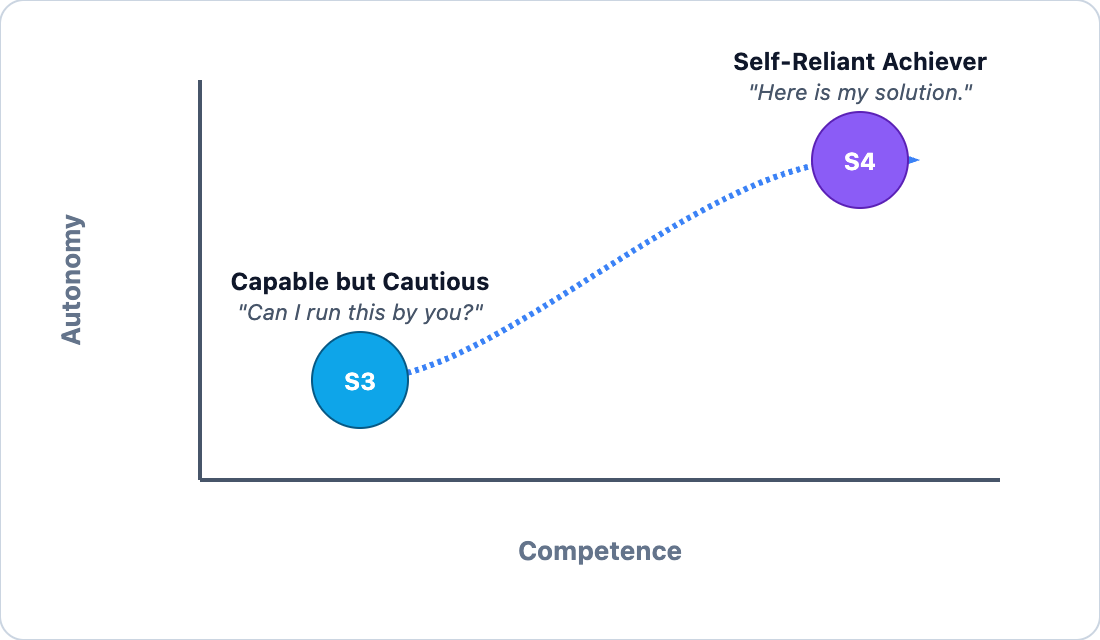
Beyond these primary indicators, you might also notice them coaching peers, anticipating risks before they emerge, and pushing back constructively on your ideas. That last one is huge. A team member who feels safe enough to disagree with you and propose alternatives is signaling they're ready to operate independently. The mistake managers make at this stage is continuing to offer cheerleading or check-ins when the person needs you to get out of the way. Continued support at this stage starts to feel like distrust, and it can demotivate your strongest performers faster than almost anything else.
Timing Your Style Changes to Prevent Frustration or Abandonment
Recognizing transitions is half the battle. The other half is timing your response correctly. Move too early and you'll either overwhelm someone who isn't ready or abandon someone who still needs you. Move too late and you'll frustrate someone who has outgrown your current approach. Either error damages trust.
A useful mental model here is the "Two-Signal Rule." Don't shift your style based on a single behavioral cue, because one cue could simply reflect a bad day, a one-off project, or a temporary stressor. Instead, wait until you've observed at least two consistent signals across two different contexts before adjusting. For example, if a team member shows hesitation in one meeting, that's data. If they show hesitation in a meeting and submit work below their usual standard, that's a pattern worth responding to.
Equally important is the principle of gradual transition. Style changes shouldn't feel like whiplash. If you've been Directing someone and you sense they're moving into the slump, you don't suddenly stop giving direction—you start layering in more questions, more empathy, and more "How are you feeling about the workload?" alongside your instructions. Similarly, when moving from Supporting to Delegating, you don't disappear overnight. You announce the shift with something like, "I've noticed you've really got a handle on this. I'm going to step back and let you run with it—come to me only when you want a sounding board." This kind of transparent transition prevents the team member from feeling either smothered or abandoned.
Finally, stay alert to regression triggers, such as new technology, organizational change, or personal stressors, which may temporarily reverse a transition. A team member who reached S4 last quarter might dip back to S2 when a new system rolls out, and that's completely normal. The skill is staying responsive rather than rigid.
In the upcoming role-play session, you'll get the chance to put this into practice. You'll engage with a team member who is showing classic signs of entering the slump after an enthusiastic start, and you'll practice pivoting your style from Directing to Coaching in real time—validating their experience without lowering the bar. Get ready to listen carefully, read the cues, and lead the transition with intention.
