The Zero Exponent
Welcome to The Zero Exponent
Welcome back to Making Sense of Exponents! We are now past the halfway point of the course, with three lessons already under our belt. You can interpret exponents as repeated multiplication, handle negative bases with confidence, and predict signs using even/odd patterns. All of that work has involved exponents that are positive integers — but today, we are stepping into new territory. What happens when the exponent drops all the way down to zero?
The answer might surprise you at first, but by the end of this lesson it will feel completely natural. Instead of handing you a rule to memorize, we are going to discover it together by following a pattern that powers already create on their own.
A Natural Question
Think about what the exponent has always meant so far. In , the exponent tells us to multiply by itself four times: . In , there is only one copy of the base, so the value is just . But asks us to write down zero copies of and multiply them together — and that does not quite fit our "repeated multiplication" picture.
Rather than getting stuck on what zero copies of a base "means," we can zoom out and look for a bigger pattern. Powers of a number are not isolated values; they form a connected sequence with a very predictable structure. Let's explore that structure now.
The Descending-Powers Pattern
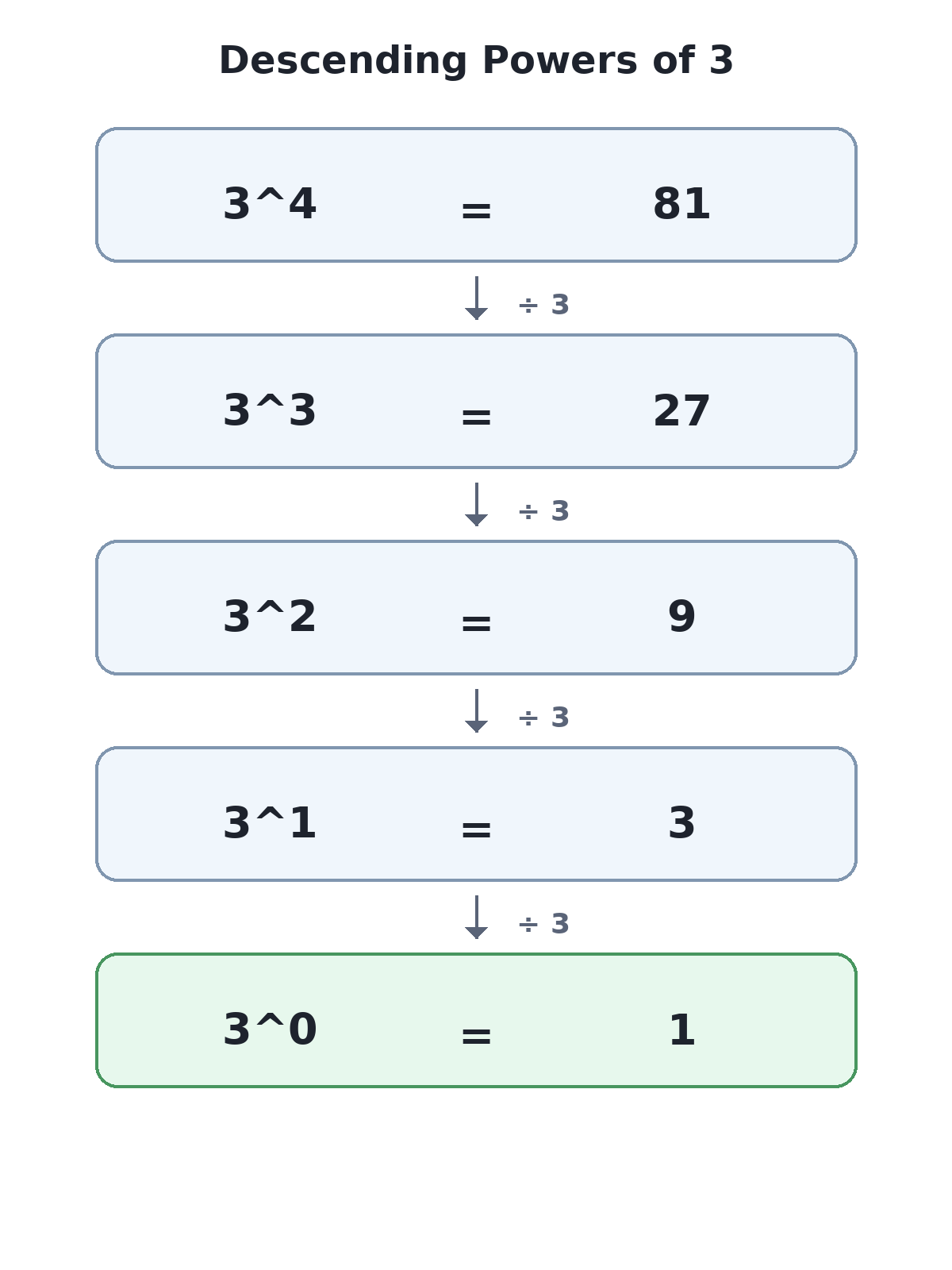
Let's list the powers of starting from and work our way down:
| Expression | Value |
|---|---|
Focus on the Value column from top to bottom. Each time the exponent drops by one, the value is divided by the base:
If we keep the pattern going one more step, we get . So .
Let's make sure this was not a coincidence by testing a different base. Here is the same pattern with base :
| Expression | Value |
|---|---|
Each step divides by : , then , then . One more step gives . Once again, .
The Zero Exponent Rule
The pattern works for every nonzero base. Whether the base is , , , or , the descending-powers pattern always lands on the same result:
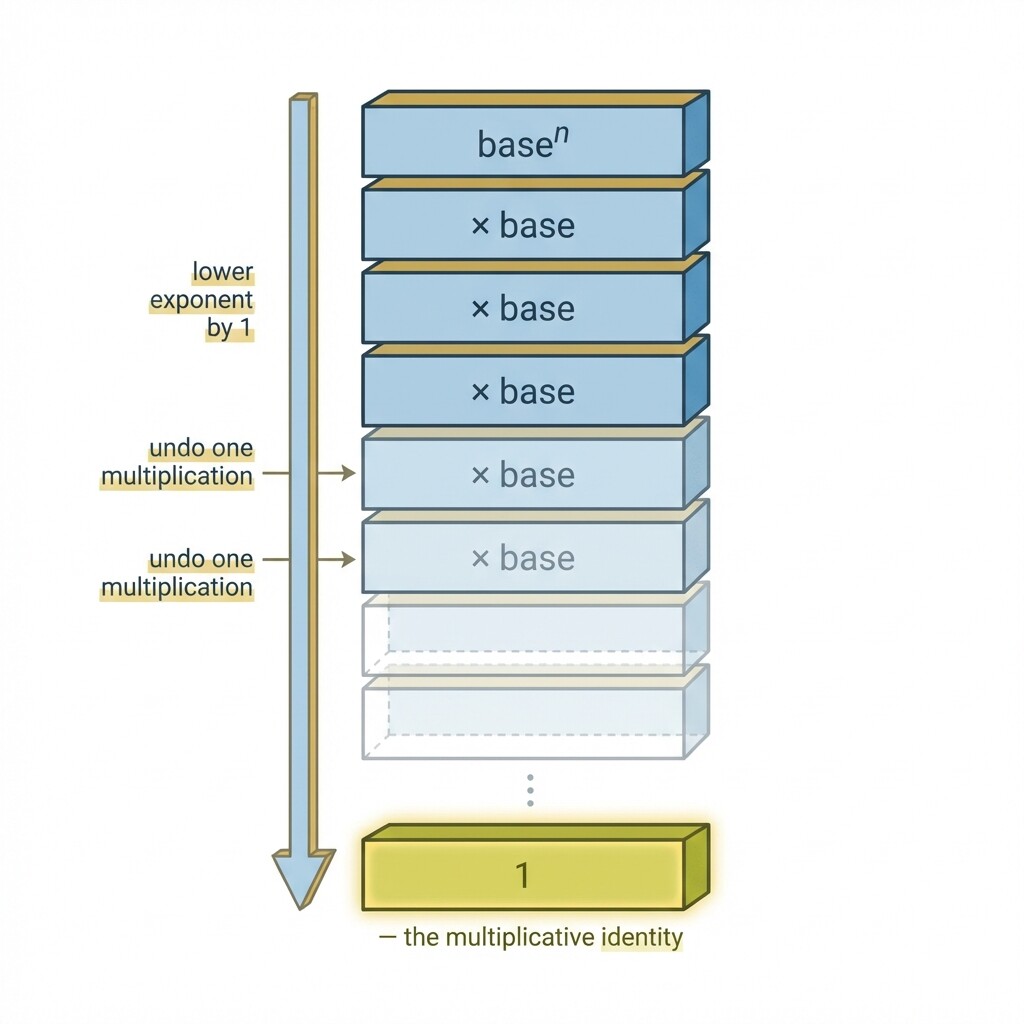
This is called the zero exponent rule. It is not an arbitrary definition we simply have to accept — it is the only value that keeps the "divide by the base" pattern consistent. Think of it this way: each time we lower the exponent by one, we undo one multiplication. Once we have undone all of them, we are left with , the multiplicative identity — the number that has no effect when you multiply by it. That is the natural starting point for building up products, and the natural landing place when we strip them all away.
You will encounter this rule constantly in science, finance, and computing. For example, in the compound-interest formula , setting (no time has passed) gives , which makes perfect sense: your balance has not changed yet. The zero exponent rule is what makes that work.
Applying the Rule Across Different Bases
Let's see the rule in action with a variety of bases:
The base does not matter at all. As long as it is not zero, the answer is always . Even a large number like or a negative base like follows the same rule.
One detail worth highlighting: parentheses still matter when a negative sign is involved. The expression has a base of , so the rule applies and the result is . However, means we first evaluate and then apply the negative sign, giving us . The table below summarizes the distinction:
| Expression | Base | Evaluation | Result |
|---|---|---|---|
| The rule gives | |||
| , then negate |
Keep this distinction in mind whenever a negative sign appears without parentheses — it is one of the most common mistakes with zero exponents.
Why Not Zero as a Base?
You might wonder why the rule requires the base to be nonzero. Let's try our descending-powers pattern with base :
| Expression | Value |
|---|---|
To continue the pattern, we would need to divide by , but division by zero is undefined. The pattern simply breaks down. That is why does not have a standard value in most mathematical settings, and the zero exponent rule explicitly requires .
For every other base — positive, negative, large, small, whole number, or fraction — the descending-powers pattern works perfectly and always arrives at .
Conclusion and Next Steps
In this lesson, we discovered that any nonzero base raised to the zero power equals , and that this result is not arbitrary. It follows naturally from the descending-powers pattern, where each drop in the exponent divides the value by the base. We also saw why is excluded and confirmed that parentheses remain important when negative signs are involved.
Now it is your turn to put this idea into practice. You will complete descending-powers sequences to watch the pattern unfold with your own hands, explain the reasoning behind the rule in your own words, and evaluate a variety of zero-exponent expressions — including tricky cases with negative bases — to build lasting confidence.
