Understanding Negative Exponents
Welcome to Negative Exponents
You have made it to the final lesson of Making Sense of Exponents! Over the past four lessons, you have gone from interpreting exponents as repeated multiplication all the way to proving that any nonzero base raised to the zero power equals . Along the way, you learned to handle negative bases and predict signs with confidence. Now there is one last frontier to explore: what happens when the exponent itself drops below zero?
A number like might look unusual at first. Your instinct might even be that a negative exponent produces a negative result — but that turns out to be one of the most common misconceptions in all of exponent arithmetic. By the end of this lesson, you will know exactly what negative exponents mean, why they work the way they do, and how to evaluate them quickly.
Picking Up the Pattern
In the previous lesson, we discovered the zero exponent rule by following a simple observation: each time the exponent drops by one, the value is divided by the base. That descending-powers pattern carried us smoothly from all the way down to .
But here is the key insight: nobody said the pattern has to stop at zero. If dividing by the base works perfectly from down to , there is no mathematical reason it cannot keep going into , , and beyond. Let's see what happens when we let it run.
Extending Below Zero
Let's revisit the powers of and continue the table past zero:
| Expression | Value |
|---|---|
From top to bottom, each value is divided by : , then , then . Let's keep dividing:
So the completed table looks like this:
| Expression | Value |
|---|---|
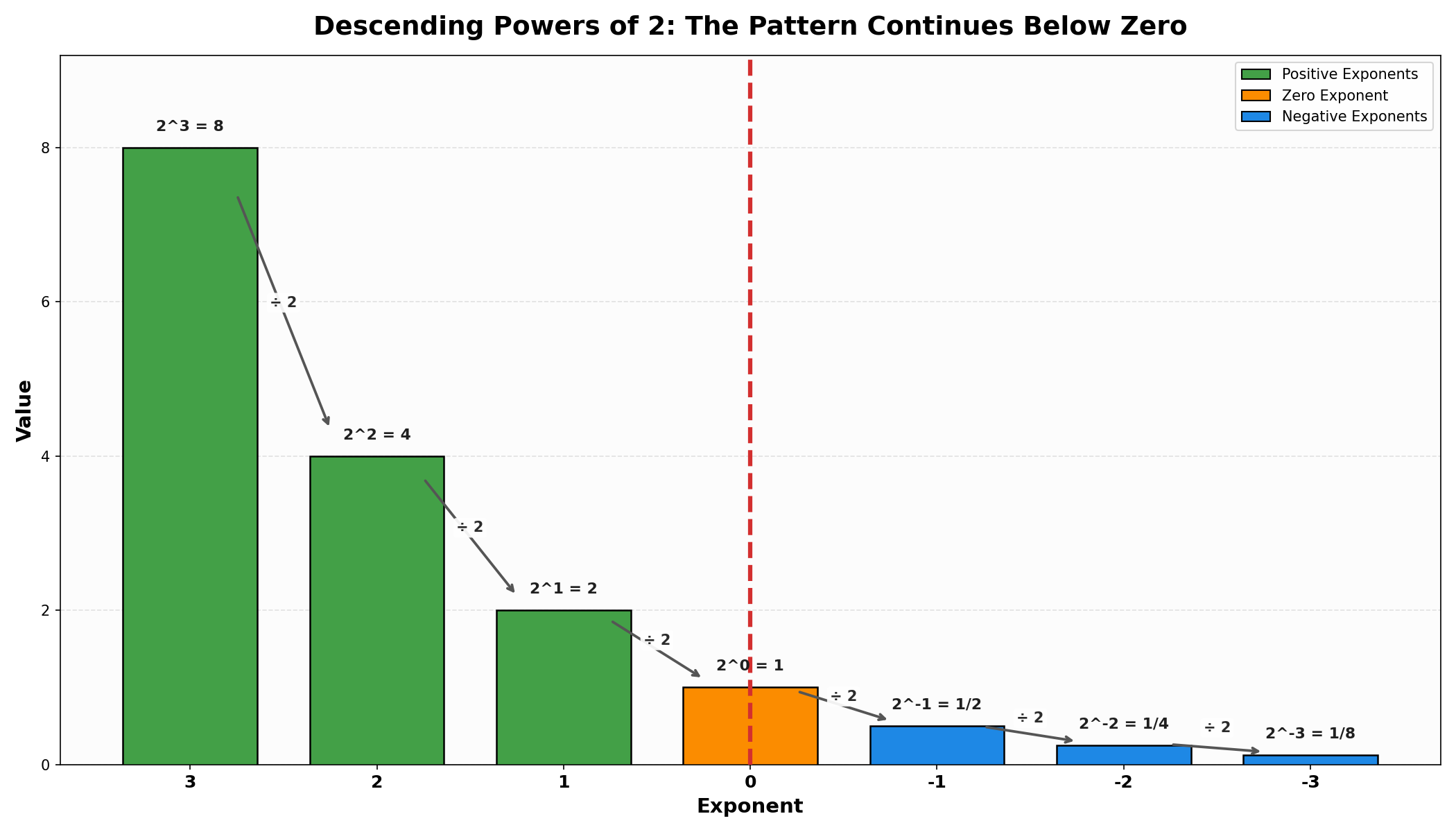
Notice something beautiful: , which is the same as . Likewise, , and . Each negative exponent produces the reciprocal of the corresponding positive power.
Let's confirm with base to make sure this is not a coincidence:
| Expression | Value |
|---|---|
Each step divides by , and once again, and . The reciprocal pattern holds.
The Negative Exponent Rule
The pattern we just observed works for every nonzero base and gives us a clean general rule:
In words: a negative exponent tells you to take the reciprocal of the base raised to the corresponding positive exponent. The negative sign in the exponent does not make the result negative — it flips the number under a fraction bar.
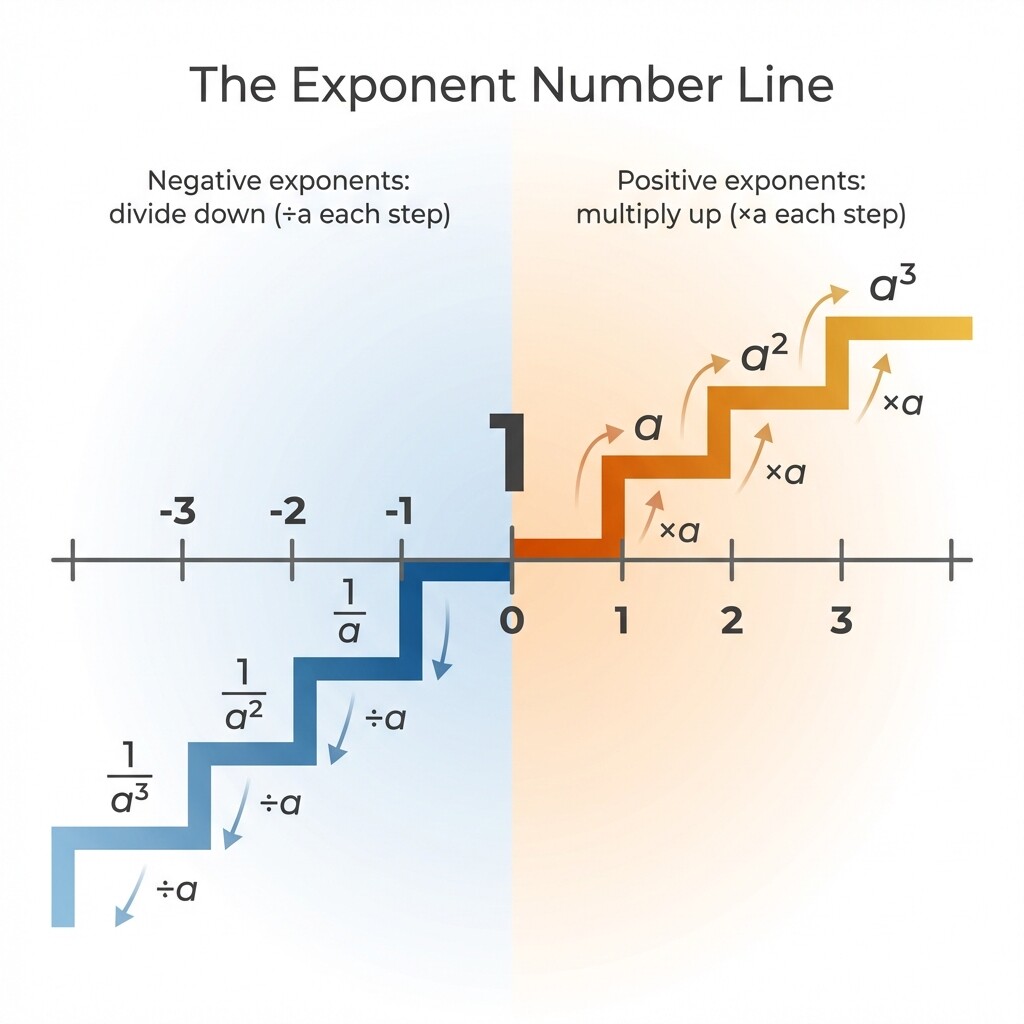
Think of it this way. A positive exponent like builds up through repeated multiplication: . A negative exponent like does the opposite — it builds down through repeated division, landing on . The zero exponent sits right in the middle at , the boundary between "multiplying up" and "dividing down."
Evaluating Negative Exponents Step by Step
To evaluate any negative-exponent expression, follow two simple steps:
- Rewrite using the rule: replace with .
- Compute the positive power in the denominator.
Let's work through a few examples.
Example 1:
Example 2:
Example 3:
When the base is positive, every result is a positive fraction or decimal that is less than . For positive bases, negative exponents produce small values but never negative ones.
If the base were negative, the sign of the result would follow the same even/odd pattern you already learned — for example, — but all of the examples in this lesson use positive bases.
A Common Misconception
This point is worth stating directly because it trips up many learners: a negative exponent does not mean a negative answer. Consider these two expressions side by side:
| Expression | Meaning | Result |
|---|---|---|
| (positive) | ||
| (negative) |
In the first row, the exponent is negative, which triggers the reciprocal rule. In the second row, the base is negative, which affects the sign of the product based on the even/odd pattern we explored earlier in this course. These are two completely different situations.
A quick way to keep them straight: a negative exponent controls size (it makes the value small), while a negative base controls sign (it can make the value negative).
Negative Exponents in Everyday Life
Negative exponents show up whenever we need to describe very small quantities in a compact way. Here are a few everyday examples:
- A millimeter is meters — just of a meter.
- A centigram is grams — of a gram.
- A recipe might call for cups of a rare spice, meaning just of a cup.
In each case, the negative exponent is simply a tidy way to express a small fraction. You will encounter this notation frequently in science and measurement, especially once you reach the later course on Scientific Notation in this learning path.
Conclusion and Next Steps
In this lesson, we extended the descending-powers pattern below zero and discovered that a negative exponent produces the reciprocal of the corresponding positive power: . We saw that negative exponents create small positive values — not negative ones — and we walked through evaluating several expressions step by step.
Now it is time to put these ideas to work. In the upcoming exercises, you will complete descending-powers tables, judge common claims about negative exponents for accuracy, evaluate a variety of expressions on your own, and match negative-exponent quantities to real-world scenarios. Let's finish this course strong!
