Negative Base Sign Patterns
Welcome to Sign Patterns for Negative Bases
Welcome back to Making Sense of Exponents! We are now on the third lesson of this course, and you have already built a solid foundation. In the first lesson, we explored how exponents represent repeated multiplication. In the second, we learned how parentheses determine whether a negative sign is part of the base. Now we are going to take that knowledge one step further and uncover a pattern that lets us predict the sign of a result when a negative base is raised to a power — without multiplying every factor by hand.
Setting the Stage
As you may recall from the previous lesson, parentheses play a critical role with negative bases. The expression tells us that is the base and gets multiplied by itself four times, while means only is raised to the fourth power and the negative sign is applied afterward. In this lesson, we will focus entirely on expressions where the negative sign is part of the base, like , and discover a reliable shortcut for determining whether the result is positive or negative.
Watching the Signs Unfold
Let's start by computing the first several powers of and paying close attention to what happens to the sign at each step:
| Expression | Expanded Form | Result | Sign |
|---|---|---|---|
| Negative | |||
| Positive | |||
| Negative | |||
| Positive | |||
| Negative | |||
| Positive |
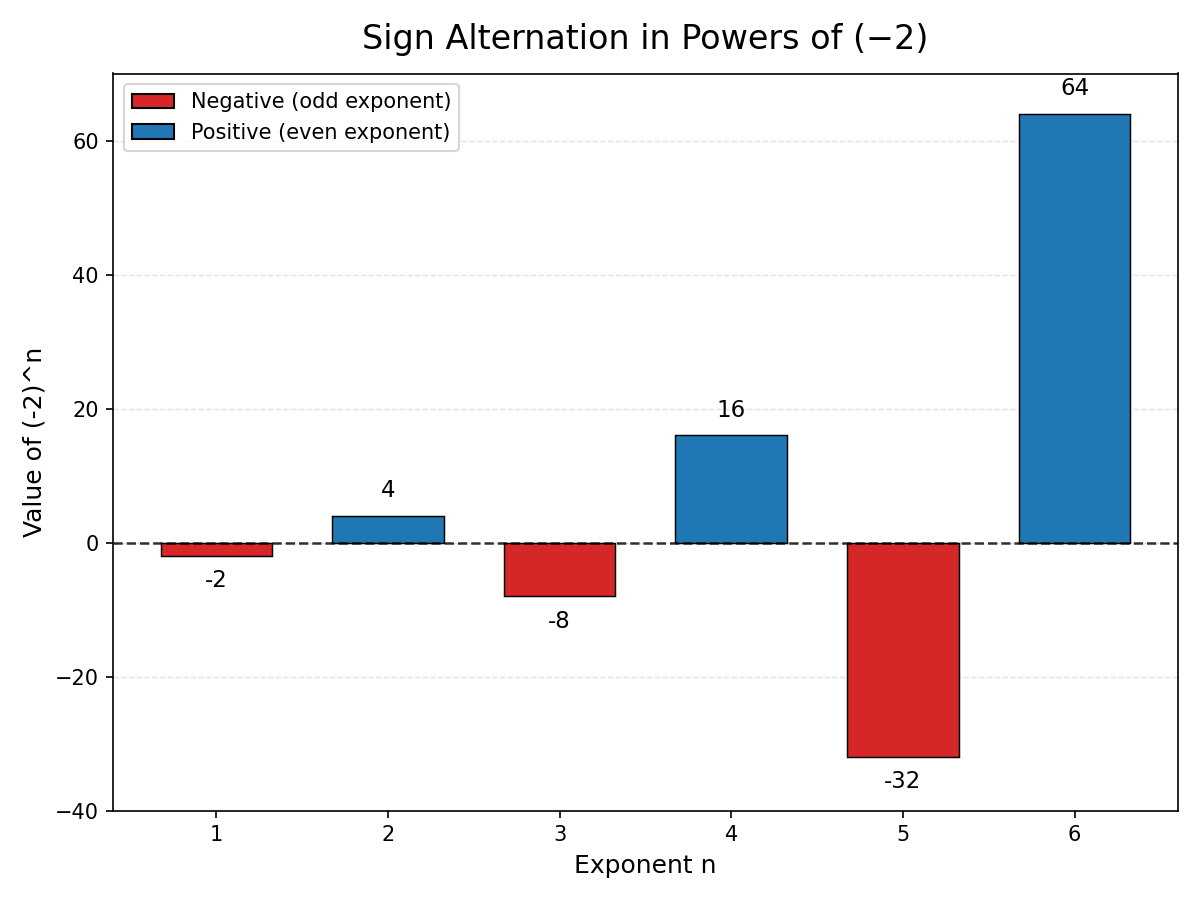
Notice the pattern? The sign alternates with every step. Odd exponents give negative results, and even exponents give positive results. This isn't a coincidence — there is a concrete reason behind it.
Why Does This Happen?
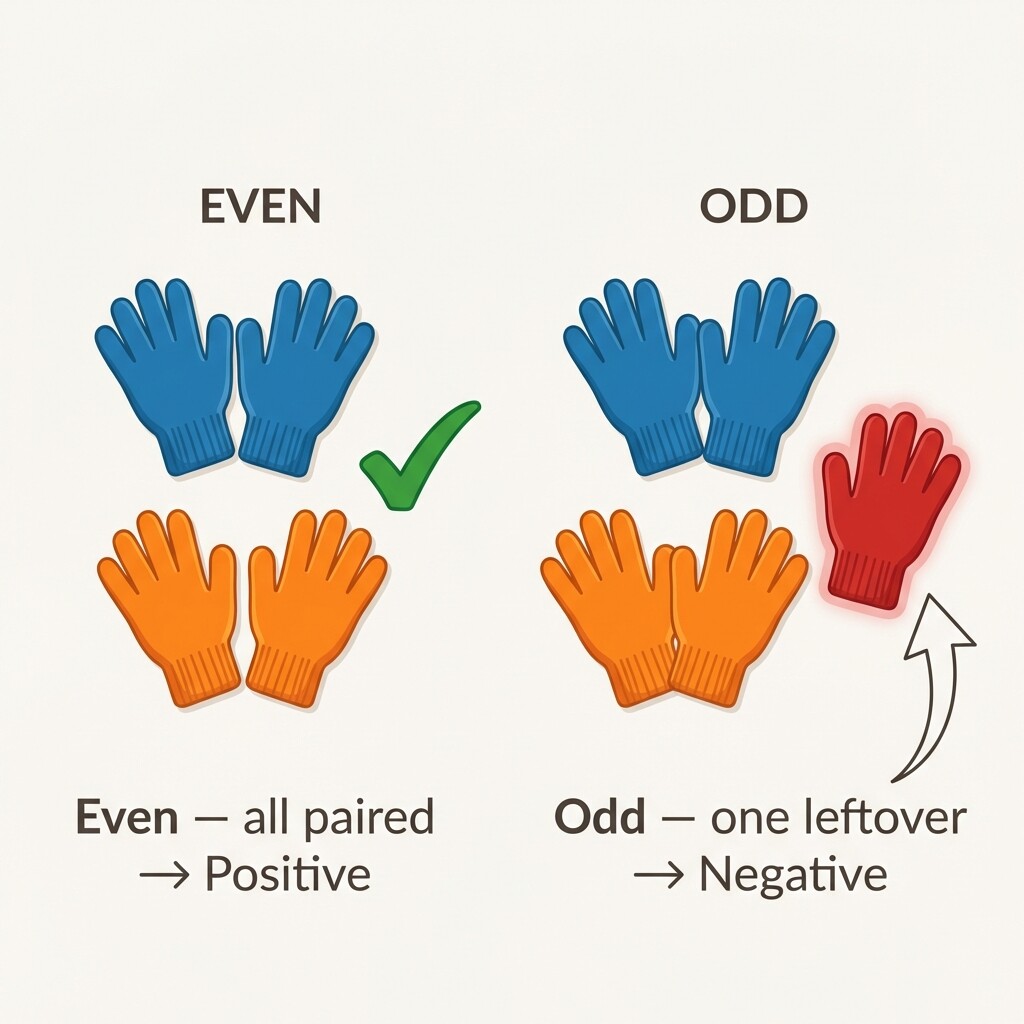
The key is how negative numbers behave when we multiply them in pairs. We know that multiplying two negative numbers always gives a positive result: . When the exponent is even, every negative factor finds a partner, and each pair produces a positive product. The final result is positive.
When the exponent is odd, the negative factors still pair up, but one factor is left without a partner. That leftover negative factor makes the entire result negative. Think of it like pairing up gloves from a pile: an even count means every glove gets a match, while an odd count always leaves one glove on its own.
The Even/Odd Sign Rule
We can now state the pattern as a clear rule. For any negative base raised to a positive integer exponent :
- If is even, the result is positive.
- If is odd, the result is negative.
This works no matter what the base is, as long as the negative sign is inside the parentheses. Whether our base is , , or , the sign of the result depends only on whether the exponent is even or odd.
Applying the Rule to Larger Exponents
The real benefit of this rule appears when the exponent is too large to compute by hand. Consider these examples:
- : The exponent is odd, so the result is negative.
- : The exponent is even, so the result is positive.
- : The exponent is odd, so the result is negative.
We did not need to calculate or to know their signs. The even/odd check gave us the answer in seconds. This kind of shortcut is especially valuable in science and engineering, where large exponents appear regularly and computing full values by hand is not practical.
A Special Case: Powers of (-1)
The base deserves its own spotlight because it makes the pattern especially clean. Since multiplied by itself any number of times is still , the only thing that ever changes is the sign:
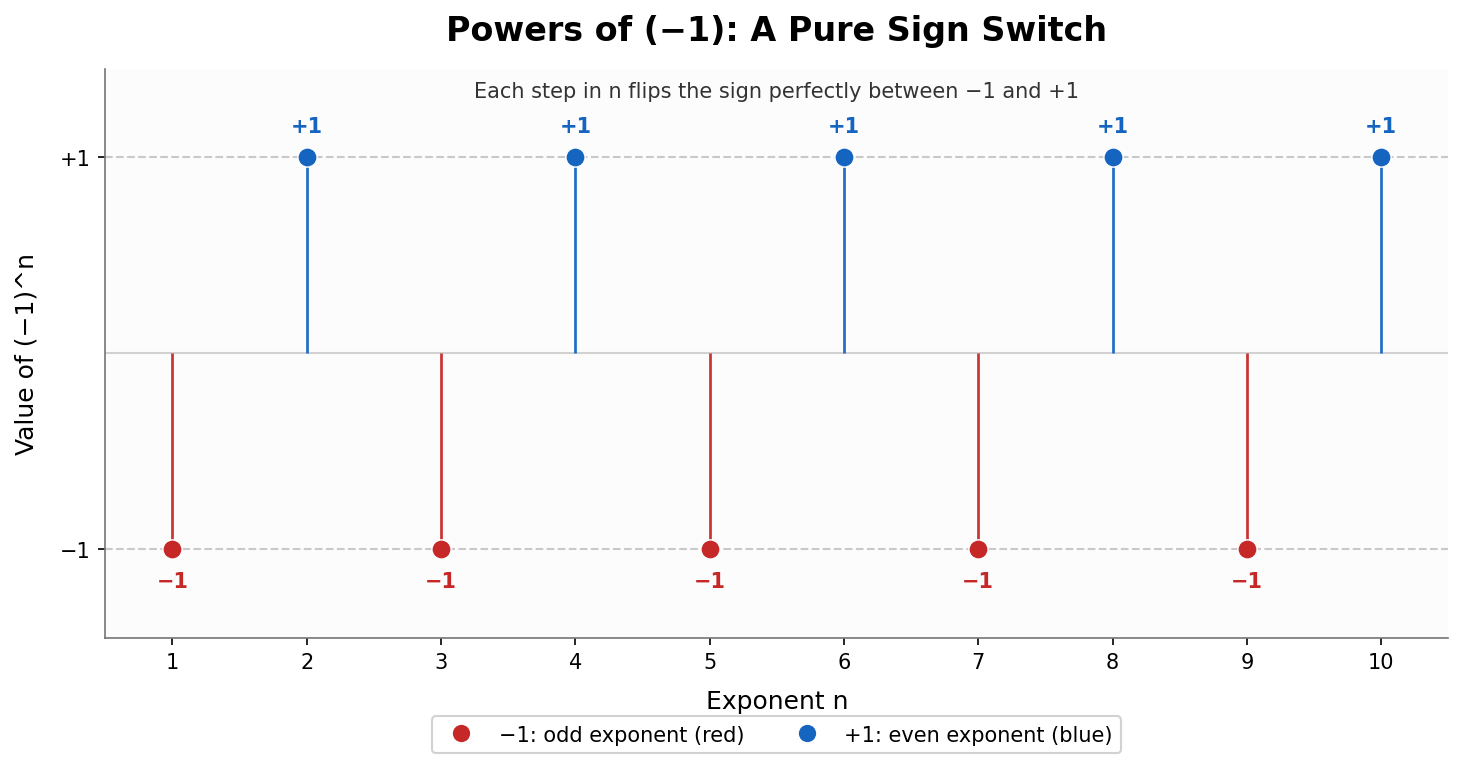
This means acts like a pure "sign switch," toggling between and as the exponent increases. You will see this idea come in handy in future math and science courses where alternating signs are a common theme.
Conclusion and Next Steps
In this lesson, we discovered that the sign of a power with a negative base follows a simple and reliable pattern: even exponents produce positive results, and odd exponents produce negative results. The reason comes down to pairing: every pair of negative factors multiplies to a positive, so an even number of factors pairs up completely while an odd number always leaves one negative factor unpaired.
Now it is time to put this pattern into action with some hands-on practice. You will build the rule from scratch by filling in a table, make quick sign predictions for expressions with large exponents, and evaluate powers of negative bases with full confidence. Let's see how sharp those even/odd instincts have become!
