Negative Bases and Parentheses
Introduction
Welcome back to Making Sense of Exponents! This is our second lesson in the course, and you are already building momentum. In the first lesson, we learned that an exponent tells us how many times to use the base as a factor, and we practiced expanding and evaluating expressions like . Now we are ready to tackle a situation that trips up many learners: what happens when a negative sign is involved?
In this lesson, we will look closely at expressions like and . They may look almost identical at first glance, but they mean very different things and produce very different results. The key lies in parentheses, and by the end of this lesson, you will be able to tell the two forms apart, identify the base in each one, and evaluate both with confidence.
Why Parentheses Matter
As you recall, the base is the number being multiplied repeatedly. When all the numbers are positive, identifying the base is straightforward. But once a negative sign enters the picture, we need a way to show whether that sign belongs to the base or not — and that is exactly the job parentheses do.
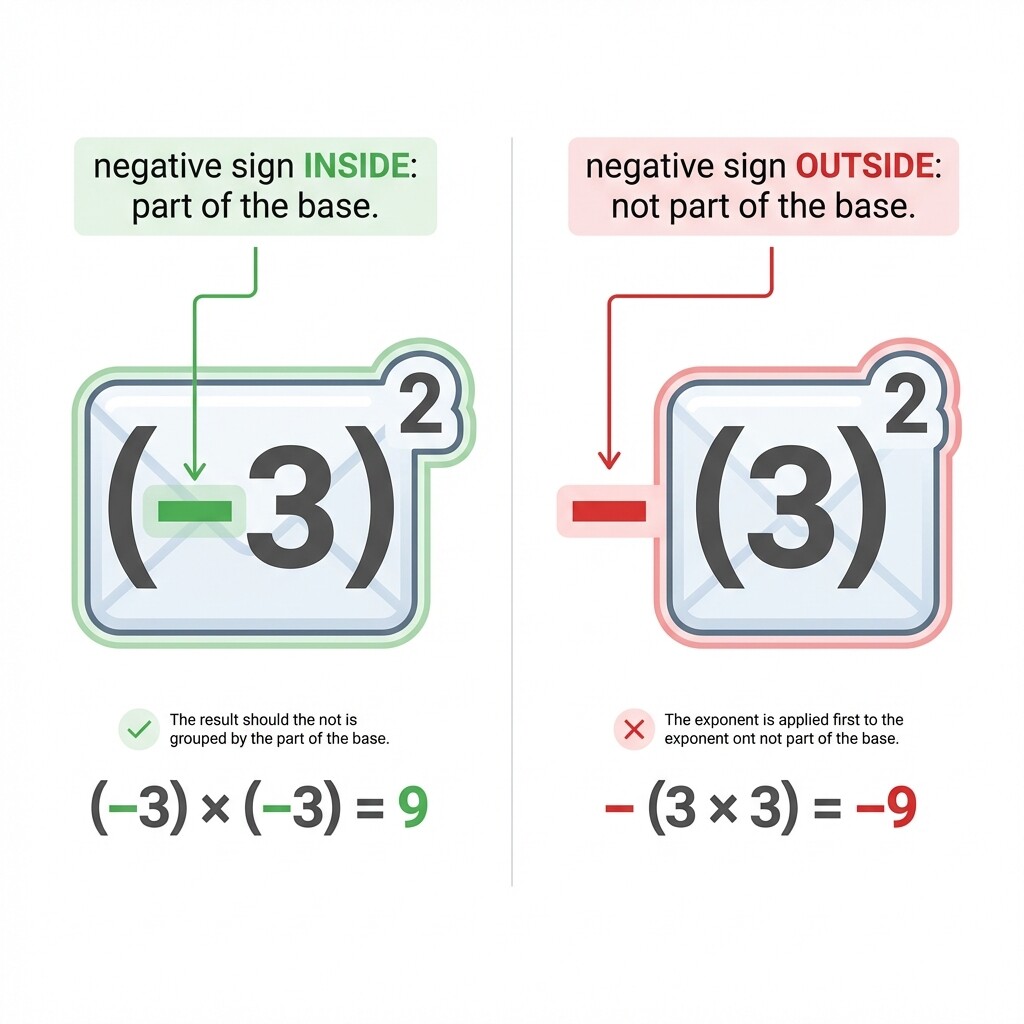
Think of parentheses as a container. Whatever is inside is bundled together as a single unit. If the negative sign sits inside, it is part of the package. If it sits outside, it is separate. This small visual detail completely changes the meaning of an expression.
This distinction is not just an academic detail — it matters in practice. If you type -3^2 into a calculator or a spreadsheet, you will get , not , because the software follows the same convention we are about to learn: without parentheses, the exponent applies to alone. Getting this right matters every time you work with negative numbers and powers, so let's look at each case one at a time.
The Negative Sign Inside Parentheses
When we write , the parentheses wrap around . This tells us the base is — the entire negative number. The exponent says "use as a factor two times":
The result is positive because multiplying two negative numbers gives a positive product. Let's try another example with a higher exponent:
Working left to right: , then , so . Notice that this time the result is negative. We will explore why certain powers of negative bases come out positive and others come out negative in the next lesson. For now, the key takeaway is that the negative sign is part of the base, so it participates in every multiplication.
The Negative Sign Outside Parentheses
Now let's look at the expression . There are no parentheses around , so the base is just . The negative sign sits outside and is applied after the exponent does its work. We can think of as shorthand for :
The exponent only touches the . We square to get , and then the negative sign in front flips it to . Here is one more:
The exponent applies to alone. We evaluate , and then the leading negative sign gives us . No matter how large the exponent is, without parentheses the negative sign stays on the sideline until the very end.
Spotting the Difference at a Glance
The entire distinction comes down to one question: does the negative sign live inside or outside the parentheses? Here is a comparison to make the pattern clear:
| Expression | Base | What It Means | Value |
|---|---|---|---|
If the negative sign and the number appear together inside parentheses with the exponent outside, the negative sign is part of the base. If there are no parentheses (or the parentheses only surround the positive number), the negative sign is not part of the base.
Evaluating Both Forms Step by Step
Let's walk through a complete pair so the process feels routine. Consider and .
Evaluating : the base is , and the exponent is .
- Expand:
- First pair:
- Next factor:
So .
Evaluating : the base is , and the negative sign is applied afterward.
- Expand:
- First pair:
- Next factor:
- Apply the negative sign:
So .
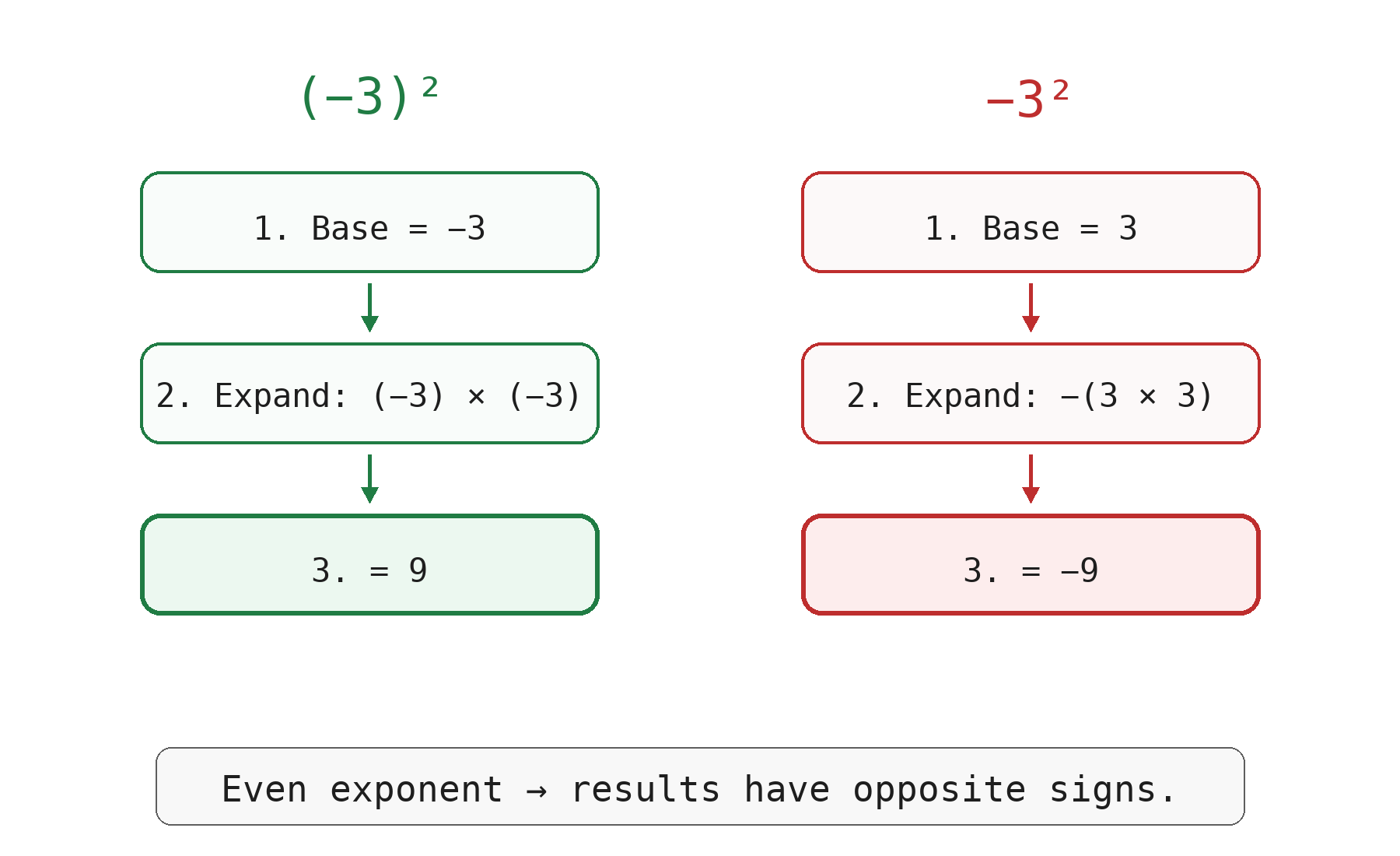
Interestingly, both expressions give the same result here! That is because the exponent is odd. But this will not always be the case — look back at the table above: while . With an even exponent, the two forms produce opposite signs. Keep this in mind as you practice.
Common Mistakes to Watch For
- Assuming parentheses do not matter. As we have seen, while . Always check whether the negative sign is inside or outside.
- Making the negative sign part of the base when there are no parentheses. In standard math notation, means "take the opposite of ." Without parentheses explicitly grouping the negative sign with the base, the exponent applies first.
When in doubt, expand the expression. Write out all the factors, and you will see exactly what the base is and where the negative sign belongs.
Conclusion and Next Steps
Let's recap what we covered. The expression has a base of because the parentheses bundle the negative sign with the number, while has a base of just with the negative sign applied after the power is computed. To identify the base, check the parentheses: if the negative sign is inside them, it is part of the base; if not, it is separate.
Now it is time to sharpen these skills with some hands-on practice! You will classify expressions by their base, trace through step-by-step evaluations, and compute results on your own. Jump in and see how quickly you can spot the difference!
