Exponents as Repeated Multiplication
Introduction
Welcome to Making Sense of Exponents, the first course in your learning path! Since this is our very first lesson together, we are starting from the ground up. By the end of this course, you will have a solid, intuitive understanding of what exponents are and how they behave. In this lesson, we will explore the core idea behind exponent notation: repeated multiplication. We will learn how to read an expression like , identify its parts, and compute its value step by step.
From Repeated Addition to Repeated Multiplication
Before we dive into exponents, let's notice a pattern we already rely on every day. Multiplication is really just a shortcut for repeated addition. For example, instead of writing , we simply write . It saves space and tells us exactly what is happening: four groups of five.
Exponents follow the same kind of logic, but one level up. When we need to multiply the same number by itself several times, writing it all out gets tedious fast. Exponent notation gives us a compact way to express that idea, and that is exactly what we will unpack next.
The Base and the Exponent
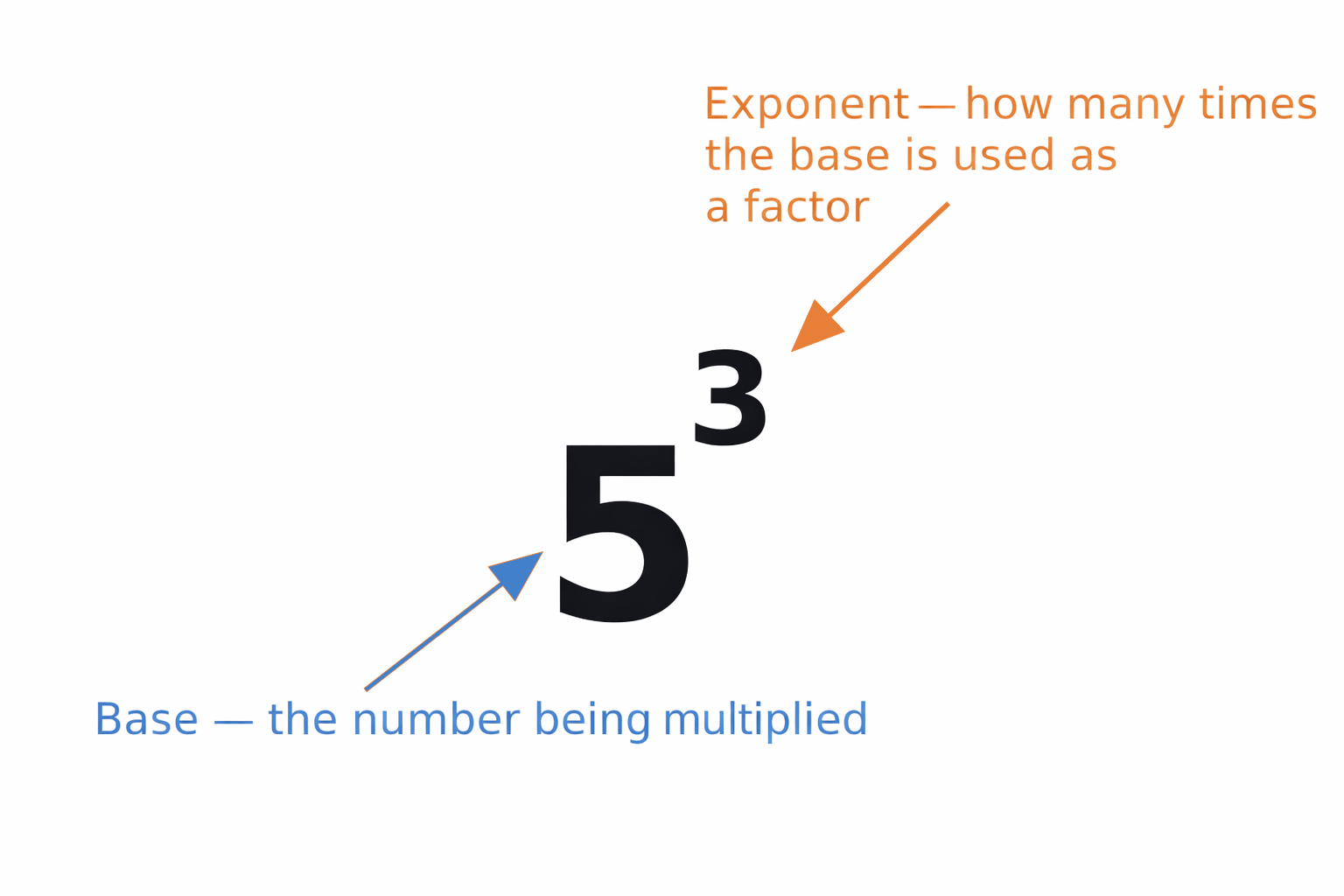
An exponential expression has two key parts:
- The base is the number being multiplied.
- The exponent (sometimes called the power) is the small raised number that tells us how many times the base appears as a factor.
For example, in the expression :
| Part | Value | Meaning |
|---|---|---|
| Base | 5 | The number we are multiplying repeatedly |
| Exponent | 3 | How many times the base appears as a factor |
So means "use 5 as a factor 3 times." We read it aloud as "five to the third power" or "five cubed." Similarly, is read as "two to the fifth power" and means the number 2 appears as a factor five times.
Expanding Into Repeated Multiplication
Now that we can identify the base and exponent, let's see how to expand an exponential expression. Expanding simply means writing out all the repeated factors. Here are a few examples:
Notice the pattern: the exponent tells us exactly how many copies of the base to write down, and we connect them all with multiplication signs. If the exponent is 4, we write the base four times. If the exponent is 2, we write it twice.
The case of an exponent of 1 is the simplest of all — the base appears just once, so . Any number raised to the power of 1 is simply itself.
Evaluating Powers Step by Step
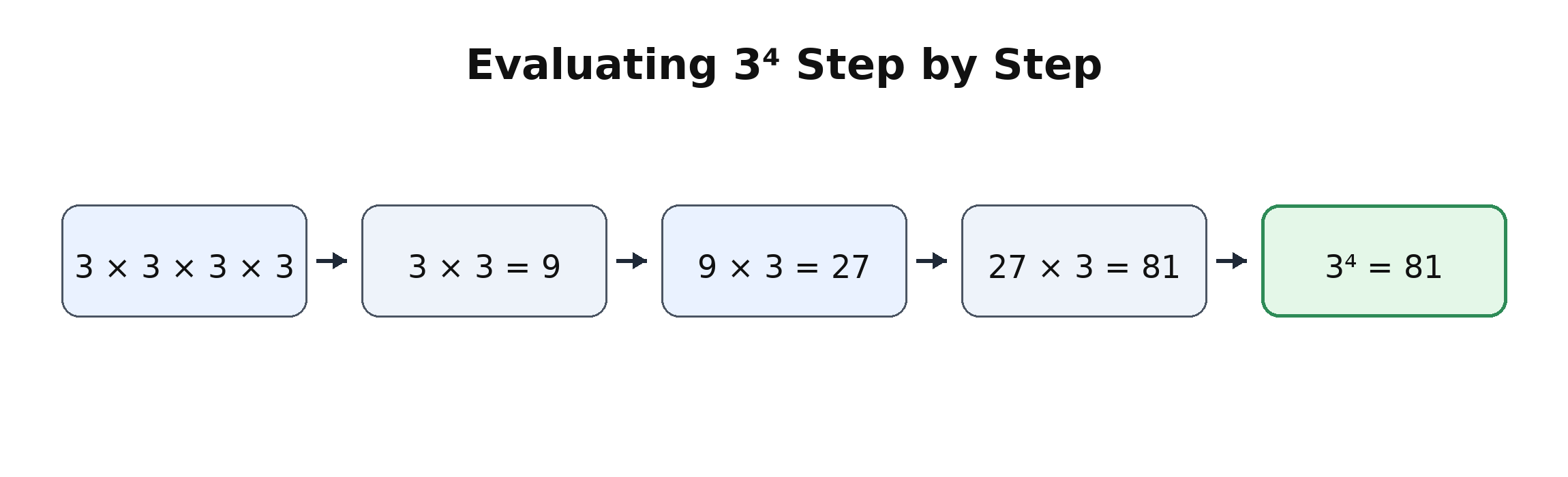
Once we have expanded the expression, we can evaluate it by multiplying from left to right. Let's walk through together:
- Expand:
- Multiply the first pair:
- Multiply by the next factor:
- Multiply by the last factor:
So . Let's try one more with . We expand it as , then multiply left to right: , then , then , and finally . Working left to right like this keeps things simple and reduces mistakes.
Exponents in the Real World
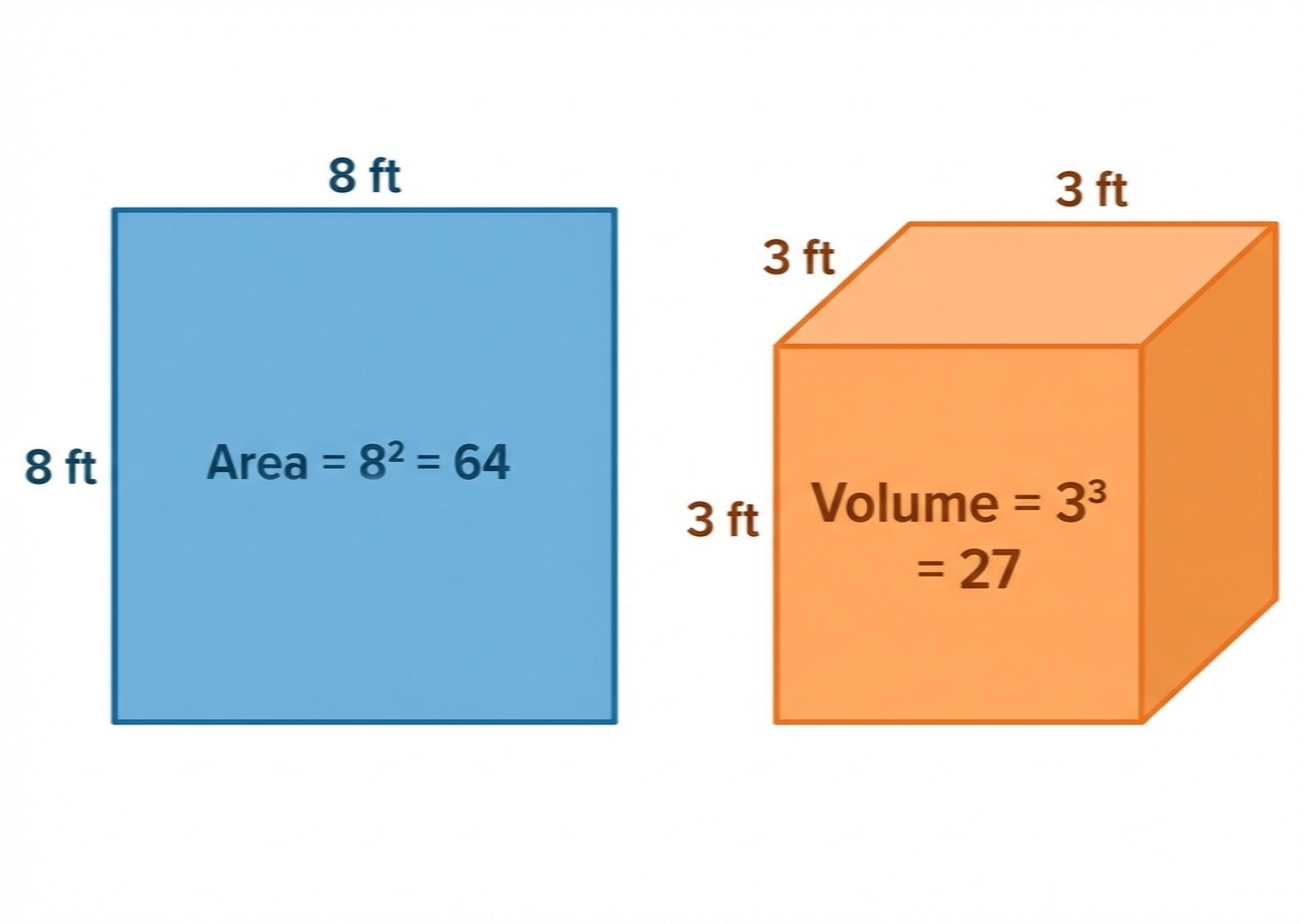
Exponents are not just abstract symbols — they show up in everyday measurements. When we talk about the area of a square, we multiply the side length by itself. A square patio with a side of feet has an area of:
When we talk about the volume of a cube, we multiply the edge length by itself three times. A cube-shaped shipping crate with an edge of feet has a volume of:
This is exactly why we call "eight squared" and "three cubed." The names come directly from geometry — a square's area is found by multiplying two equal side lengths together, and a cube's volume is found by multiplying three equal edge lengths together.
Common Mistakes to Watch For
As you get comfortable with exponent notation, keep these two pitfalls in mind:
- Multiplying the base by the exponent instead of repeating it. For instance, is not . It is .
- Swapping the base and the exponent. In , the base is and the exponent is , so we get . If we accidentally flip them to , we get — a completely different result. The order matters!
Whenever something looks off, expand the expression and count the factors. That simple check will catch most errors.
Conclusion and Next Steps
Let's recap the key ideas from this lesson. An exponent tells us how many times to use the base as a factor in a multiplication. To evaluate an expression like , we expand it into and then multiply step by step to get . We also saw how squaring and cubing connect naturally to the areas of squares and volumes of cubes.
Now it is time to put these ideas into action! Up next, you will work through a set of hands-on practice tasks where you will identify bases and exponents, write out expansions, compute powers on your own, and even apply exponents to real-world measurements. Let's see what you can do!
