Read and Understand Expressions
🎉 Introduction
Welcome to Read and Understand Expressions! In the previous lesson, you learned how to spot changing quantities in everyday situations and represent them with clearly defined variables. Now, you are ready for the next natural step: learning to read a math expression and explain, in plain language, what each part means. By the end of this lesson, you will be able to look at an expression and describe the real-world story it tells. Specifically, you will be able to:
- Identify the building blocks of an expression, including variables, coefficients, and constant terms.
- Break down an expression part by part to explain what each piece calculates.
- Translate a full expression into a plain-language description of a real-world situation.
From Variables to Expressions 🧩
A variable on its own tells you what is changing, but it does not tell you what happens to that quantity. That is where expressions come in. An expression combines variables, numbers, and operations (like addition or multiplication) to describe a calculated quantity. Think of it this way: if a variable is a single ingredient, an expression is a mini recipe that says what to do with that ingredient.
The goal in this lesson is to learn how to read that recipe out loud, piece by piece. Once you can do that, you unlock the ability to connect math directly to real situations.
The Building Blocks of an Expression 🧱
Before you can interpret a full expression, you need to know the names of its parts. Let's use the expression as an example, where = the number of hours worked.
| Part | Name | What It Means in This Example |
|---|---|---|
| Variable | The quantity that changes (hours worked) | |
| Coefficient | The number multiplied by the variable (rate of $4 per hour) | |
| Term | A single chunk of the expression (total hourly earnings) | |
| Constant term | A fixed number that does not depend on the variable (a flat bonus of $25) |
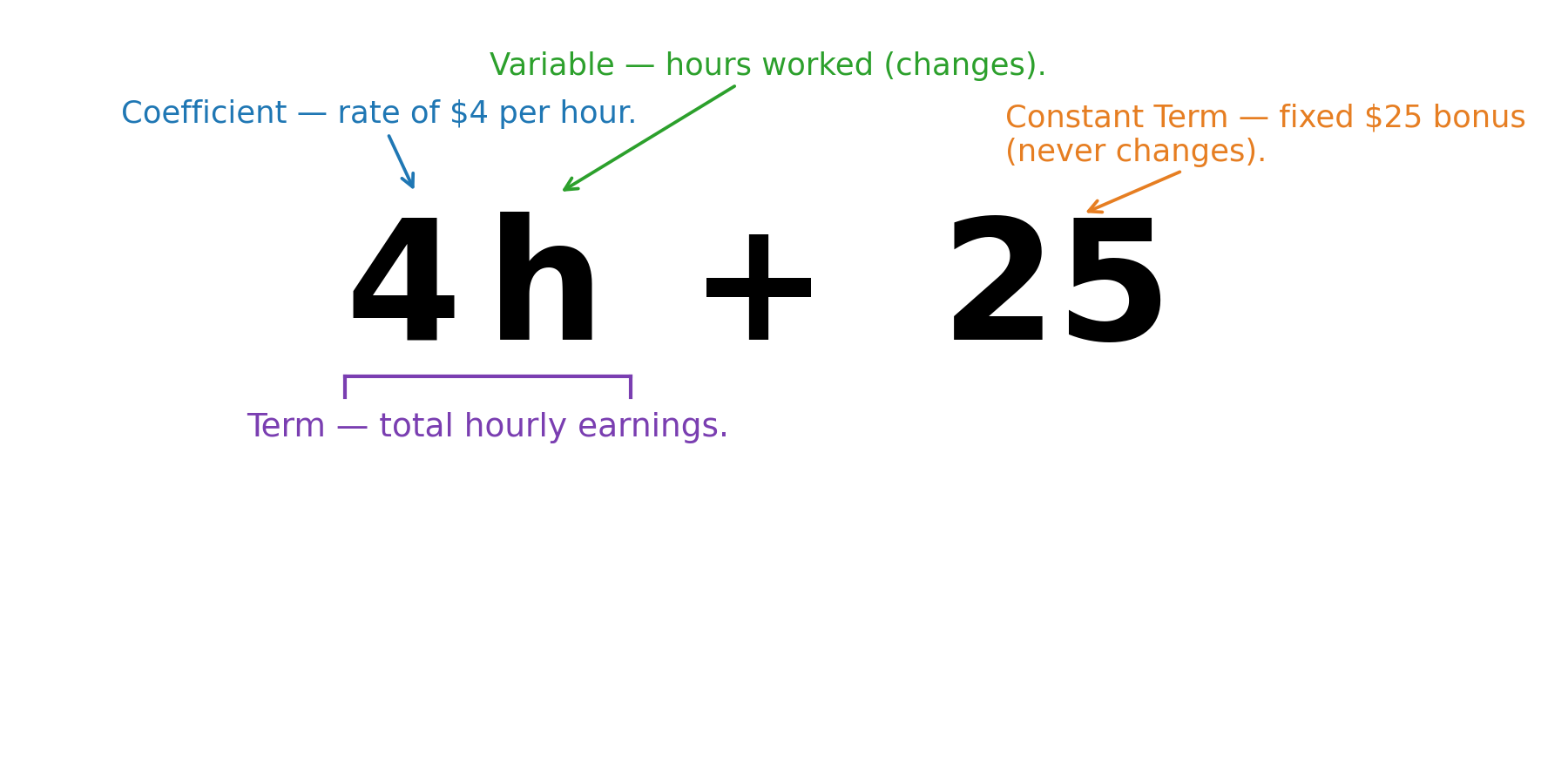
A coefficient is simply the number attached to a variable by multiplication. In , the coefficient is . In an expression like , the variable has no number written in front of it, but there is an invisible , so the coefficient is . This detail trips people up early on, so it is worth remembering: a positive variable standing alone always has a coefficient of 1.
But what if the variable is being subtracted, like in the expression ? The same invisible is there, but the minus sign belongs to the term. Subtracting is exactly the same as subtracting , which means the coefficient of in this case is .
One more edge case to keep in mind: in an expression like , the variable is being divided by . Division by is the same as multiplication by , so the coefficient here is . Spotting coefficients in these disguised forms will come in handy during practice.
Reading an Expression Part by Part 📖
Now that you know the vocabulary, let's practice reading a full expression in context. Consider this situation:
A dog-walking service charges $12 per walk plus a one-time registration fee of $20. Let = the number of walks.
The expression for the total cost is:
Here is how you read it, piece by piece:
- The term — Let's break this into its coefficient and variable. The coefficient represents the price per walk, and represents the number of walks. When they are multiplied together, the term gives you the total cost of all the walks. This is the part of the cost that changes depending on how many walks are booked.
- The constant term — The constant is the one-time registration fee. Because it does not have a variable attached to it, this amount is fixed. It stays exactly the same no matter how many walks you book.
- The full expression — When you add the changing cost () and the fixed cost () together, you get the whole picture. This full expression represents the total amount paid to the dog-walking service for walks.
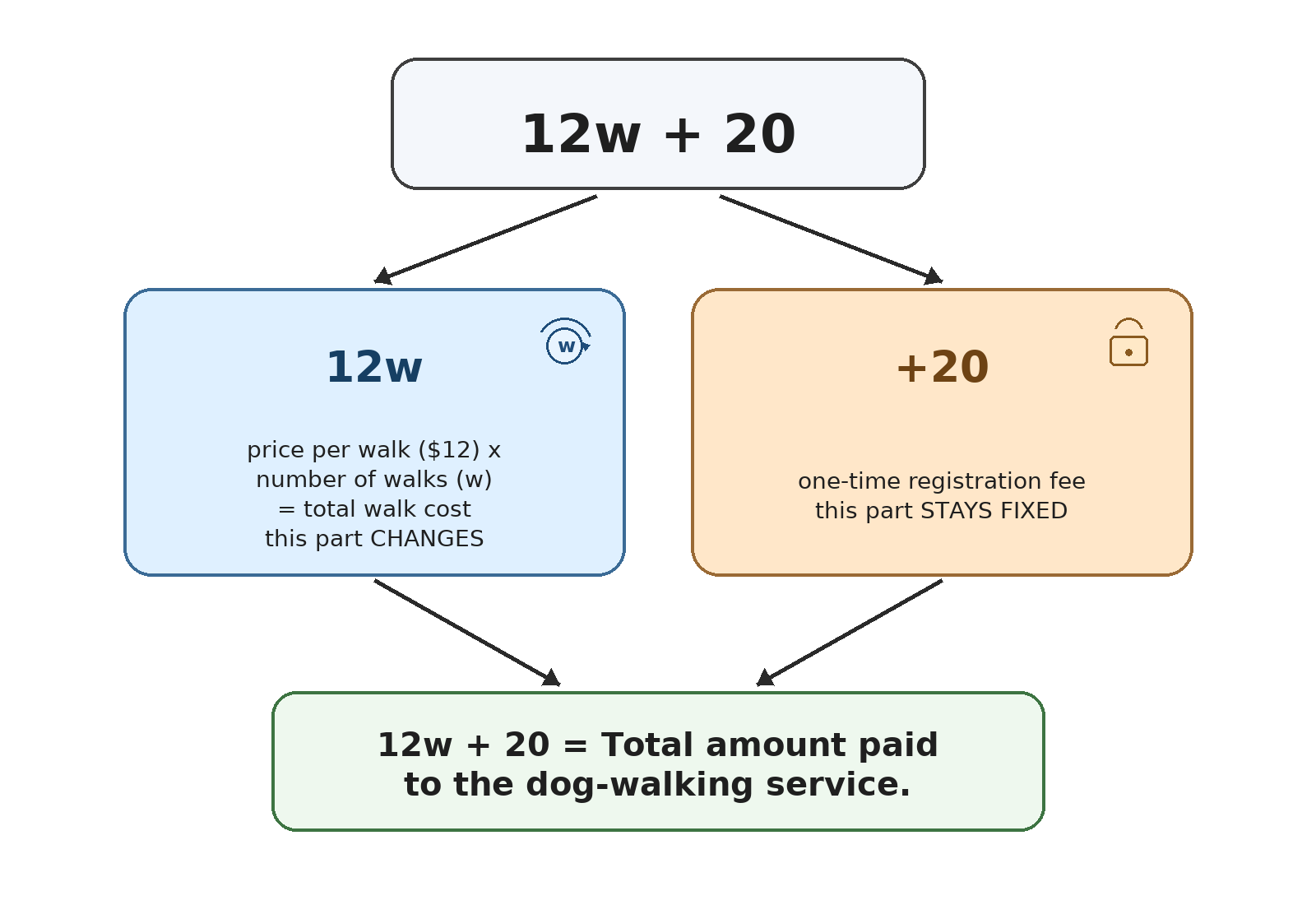
Notice the pattern: you explain each term on its own, then summarize what the whole expression calculates. This "part by part, then the whole" approach works for any expression we encounter.
Same Structure, Different Stories 📚
One of the most important ideas about expressions is that the same structure can mean completely different things depending on context. Let's look at the structure in two different situations.
Note: In the previous lesson, you learned to use descriptive letters like for cupcakes or for questions. However, algebra often uses as a universal, generic placeholder. We are using for both examples here to show you how the exact same written expression can tell completely different stories!
Situation A: A bakery sells cupcakes for $3 each, and there is a $10 delivery fee. Let = the number of cupcakes ordered from the bakery, measured in cupcakes.
Here, means: the total cost of ordering cupcakes with delivery, measured in dollars.
Situation B: A student earns 3 points for every correct answer on a quiz and receives a 10-point bonus for finishing early. Let = the number of correct answers on the quiz, measured in questions.
Here, means: the total quiz score after earning points for correct answers plus the early-finish bonus, measured in points.

The math looks identical, yet the real-world meaning is completely different. This is why context matters so much. An expression without a defined variable and a described situation is like a sentence with no subject — it is grammatically complete but meaningless. This is exactly why we spent time in the previous lesson learning to write highly specific variable definitions. If our definition for was just "cupcakes," we wouldn't know if meant the number of cupcakes or the cost of the cupcakes. By clearly stating exactly what the variable measures and including its units, we ensure the entire expression tells a precise, accurate story.
Describing a Phone Plan in Plain Language ☎️
Let's bring everything together with one more example, from start to finish. Imagine a phone plan that costs $0.10 per text message plus a flat monthly fee of $15. Let = the number of text messages sent in one month.
The expression for the monthly bill is:
You can now describe this in plain language: "Multiply the number of texts sent by $0.10 to get the texting charges, then add the $15 monthly fee. The result is the total monthly phone bill."
For each part, it helps to ask two quick questions:
- What does this piece calculate? ( calculates the total texting charges; is the flat monthly fee.)
- Does this piece change or stay fixed? ( changes with the number of texts; stays the same every month.)
If you can answer both questions for every piece, you truly understand the expression.
Conclusion and Next Steps
In this lesson, you learned how to break an algebraic expression into its building blocks — the variable, coefficient, and constant term — and explain each part in everyday language. You also discovered that the same mathematical structure can tell very different stories depending on the situation it describes. These reading skills are the bridge between abstract symbols and real meaning, and they will carry you through the rest of this course.
Now it is time to put these ideas to the test! In the upcoming practice tasks, you will identify coefficients (including some tricky ones), match expressions to their real-world meanings, and fill in plain-language descriptions. You will even get to play the role of teacher and explain an expression to a friend. Let's jump in and make these concepts your own.
