Differentiate Expressions, Equations, and Inequalities
🎉 Introduction
Welcome back to Make Sense of Expressions and Inequalities! In the previous lessons, you worked with expressions and used them to represent quantities in real situations. Now you are ready for the next step: learning how to tell whether a math statement is an expression, an equation, or an inequality, and what each one means. Specifically, you will be able to:
- Identify whether a mathematical statement is an expression, equation, or inequality by looking for comparison symbols.
- Explain the purpose of each form: an expression describes a quantity, an equation shows an exact value, and an inequality shows a limit or range.
- Match real-world situations to the correct form based on whether the situation describes a quantity, an exact amount, or a boundary.
So far, we have focused entirely on expressions. An expression like tells us what to compute — multiply h by 4, then add 25 — but it never makes a claim about the result. It does not say the result equals something or must stay below something. It simply calculates a quantity and stops there.
In real life, though, we often need to go further. You might need to say that a total is exactly $100, or that a budget must not exceed $500. That is where equations and inequalities enter the picture. Let's explore what makes each of the three forms distinct and when we would reach for one over the others.
Expressions: Describe a Quantity 🔢
An expression is a combination of numbers, variables, and operations that represents a value. It contains no comparison symbol of any kind. Here are a few examples:
Think of an expression as a noun in a sentence. It names a quantity, such as "the total cost" or "the remaining balance," but does not make a complete statement about it. Because an expression has no equals sign and no inequality symbol, it cannot be true or false. It simply is.
Equations: State an Exact Match 🟰
An equation is formed when you take an expression and declare that it equals a specific value or another expression. The defining feature is the equals sign (). For example:
This statement says: "The quantity is exactly 40." That one small symbol changes everything. Unlike an expression, an equation can be true or false depending on the value of the variable. If , then , and the equation is true. If , it is not.
We use equations when a situation calls for an exact target or a known result. For instance, if a store receipt shows a total of $40 and we know the pricing formula is , an equation is the right tool because the total is a precise, fixed number.
Inequalities: Set a Limit 🚧
An inequality looks similar to an equation, but it replaces the equals sign with an inequality symbol. The four common symbols are:
| Symbol | Meaning |
|---|---|
| less than | |
| greater than | |
| less than or equal to | |
| greater than or equal to |
Here is an example using our familiar expression:
This says: "The quantity must be at most 40." Instead of pinning the quantity to one exact number, an inequality sets a boundary. Many values of could make this statement true, not just one.
You can use an inequality when a situation involves a limit, maximum, minimum, or range instead of one exact value. Budget ceilings ("spend no more than $40"), minimum requirements ("score at least 70"), and speed limits ("drive under 65 mph") are all naturally modeled with inequalities.
Seeing All Three Side by Side 📊
Let's put the three forms next to each other using a single scenario. Imagine a food truck sells tacos for $2 each and charges a $5 service fee. If = the number of tacos ordered, then the pricing formula is .
| Form | Example | What It Says |
|---|---|---|
| Expression | The total cost for tacos (no claim about what that cost equals or must be) | |
| Equation | The total cost is exactly $25 | |
| Inequality | The total cost must be at most $25 |
Notice the one thing that changes each time: the symbol (or lack of one) between the expression and the number on the right. That symbol is the fastest way to identify which form we are looking at:
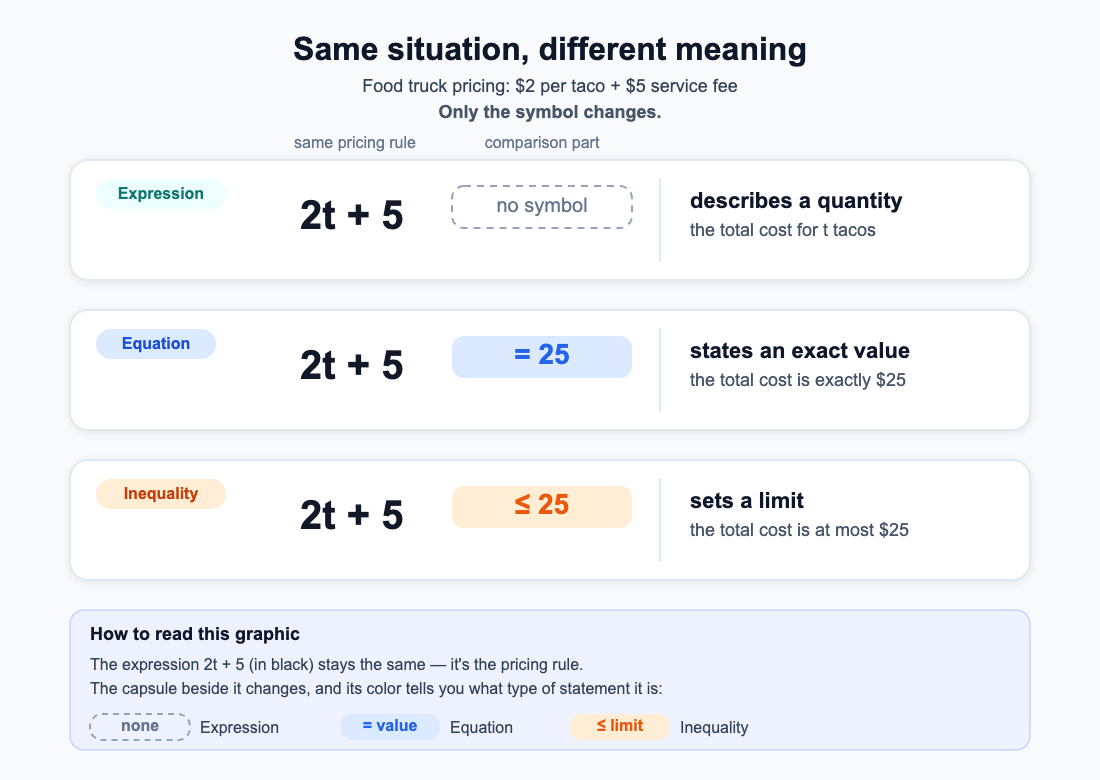
- No comparison symbol → expression
- Equals sign () → equation
- Inequality symbol () → inequality
Why the Difference Matters 💡
Choosing the wrong form can lead to real confusion. Suppose a friend says, "I only have $25 to spend on tacos," and writes:
This equation says the total is $25, not that it must stay at or below $25. If the friend actually wants to keep spending within a budget, the correct statement is . The difference is small on paper but large in meaning: an equation locks in one exact outcome, while an inequality opens up a whole range of acceptable outcomes.
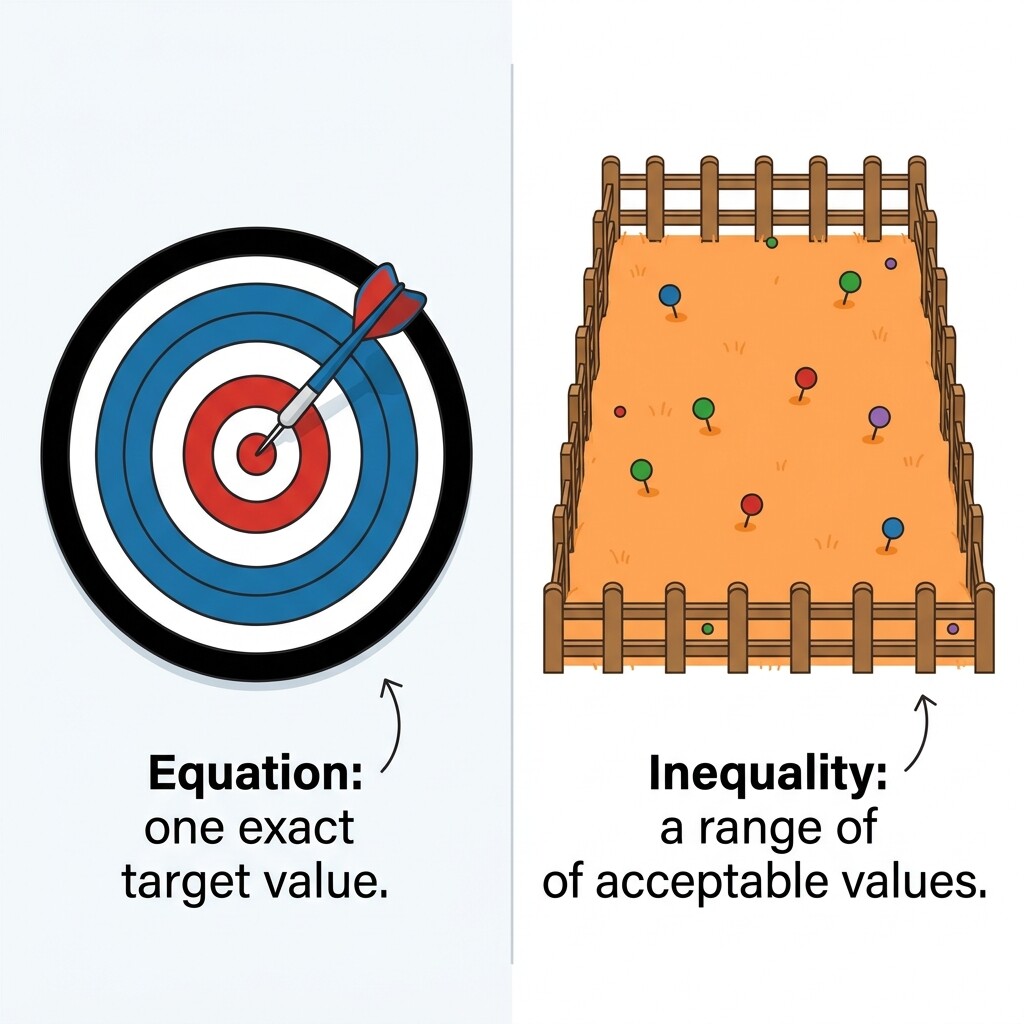
As a quick rule of thumb, listen for the language in a situation:
- Words like "is," "equals," "comes to" point toward an equation.
- Words like "at most," "no more than," "under," "at least," "must exceed" point toward an inequality.
- If no comparison is being made at all, we probably just need an expression.
Conclusion and Next Steps
In this lesson, you learned to distinguish expressions, equations, and inequalities by looking at their symbols and, more importantly, by understanding their purpose. An expression names a quantity, an equation pins that quantity to an exact value, and an inequality sets a boundary around it. Recognizing which form fits a given situation is a skill we will rely on throughout the rest of this course and beyond.
Up next, you will put these ideas into practice with a series of hands-on tasks. You will classify algebraic statements, sort them into categories, complete explanations in your own words, and even correct a friend's reasoning error. These exercises are designed to move you from quick recognition to confident understanding, so let's dive in!
