Decide How to Represent a Situation with Math
🎉 Introduction
Welcome to Decide How to Represent a Situation with Math! In the previous lessons, you learned how to identify variables, read expressions, and recognize whether a written math statement is an expression, an equation, or an inequality. Now you are ready for the next step: looking at an everyday situation and deciding which mathematical tool fits it best — before writing any math. In this lesson, you will learn to:
- Identify the quantity a real-world situation is talking about.
- Decide whether the situation is asking you to describe an amount, match an exact target, or stay within a limit.
- Choose the correct mathematical form — expression, equation, or inequality — based on that purpose.
Choosing the right form matters because each one communicates something different. An expression describes a quantity, an equation matches it to an exact value, and an inequality places it within a boundary. If you choose the wrong form, you change the meaning of the situation — for example, making a flexible budget look fixed. Starting with the right form makes the math clearer and more accurate.
Three Purposes, Three Tools 🧰
The key to making this decision is to focus on purpose. Before worrying about numbers, variables, or symbols, ask yourself what the situation is trying to do with the quantity. Is it simply describing an amount? Is it saying the amount should be exactly equal to a certain value? Or is it placing a limit on the amount, such as staying under, over, at least, or no more than?
Every situation that calls for math usually fits one of these three purposes. If the goal is to describe an amount, you can use an expression. If the goal is to match the amount to an exact target, use an equation. If the goal is to keep the amount within a boundary, you'll use an inequality. Once you understand the purpose of the situation, choosing the right mathematical tool becomes much easier.
| Purpose of the Situation | Tool to Use | Signal Phrases to Listen For |
|---|---|---|
| Quantify an amount | Expression | "How much is …?" "What is the total?" "Find the cost of …" |
| Assert equality with a target | Equation | "… is exactly," "… equals," "… comes out to" |
| Restrict an amount within a limit | Inequality | "… must stay under," "… at least," "… no more than" |
The One Question to Ask ❓
Before choosing a tool, pause and ask yourself one question:
"Is this situation asking me to describe an amount, match an exact target, or stay within a limit?"
That single question will guide your choice almost every time. Let's walk through three quick examples from everyday life to see it in action.
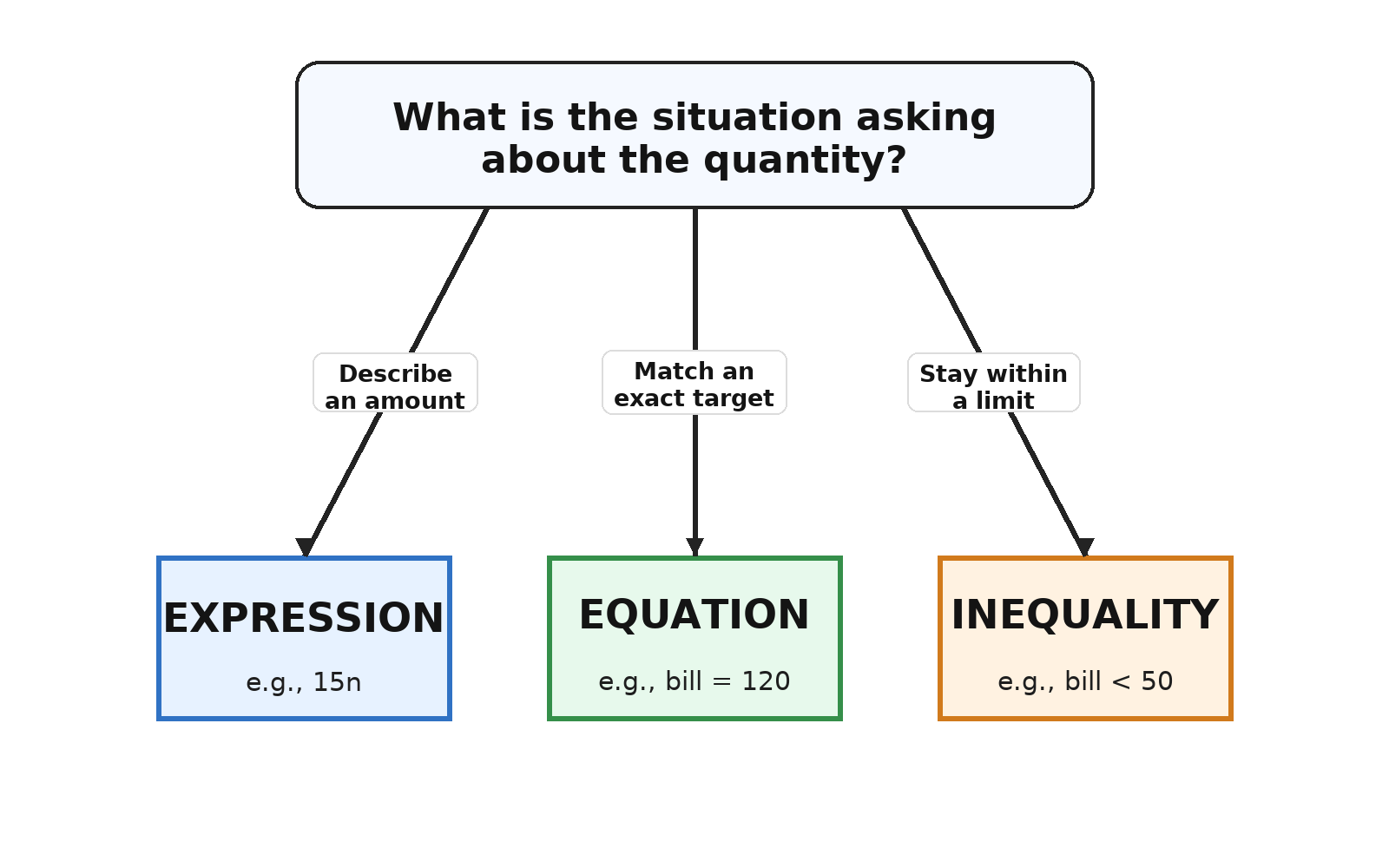
Example 1 — Streaming subscriptions. "I want to know how much I will pay for streaming subscriptions at $15 each." Here you are asked to describe an amount. No target is mentioned, and no limit is set. The right tool is an expression (something like ).
Example 2 — Grocery budget. "I need my weekly grocery bill to come out to exactly $120." The phrase "come out to exactly" signals an exact target. The right tool is an equation.
Example 3 — Phone bill. "I must keep my monthly phone bill under $50." The word "under" sets a limit, not an exact value. The right tool is an inequality.
Real descriptions are not always as tidy as these textbook examples. Here are a few adult-life situations with slightly messier wording, along with the reasoning behind each choice.
- "I'm trying to figure out my take-home pay after taxes and insurance are deducted." — There is no target and no limit. You simply want to quantify the remaining pay. → Expression
- "We promised the landlord we would split the rent evenly so each roommate pays exactly $750." — The word "exactly" points to a precise value each share must equal. → Equation
- "The event room can hold at most 200 guests, and we have already confirmed 120." — The phrase "at most" sets a ceiling on the guest count. You need to restrict the remaining invitations. → Inequality
- "I want to save enough this year so that my savings account has exactly $5,000 by December." — The word "exactly" a specific number acts as an exact target. → Equation
In each case, the formula itself does not matter yet. What matters is recognizing the job the situation is asking math to do.
Watch for Tricky Wording ⚠️
Some situations can fool us because the wording feels similar on the surface. Paying close attention to small differences in phrasing prevents a wrong choice. Consider three sentences that all mention "total trip cost":
- "I want to know my total trip cost." → No target, no limit. Expression.
- "I want my total trip cost to be $500." → Exact target. Equation.
- "I want my total trip cost to stay under $500." → Upper limit. Inequality.
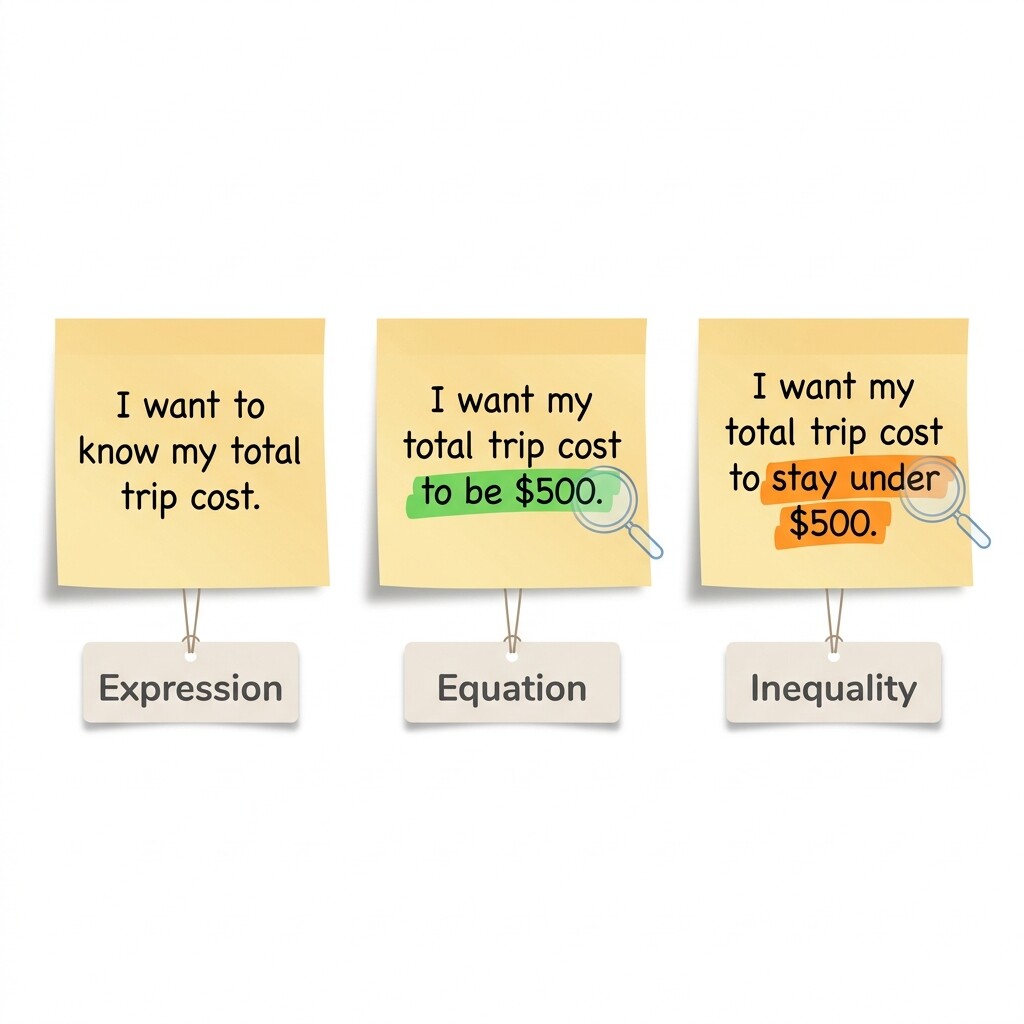
All three sentences talk about the same quantity, yet each one calls for a different tool. The deciding factor is never the quantity itself but what the sentence says about that quantity. If it only names the quantity, you need an expression. If it pins the quantity to a number, you need an equation. If it caps or floors the quantity, you need an inequality.
Your Three-Step Decision Checklist ✅
Let's consolidate the decision process into a simple checklist you can carry forward into any new situation:
- Identify the quantity. What is being measured or calculated?
- Read the intent. Is the situation asking you to describe, match, or restrict that quantity?
- Choose the tool. Describe → Expression. Match an exact value → Equation. Set a limit or boundary → Inequality.
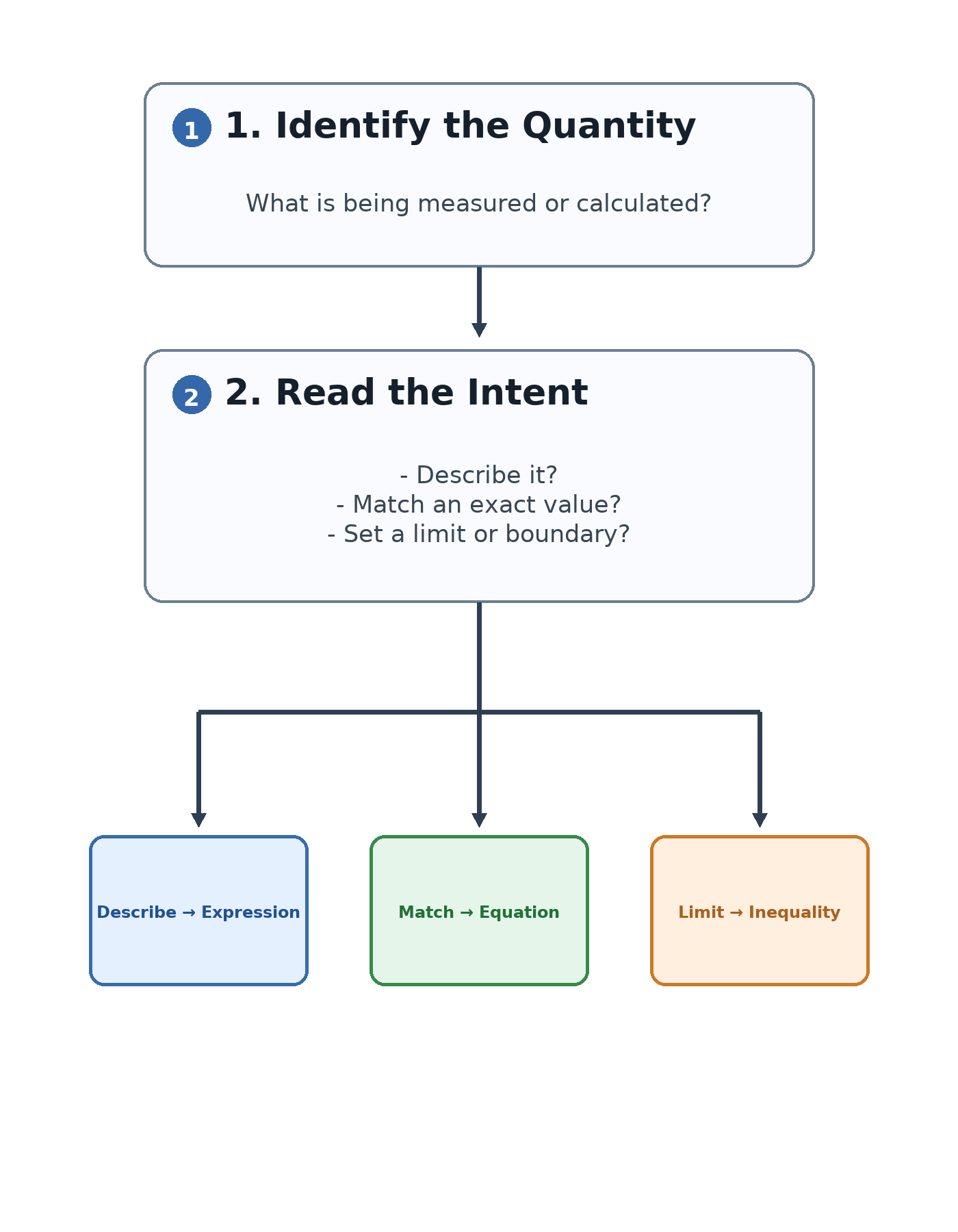
That is the entire framework. It may feel straightforward, and that is the point. A simple process gives you something reliable to return to every time you meet a new situation. Instead of guessing based on a few familiar words, you can slow down, identify the quantity, think about the intent, and choose the form that matches. This clear, repeatable approach helps reduce mistakes, builds confidence, and makes the next step — actually writing the math — much easier when situations become more detailed or less familiar.
Conclusion and Next Steps
In this lesson, you learned to read a real-world situation and decide whether it calls for an expression, an equation, or an inequality by asking one question: does this situation ask me to describe an amount, match a target, or stay within a limit? Combined with the skills from the first three lessons, this decision-making ability gives you a complete foundation for representing everyday situations with math.
Now it is time to put that foundation to the test. Up next, you will work through a set of hands-on practice tasks where you classify situations, sort them into categories, explain your reasoning in your own words, and even help a friend fix a common mistake. These exercises are your chance to turn understanding into confidence, so jump in and show what you have learned!
