Identify What Changes
🎉 Introduction
Welcome to Make Sense of Expressions and Inequalities, and congratulations on taking the first step in this course! This is the first lesson out of four, so you are right at the beginning of your journey into the world of pre-algebra! In this lesson, you will learn how to look at an everyday situation, spot the quantity that changes, and represent it with a clearly defined variable. This skill is the foundation for everything else we will build together. By the end, you will be able to:
- Distinguish fixed quantities from varying quantities in everyday situations.
- Identify the quantity that changes and choose a variable letter to represent it.
- Write a clear variable definition that states what the variable represents and includes its units.
Let's think about something we all do naturally. When you glance at a grocery receipt, you instinctively know that the store's name at the top never changes, but the total at the bottom depends on what you bought. In daily life, you constantly separate things that stay the same from things that shift.
Once you can pinpoint what is changing in a situation, you can describe the entire pattern in a compact, reusable way. That is exactly the skill you are building in this lesson.
Fixed Quantities vs. Varying Quantities 🔒
Every real-world situation contains quantities, and these quantities fall into two camps:
- Fixed (constant) quantities stay the same within the situation. For example, a monthly subscription fee of $15 does not depend on how much you use the service.
- Varying (changing) quantities can take on different values. The number of extra gigabytes of data you use each month, for instance, is different from one month to the next.
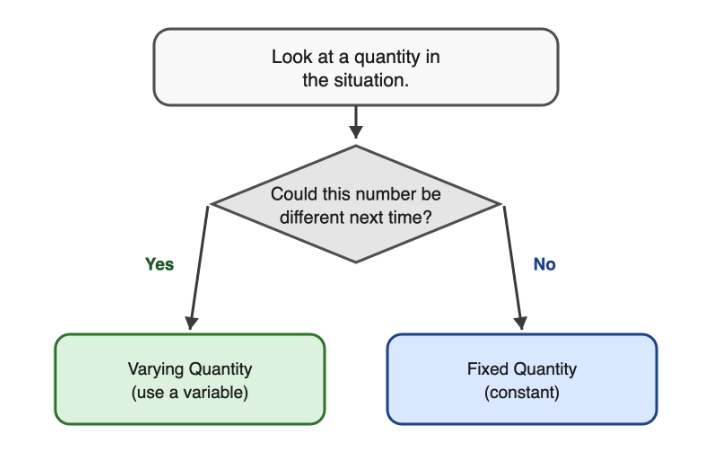
A helpful question to ask yourself is: "Could this number be different next time?" If the answer is yes, you are looking at a varying quantity.
What Is a Variable? ✏️
Once you spot a quantity that changes, you need a way to talk about it before you know its exact value. That is exactly what a variable is: a letter that stands in for a quantity whose value can change or is not yet known. For example, if the number of hours you work this week could be anything from 0 to 40, you might let the letter represent that number.
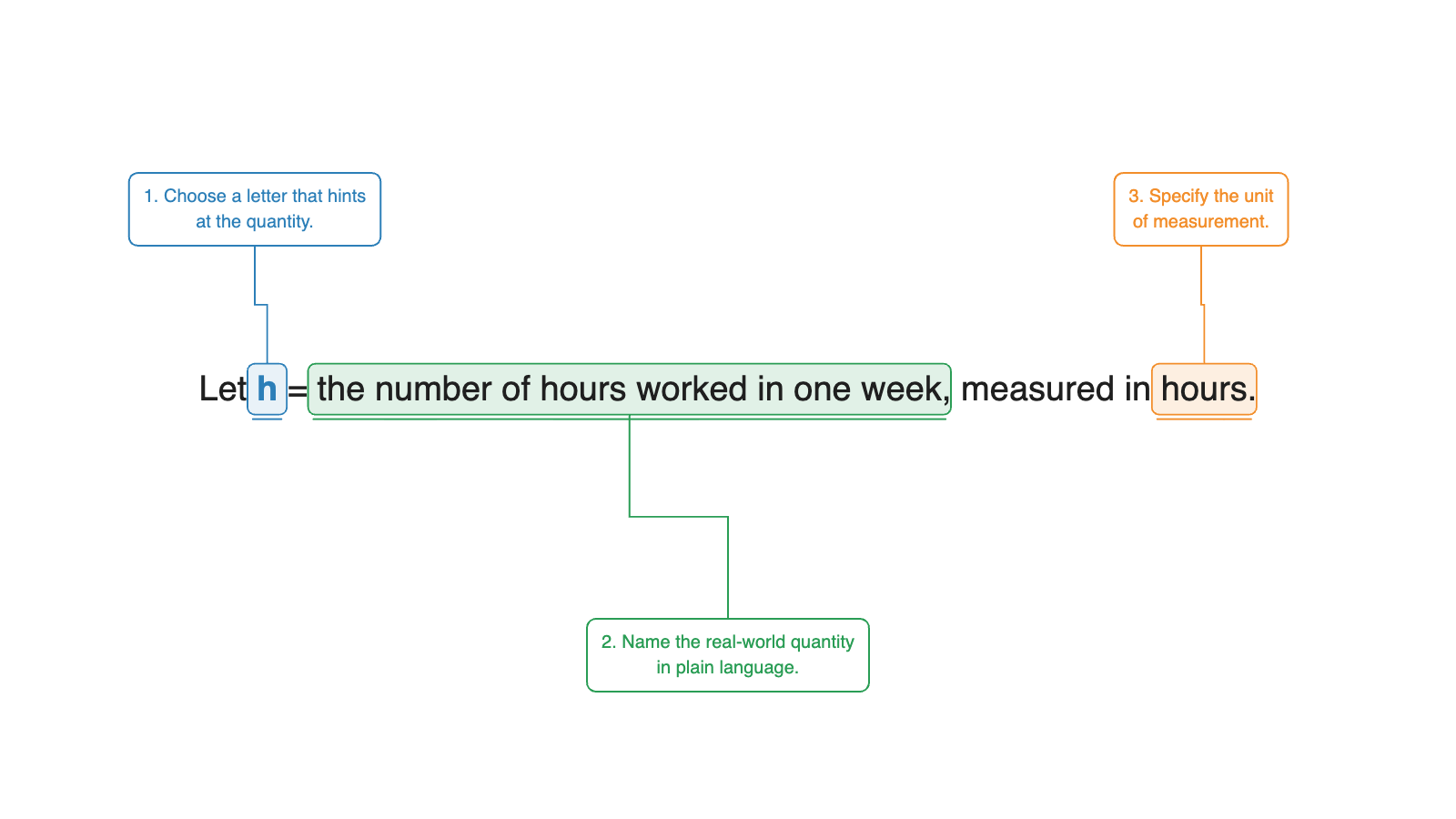
But choosing a letter is only part of the job. A well-defined variable should also make clear what real-world quantity it represents and what units are being used. In other words, a strong variable definition answers three questions at once:
- Which letter? Pick a letter that reminds you of the quantity (like for hours or for distance).
- What does it represent? State the real-world meaning in plain language.
- What units? Specify the unit of measurement so there is no confusion.
Here is a template that ties all three together:
Let = the number of hours worked in one week, measured in hours.
Compare that with a vague version: "Let = work stuff." The vague version leaves us guessing. Does mean hours? Days? Dollars earned? A clear definition removes all doubt.
Seeing It in Action 🎬
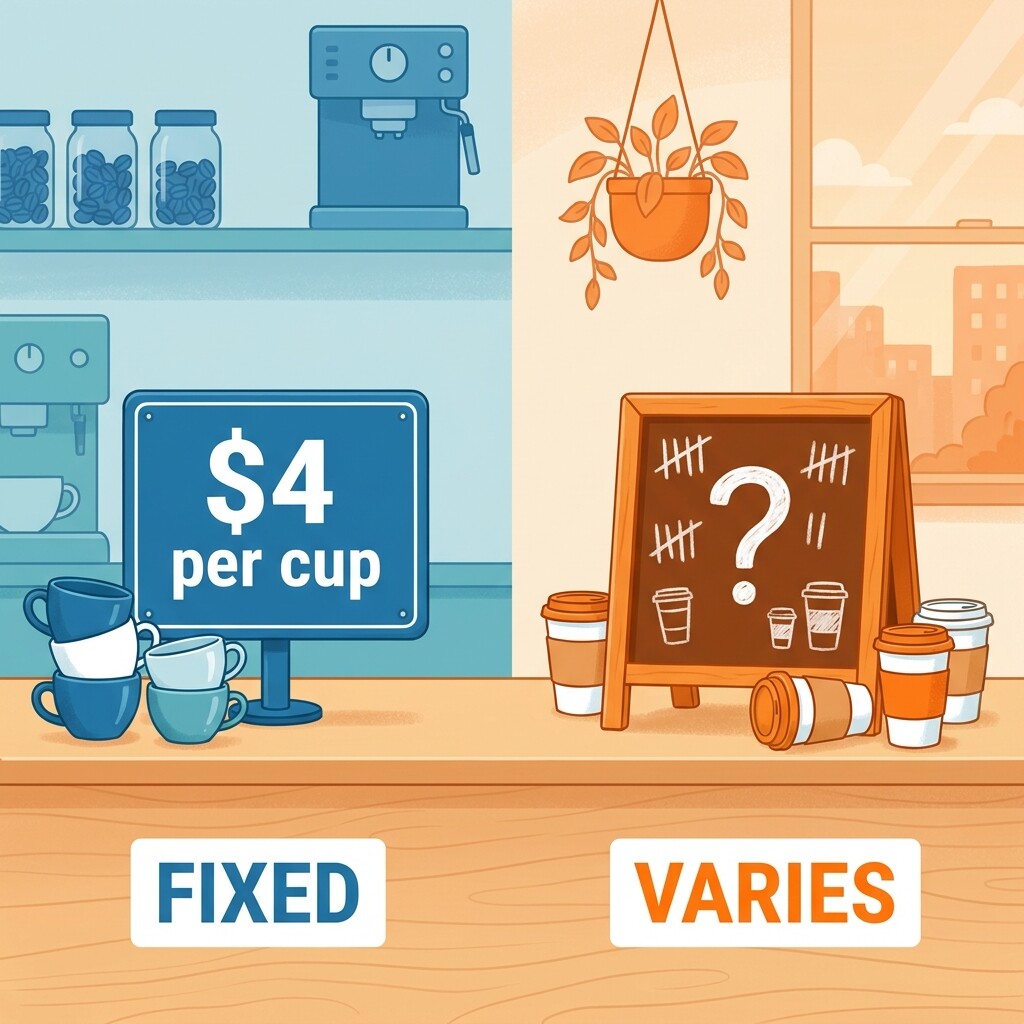
Now let's put your new skills to work with a concrete scenario. Imagine you are tracking your weekly spending on coffee. Every week you buy a different number of cups, and each cup costs $4.
| Quantity | Fixed or Varying? |
|---|---|
| Price per cup ($4) | Fixed |
| Number of cups bought this week | Varying |
Since the number of cups changes from week to week, that is the varying quantity. You can define the variable like this:
Let = the number of cups of coffee purchased in one week, measured in cups.
With this definition in hand, the weekly coffee cost can be written as the expression , where is the fixed price per cup and captures the part that changes. Notice how every piece of the expression connects back to something real.
Watch Out for Vague Definitions 👀
One of the most common early mistakes is writing something like "Let = coffee" or "Let = money." These definitions are incomplete because they do not tell us what about coffee or money you are measuring, nor do they specify units.
Always aim for the full pattern:
Let letter = the specific quantity described in plain language, measured in units.
Here is a quick comparison to see the difference:
| Vague Definition | Clear Definition |
|---|---|
| Let = coffee | Let = the number of cups of coffee purchased in one week, measured in cups |
| Let = money | Let = the amount of money spent on groceries this month, measured in dollars |
| Let = travel | Let = the time spent commuting to work each day, measured in minutes |
If someone else can read your definition and understand exactly what the variable counts or measures, you have done it right.
Conclusion and Next Steps
In this lesson, you learned how to scan a real-world situation for the quantity that changes, assign it a meaningful variable letter, and write a clear definition that includes the quantity's name and units. These three small steps may seem simple, but they set the stage for every expression, equation, and inequality you will encounter later in this course.
Up next, you will put these ideas into action with a set of hands-on practice tasks. You will sort fixed and varying quantities, fill in variable-definition templates, and even critique a vague definition to make it better, so get ready to roll up your sleeves!
