Make the Final Decision Responsibly
Make the Final Decision Responsibly
After systematically evaluating your options against clear criteria and understanding the trade-offs involved, you've reached the moment of truth—making the actual decision. This critical juncture requires more than just picking the highest-scoring option from your analysis. Making decisions responsibly means understanding who should make the call, articulating your reasoning transparently, and anticipating how your choice will ripple through your group or community. The way you approach this final step often determines whether your decision gains support, creates lasting value, or becomes another well-intentioned idea that never quite takes hold.
Throughout this lesson, you'll learn to match decision authority to the situation at hand, ensuring that choices get made at the right level with appropriate input. You'll discover how to explain your reasoning in ways that build confidence and understanding, even among those who might have preferred a different outcome. Finally, you'll learn to anticipate and prepare for the impacts your decision will create, turning potential surprises into managed expectations.
Decide at the Right Level of Autonomy
Not every decision belongs to the same person or requires the same process. The art of responsible decision-making begins with recognizing which decisions you should make alone, which require collaboration, and which you should delegate entirely. Getting this wrong creates bottlenecks, frustration, and missed opportunities—while getting it right accelerates progress and develops capability throughout your group.
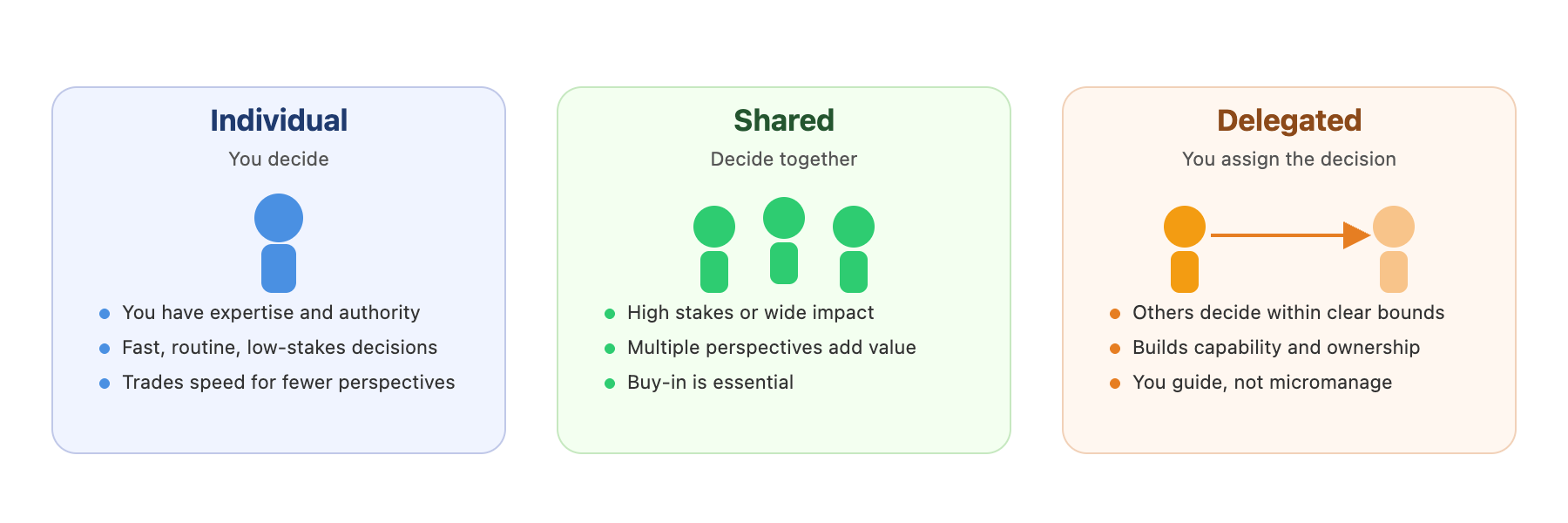
Choosing the right level requires asking yourself several key questions such as:
- "Who has the most relevant expertise for this decision?"
- "Who will be most affected by this choice?"
- "What's the cost of delay versus the value of additional input?"
- "What decision rights have already been established?"
Consider how this might play out when deciding on a new tool or process for your group. Here's how a conversation between two people might unfold:
- Jessica: I've been researching some new tools, and I think I'll just go ahead and set one up for everyone.
- Ryan: Hold on, Jessica. How many people would be using this tool?
- Jessica: Well, it would be for my group initially, but ideally all four teams would use it eventually—maybe 45 people total.
- Ryan: That's a significant change. Have you checked with anyone about compatibility or with the other team leads about their specific needs?
- Jessica: I figured since I have the authority and I've used this tool before, I could just make the call.
- Ryan: Given the scope, this sounds like a shared decision. You could lead it, but you'll need input from others on technical feasibility and from the team leads on their requirements. Otherwise, you might face resistance later.
Notice how this dialogue demonstrates the shift from thinking about a decision as individual to recognizing it as shared. Jessica initially focused on her authority and expertise, but Ryan helped her see the broader implications that require collaborative input.
The level of autonomy also shifts based on context and situation urgency. During a crisis, decisions that would normally be shared might temporarily become individual to enable rapid response. Conversely, during periods of significant change, you might involve more people in decisions that would typically be yours alone to build understanding and commitment. The key is making these shifts explicit rather than leaving others guessing about how decisions will be made.
Explain the Reasoning Behind the Chosen Path
Once you've made your decision, it's time to help others understand not just what you've decided, but why this path makes sense. Start by connecting your decision back to the original problem or opportunity. People need to understand what you were trying to solve before they can appreciate your solution. Frame your reasoning as a story that moves from challenge to resolution. Instead of simply announcing "We're switching to Option B", provide the context that tells the full story.
Your explanation should explicitly reference the criteria and method you used to evaluate options. This demonstrates that your decision wasn't impulsive but followed a thoughtful process. Share enough detail to show rigor without overwhelming your audience with every analytical step. You might explain: "We used weighted scoring across four criteria that everyone agreed upon. While Option A scored highest on innovation, Option C better balanced all our priorities, especially our critical need for reliability".
When explaining your reasoning, anticipate and address likely concerns proactively. If you know some people wanted a different option, acknowledge their perspective and explain why you ultimately chose differently: "I know several of you favored the premium option for its advanced features. Those features are impressive, but our analysis showed we wouldn't use most of them for at least eighteen months, and we need a solution that delivers value immediately".
Your tone in explaining the decision shapes how it's received. Express confidence without arrogance, acknowledging that while you've made the best decision possible with available information, you remain open to learning as you implement your decision.
Consider Potential Impacts Before Finalizing
Before cementing your decision, responsible decision-makers pause to think through the ripple effects their choice will create. This isn't about second-guessing yourself or paralysis by analysis, but rather ensuring you're prepared for what comes next and haven't overlooked critical consequences. By systematically considering impacts, you can refine your decision, prepare mitigation strategies, and set realistic expectations.
Begin by mapping key player impacts—understanding how different groups or individuals will be affected by your choice. Some impacts are obvious, like how selecting a new tool affects those who use it daily. Others are subtle, like how changing meeting schedules impacts people with other commitments. For each key group, consider how this decision changes their daily activities, what benefits they'll experience, what challenges or frustrations might arise, and what support they'll need to adapt successfully.
Resource implications extend well beyond the obvious costs of actioning a decision. It might require time from specific people, change or disrupt existing systems, or demand new skills from your group. Ask yourself whether you have the capacity to implement this properly, what other activities might need to slow down to accommodate this change, and what hidden costs or resource needs might emerge down the line.
Additionally, don't forget to consider cultural and emotional impacts. Decisions that seem purely practical often carry symbolic weight. These soft impacts are often harder to quantify but can determine whether your technically correct decision succeeds in practice. Consider what message this decision sends about your values, how it might affect trust and relationships, and what norms you're reinforcing or challenging.
Once you've identified potential impacts, develop strategies to address the most significant risks or negative effects. If your decision will create additional workload for a particular group, perhaps you can provide temporary support or adjust other priorities. If it might cause confusion, consider phasing implementation or providing extra communication. Having these mitigation strategies ready demonstrates thoughtfulness and increases confidence in your decision.
You've now learned how to make final decisions with the responsibility and transparency they deserve. In your upcoming exercises, you'll practice communicating a decision to someone who wants to understand your reasoning, helping you develop the skill of explaining not just what you decided but why it makes sense. This practice will prepare you for those crucial moments when your ability to articulate decisions clearly determines whether others embrace or resist the path forward.
