Evaluating Options with Structure and Logic
Evaluate Options with Structure and Logic
Now that you've established clear success criteria and chosen your decision-making method, it's time to put that framework into action. The evaluation phase transforms your preparation into insights, systematically revealing which option best serves your goals. Throughout this lesson, you'll discover how to move beyond surface-level comparisons and instead conduct evaluations that uncover hidden complexities, expose critical trade-offs, and connect your choices to the bigger picture.
The difference between casual and effective decision-making often lies in this evaluation step. Where some rely on gut reactions or focus on the most obvious benefits, a structured approach ensures every option receives fair consideration. You'll learn to compare choices against your established criteria, surface risks that others might miss, and test your options against real-world constraints. This systematic approach doesn't eliminate judgment—it sharpens it, helping you make decisions that stand up to scrutiny long after they're made.
Compare Options Using Agreed-Upon Criteria
The criteria you established earlier now become your evaluation engine. Rather than getting lost in endless debates about subjective preferences, you can anchor every discussion to the specific standards you've already agreed matter most. This disciplined approach prevents the common trap of letting an option's most attractive feature overshadow its fundamental weaknesses.
Creating a consistent structure for comparison forms the foundation of effective evaluation. When using a weighted scoring model, for instance, you'll want to score each option against every criterion using the same scale—perhaps 1 to 5, where 1 means "fails to meet the criterion" and 5 means "exceeds expectations". The key is maintaining objectivity throughout the process. When evaluating "integration capabilities", don't let your enthusiasm for one aspect influence how you score another.
Consider how this structured comparison might unfold when choosing between three options for a group project. Your criteria include "relevant experience" weighted at 30%, "creativity" at 20%, "organization skills" at 25%, and "availability" at 25%. Option A scores a perfect 5 on relevant experience since they've completed similar projects before. However, they score only a 2 on availability, as they have limited free time. Meanwhile, Option B offers moderate scores across all criteria—nothing spectacular, but no glaring weaknesses either. Option C excels in creativity and availability but has limited experience in the subject.
Without this structured comparison, you might gravitate toward Option A because their experience feels most impressive, or toward Option C because their creativity stands out. The weighted scoring reveals something surprising: Option B, despite lacking any standout strength, actually delivers the best overall fit when all factors are considered together. This systematic evaluation protects you from letting one positive or negative trait dominate your decision.
Here's how this evaluation process might sound in practice:
- Ryan: I'm really impressed with Option A's experience. They've done this kind of project before—shouldn't we just go with them?
- Jessica: Hold on, let's score them against all our criteria first. Yes, they get a 5 for relevant experience, but what about availability?
- Ryan: Well, they have limited time, so that's probably a 2. But their experience is worth it, right?
- Jessica: That's exactly why we weight the criteria. Availability is 25% of our decision, not 100%. Let's score all three options completely before deciding.
- Ryan: You're right. Option C has that amazing creativity, but they score only a 2 on experience. When I calculate the weighted scores, Option B actually comes out ahead.
- Jessica: Exactly! And let's document why we gave each score. For Option A's organization skills, I'm noting "Strong planner but has a busy schedule".
Notice how the structured approach prevented Ryan from making a decision based solely on one impressive feature. The dialogue also demonstrates the importance of documenting rationale—these notes prove invaluable when you need to explain your evaluation to others or revisit your decision months later. They transform abstract scores into concrete observations that others can understand and verify.
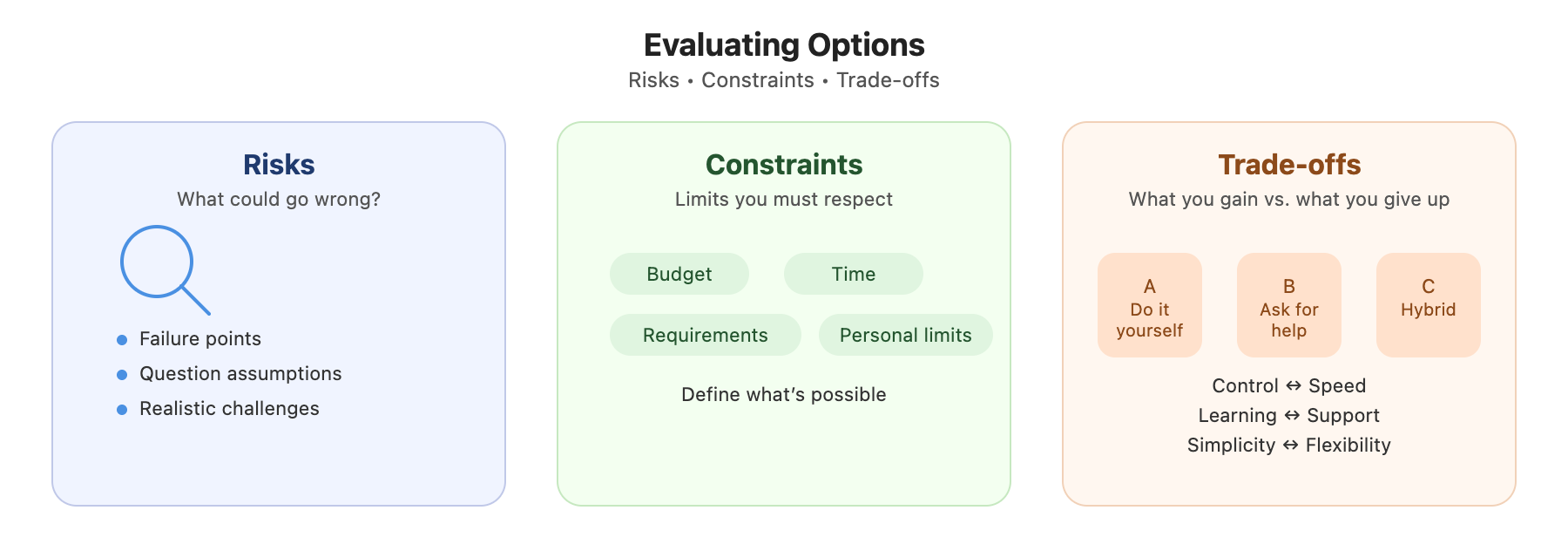
Identify Key Risks, Constraints, and Trade-offs
Every option carries hidden complexities that only emerge through deliberate analysis. While comparing options against criteria tells you how well each performs, examining risks, constraints, and trade-offs reveals what could go wrong and what you're sacrificing with each choice. This deeper layer of evaluation often determines whether a decision succeeds or fails in practice.
Test Potential Solutions Against the Broader Context
The best option in isolation might prove problematic when placed in your actual environment. Testing solutions against the broader context ensures your decision works not just on paper but within the complex reality of your situation, resources, and goals. This final evaluation step often reveals surprising insights that change which option makes the most sense.
Begin by examining fit, or how each option aligns with your current skills, resources, and ongoing commitments. An option requiring extensive collaboration might excel in theory but fail if your group has limited time to meet.
Furthermore, timing and sequencing factors can dramatically influence which option makes sense. The context surrounding your decision includes what happened before and what's coming next, creating a temporal dimension to your evaluation. An option that would be perfect in six months might be premature today, while another might lose its effectiveness if delayed.
Environmental factors add another layer to contextual testing. Changes in your schedule, unexpected events, or shifting priorities all influence which option makes sense at any given time. A bold choice might be perfect when you have lots of free time but risky during a busy period. A cautious approach that seems overly safe in calm times might prove wise when things are uncertain. Testing against context means asking "Given everything happening around me, does this still make sense?" and being honest about the answer.
You've now learned how to systematically evaluate options using structure and logic rather than instinct alone. In your upcoming exercises, you'll practice walking through this evaluation process with a peer, scoring options against criteria and identifying crucial trade-offs that might otherwise go unnoticed. This hands-on practice will help you internalize these evaluation techniques so they become second nature in your daily decision-making.
