Before a Meeting, Tell Your Team That Silence Denotes Agreement
Discover Why People May Not Speak Up in Meetings 🤫
Understanding why people remain silent in meetings is essential for any manager who wants to achieve real consensus. Most managers assume that when they directly ask "Does anyone have concerns?" or "What does everyone think?", team members will respond candidly. However, as Bob Frisch and Cary Greene explain in the HBR Guide to Making Every Meeting Matter, organizational dynamics create powerful forces that keep people quiet even when they have valuable input or serious reservations.
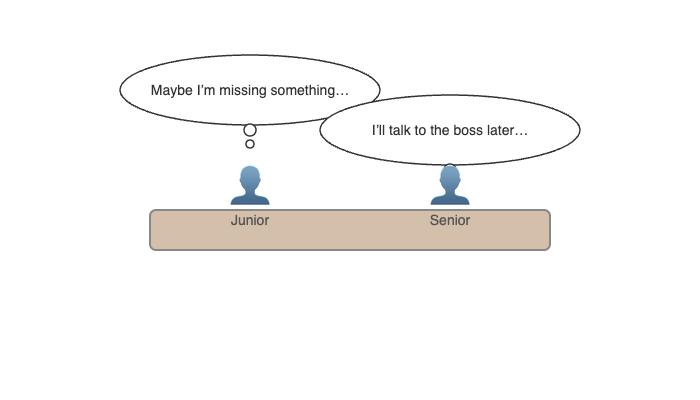
Junior team members often hesitate to disagree with bosses or senior colleagues, sometimes out of deference to authority or uncertainty about whether their input is welcome. They may worry that speaking up will be seen as challenging the group or the leader, so they remain silent, telling themselves "Maybe I'm missing something" or "They must have already thought of this."
In contrast, more powerful team members operate from a different calculation by bringing up issues offline to decision makers. These senior members think "I'll just talk to the boss after the meeting" or "I'll handle this through my network." They see no need to voice concerns publicly when they have private channels of influence. This creates a particularly insidious dynamic where the most influential voices save their real opinions for corridor conversations, undermining decisions that seemed to have broad support.
The combination of these dynamics creates meetings where genuine agreement is impossible to distinguish from polite silence. Everyone nods along, no one objects, and the manager leaves believing they have consensus. "If you get unanimous, but mostly unvoiced, support for a decision that you thought might be contentious, it should be a warning sign." This is why it’s so important to address the underlying reasons for silence before assuming that a lack of objections means true agreement.
Implement the "Silence Denotes Agreement" Rule ✅
So, how can you prevent this from happening while encouraging team members to speak up? By establishing a rule: silence denotes agreement. This rule makes it clear that if someone doesn't speak up when given the opportunity, they're voting "yes" for the proposal. There's no neutral position, no abstaining, and no revisiting the decision after the meeting ends. To implement it, state explicitly: "If you don't voice your concerns or objections during this meeting when asked, you're agreeing to support this decision. Silence means yes." Then, consistently enforce it—even when it creates uncomfortable moments.
For example:
- Ryan: Victoria, I’ve been thinking about the vendor selection from Tuesday. I have some concerns.
- Victoria: We discussed it at length, and I asked several times if there were any concerns. You didn’t raise any.
- Ryan: I needed more time to think.
- Victoria: I understand, but we agreed that silence means agreement. The decision stands. Next time, please share your thoughts during the meeting.
Notice how Victoria remains professional but firm. If you reverse the decision now, the rule loses all credibility.
Expect some pushback at first—people may claim they didn’t understand or needed more time. Stand firm: only genuinely new information that wasn’t available during the meeting should prompt reconsideration.
Equally important is creating space for concerns during the meeting. Pause after proposals, explicitly ask for objections, and watch for nonverbal cues. If someone seems hesitant, say: "Iman, you look like you might have a concern. Remember, if you don't share it now, we're considering you in agreement." This helps quieter team members find their voice.
Encouraging Constructive Participation 🙌
Even with the silence denotes agreement rule in place, some team members will struggle to voice concerns publicly. There are several techniques that create safer channels for feedback while still maintaining the principle that concerns must be raised during the meeting, not after.
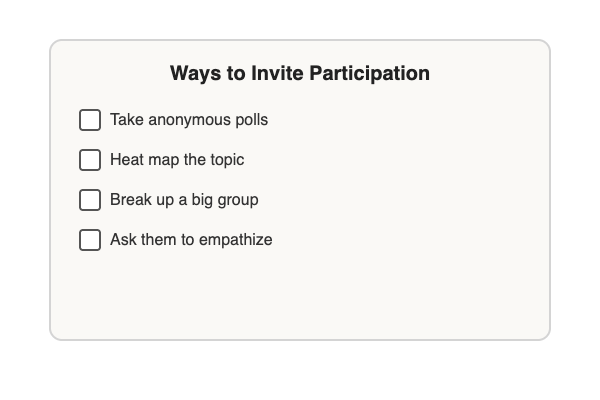
Anonymous polling transforms controversial topics into data discussions. Instead of asking "Who disagrees with this proposal?" which requires public dissent, you can poll the team: "On a scale of 1-10, how confident are you this solution will work?" When the results show that confidence averages only 6 out of 10, you've surfaced doubt without forcing anyone to be the dissenter. You can then explore what would increase confidence levels, turning potential conflict into collaborative problem-solving.
Heat mapping provides a visual way for people to express concerns without verbal confrontation. By placing proposal components on charts and giving team members colored dots—yellow for questions, red for significant concerns—you create an immediate visual representation of where issues lie.
When dealing with larger groups, breaking them into smaller units unleashes honest discussion that gets suppressed in bigger settings. Divide your team into groups of three or four with specific prompts such as "What could go wrong with this plan?" or "What concerns might your team have?" Small groups feel safer for sharing doubts, and when each group reports back, concerns are presented as group findings rather than individual objections.
Perhaps the most powerful technique is the empathy approach. Instead of asking "What are your concerns?" ask "What objections do you think our stakeholders might have?" or "What might worry our implementation team?" This reframing allows people to voice concerns without owning them personally. A team member can say "I think the developers might worry about the timeline" instead of "I'm worried about the timeline." The concerns get surfaced either way, but the psychological safety increases dramatically.
Now that you've learned how to address hidden silence and implement the "silence denotes agreement" rule, you'll have the opportunity to apply these techniques in realistic scenarios. In the upcoming tasks, you'll practice establishing this rule, using feedback methods that encourage honest participation, and navigating situations where someone tries to revisit a decision after the meeting has ended.
