Dealing with People Who Derail Meetings
Dealing with People Who Derail Meetings 🚧
You’ve just established the “silence denotes agreement” rule to encourage participation. But what happens when someone does speak up—and takes the conversation off track? As highlighted in the HBR Guide to Making Every Meeting Matter, Roger Schwarz offers practical techniques for managing these moments without shutting down valuable contributions. The real challenge isn’t just getting people back on track; it’s recognizing that what seems like a derailment might actually be a crucial connection you’re missing. In this lesson, you’ll learn how to approach these situations with curiosity instead of frustration, turning potential disruptions into productive discussions.
Agree on the Track and Check Readiness Before Moving On 🛤️
The most common reason meetings go off track is that participants never actually agreed on what track they were supposed to be on in the first place. When you assume everyone shares your understanding of the meeting's purpose, you're setting yourself up for derailments. Without explicit agreement on the meeting's purpose and topics, each person uses their own interpretation to decide what's appropriate to discuss—and naturally, these interpretations differ.
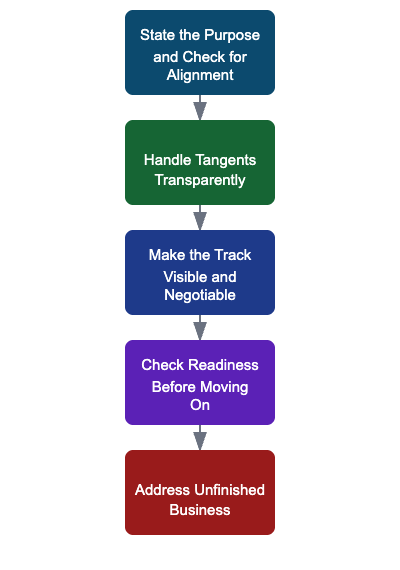
To keep meetings on track, use these steps:
-
State the Purpose and Check for Alignment
Don’t just announce, "Today we're discussing the Q2 budget," and dive in. Instead, clarify the scope:
"My understanding is we're here to finalize the Q2 operating budget allocation, not to revisit the overall budget amount or discuss Q3. Does anyone have a different understanding?"
This simple check ensures everyone is on the same page and prevents tangents, like someone arguing for a bigger budget when you’re only dividing what’s already approved. -
Handle Tangents Transparently
When someone suggests a related but off-topic idea, don’t shut it down. Instead, involve the group:
"That could be valuable. Let's check with the group! Would it be helpful to spend 10 minutes on vendor selection now, or should we add it to our next meeting's agenda?"
This approach maintains control while respecting the potential value of new topics. -
Make the Track Visible and Negotiable
When you add a new topic, do it openly so everyone knows what’s being discussed. When the team explicitly agrees on the agenda, people become more aware of when they're wandering off topic and will often self-correct:
"I realize this is getting into vendor selection territory, which we agreed to discuss next week." -
Check Readiness Before Moving On
Rushing through agenda items can leave unfinished business that resurfaces later. Instead of saying, "Okay, let's move on," pause and ask:
"I think we've covered the budget allocation thoroughly. Does anyone have something else we need to address before moving to implementation timelines?"
This surfaces lingering concerns, ensures closure, and shows respect for everyone’s need to process decisions. -
Address Unfinished Business
If someone says, "Actually, I'm still unclear on how the budget affects our hiring plans," you’ve uncovered an incomplete conversation. Ask:
"What specifically do you need to understand about the hiring impact before we can proceed?"
This turns potential future derailments into productive discussions now.
By following these steps, you transform track management from a solo task into a shared team responsibility. When you and the team agree on the goals and transitions, you’re building shared ownership of the meeting’s flow. This ensures that when you move on, everyone is genuinely ready to engage with the next topic, and unfinished business doesn’t come back to haunt you later.
Spot the Real Derailment—Or a Hidden Gem? 🔍
Sometimes what looks like a derailment isn't one at all. Your assumption that someone is off track might be preventing you from seeing a critical connection. This requires a fundamental shift from policing the conversation to being genuinely curious about it.
When someone appears to go off topic, resist the urge to immediately redirect. Instead, use a curiosity script, like: "I'm not seeing how your point about office renovation connects to our discussion about project timelines. Help me understand the connection." Notice the phrasing: you're not saying they're wrong or off track. You're acknowledging your own limitation in seeing the connection and asking for help. This creates psychological safety for the speaker while maintaining focus on relevance.
Here's how this might play out in an actual meeting:
- Jake: Wait, we need to talk about the new vendor certification requirements that just came in from legal.
- Victoria: Thanks for bringing that up, Jake. I’m not immediately seeing how vendor certification connects to our timeline discussion. Can you help me understand the connection?
- Jake: The new requirements add a mandatory 30-day verification period for any vendor we use. That means our timeline for the data migration project needs an extra month built in, or we'll hit a wall when we try to bring the vendor onboard.
- Victoria: Oh wow, I hadn't considered that. Team, should we adjust our timeline discussion to account for this, or schedule a separate meeting about vendor requirements?
Notice how, instead of immediately redirecting Jake, Victoria used this curiosity approach to uncover critical information that directly affected their timeline planning. What seemed like a derailment was actually essential context that would have caused major problems if overlooked.
Often, you'll discover surprising connections. The team member might respond with information that transforms your understanding of the situation. If there is indeed a connection, the team can then decide whether it makes more sense to explore the idea now or later. The key is that you're making this decision based on understanding, not assumptions.
Even when there truly is no connection, this approach maintains dignity and engagement. If the person says "You're right, it's not related. I was just worried about it," you can respond with "That sounds important. Let's capture it for our next meeting." It can then be agreed upon to maybe address it in a different meeting or take it offline. You've validated their concern without letting it derail the current discussion. This respectful handling encourages people to stay engaged rather than withdrawing after being shut down.
Additionally, testing your assumptions does more than manage derailments—it builds a culture of purposeful discussion. Team members start making connections explicit, saying things like, "This might seem off topic, but here's how it relates..." They become partners in maintaining focus, not just potential disruptors.
By approaching derailments with curiosity and shared ownership, you can turn potential distractions into valuable insights and keep meetings productive. Next, you’ll practice these techniques in role-play sessions—establishing and maintaining the track, checking for readiness before transitions, and transforming apparent derailments into meaningful contributions.
