Facilitating Rules and Decisions
Welcome to the Course 🎉
Welcome to Leading Meetings That Decide and Deliver! Throughout this course, you will master the critical skills needed to transform your meetings from time-wasters into powerful catalysts for decision-making and action. As a people manager, you’ve likely experienced meetings where discussions go off track, a few voices dominate, or decisions are made without clear agreement on how they were reached. You may have seen meetings where unclear expectations or lack of ground rules lead to confusion, interruptions, or uneven participation.
This course equips you with proven techniques from the HBR Guide to Making Every Meeting Matter, to ensure your meetings produce real decisions that stick. You'll learn how to surface hidden concerns before they derail your plans, manage the inevitable derailments that threaten meeting focus, establish ground rules that create psychological safety for honest discussion, and close meetings so effectively that action items actually get completed.
Once you master the skills in this course, you will conduct meetings where people speak up honestly rather than undermining decisions later, where discussions stay on track without stifling valuable contributions, and where every participant leaves knowing exactly what was decided and what they need to do next. These aren't just meeting management techniques—they're leadership skills that will transform how your team collaborates and delivers results.
Establish Ground Rules 📏
Meetings run smoother and achieve more when everyone agrees on a few simple ground rules from the start. The most effective guidelines are those shaped by the team itself—turning rules into shared commitments that everyone owns, rather than top-down restrictions.
The key insight about meeting guidelines is that they don't need to be rigid or overly formal. Instead, they should serve as shared expectations that reflect your team's unique needs and working style. Start by asking your team what frustrates them most about meetings. You'll likely hear complaints like "We always start 10 minutes late" or "The same three people dominate every discussion." These frustrations become the blueprint for your guidelines.
For recurring meetings, dedicate 15 minutes in your next session to collectively establish norms. Ask questions like "What would make our weekly meetings more effective? and "What behaviors should we encourage or discourage?" When team members suggest guidelines, they're more likely to follow them. One team might decide they need strict time limits for updates, while another might prioritize getting everyone's input before moving to the next topic. The specific rules matter less than the fact that everyone participated in creating them.
Remember to revisit these guidelines periodically, asking "Are our ground rules still serving us, or do we need to adjust them?" This keeps your guidelines as living documents that evolve with your team's needs rather than becoming outdated restrictions that everyone ignores.
Clarifying Expectations for Meeting Participation and Etiquette 🤝
While collaborative guideline creation works well for recurring meetings, sometimes you need to establish explicit ground rules immediately—especially when leading meetings with new groups or addressing persistent problems. The most common areas that derail meetings are time management, device usage, and interruption behaviors.
Here’s a table with examples of how to address these problem areas:
| Area | Common Problem | Example Rule/Norm | Enforcement Tip |
|---|---|---|---|
| Time Management | Meetings start late or run over | "Begin promptly at 2:00 and end by 3:00, even if we table some discussions." | Consistently start/end on time to reinforce the commitment |
| Device Usage | Distraction from phones/laptops | "Laptops closed unless presenting or taking notes"; "Phones face-down unless urgent call expected." | Gently remind: "Let's maintain our focus." |
| Interruption Behaviors | People talking over each other | "Hear each person's full thought before responding"; "Raise hand to speak next" | Intervene: "Hold that thought, Chipo. Let Dominic finish first." |
Here’s how a meeting leader might set the ground rules for interruption behaviors:
Victoria: Before we dive in, I want to set a quick ground rule for our discussion. Let’s make sure we hear each person’s full thought before responding. If you want to add something, just raise your hand or signal, and I’ll make sure everyone gets a turn.
Dan: What if someone accidentally interrupts?
Victoria: I’ll gently step in and ask that we let the person finish before moving on. It might feel a bit awkward at first, but it helps everyone get their say while being respectful.
Dan: Sounds good. Thanks for making it clear.
Notice how Victoria explicitly states the expectation, explains how interruptions will be handled, and reassures the team that the process is about fairness, not formality. This kind of clarity helps everyone participate more thoughtfully and creates a more respectful meeting environment.
It’s also important to encourage balanced participation so meetings create space for more voices. Consider implementing a "step up, step back" rule: frequent contributors make room for others, while quieter members challenge themselves to speak up. Make this visible by keeping a participation chart or having people move a token to the center when they speak. This shifts balanced participation from your sole responsibility to a shared team commitment. These explicit rules might feel rigid at first, but they create the safety and structure that allow genuine collaboration to flourish.
Reach Group Decisions During Meetings 🗳️
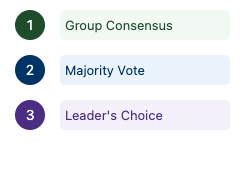
After establishing ground rules that create productive meeting environments, you need frameworks for actually making decisions. Too often, meetings end with vague agreement but no clear decision, or worse, a decision that only some people truly support. These three distinct decision-making methods to transform your meetings from discussion forums into decision engines:
-
Group consensus is the most powerful but most misunderstood method. It does not mean arguing until everyone agrees completely. Instead, consensus means reaching a decision that everyone understands, supports, and is willing to help implement. You'll hear phrases like "This isn't my first choice, but I can see why it's best for the team" or "I have concerns, but I'm willing to try this approach and give it my full effort." Use consensus for decisions requiring strong buy-in and complex implementation, where the investment of time pays off when everyone becomes a champion of the decision rather than a reluctant participant.
-
Majority vote works when you need quick decisions and can accept that some people will disagree. The proposal with the most votes wins—simple and fast. However, voting can create winners and losers, potentially damaging team cohesion. Use it for lower-stakes decisions or when you're choosing between roughly equivalent options.
-
Leader's choice might seem autocratic, but it's sometimes the most appropriate method. After hearing everyone's input, the leader makes the final decision. This isn't about ignoring the team. The leader typically chooses what the majority prefers but takes responsibility for the choice. Use this method during crises, when expertise matters more than buy-in, or when the team is genuinely split and needs someone to break the tie.
The magic isn't in picking one method forever but in explicitly stating which method you're using for each decision. Start important discussions by saying "We need to decide on our Q3 priorities. Given the impact on everyone's work, I'd like us to reach consensus. If we can't agree within 45 minutes, I'll make the call based on our discussion." This clarity prevents the frustration of people thinking they're voting when you're just gathering input, or expecting consensus when you've already decided. Match the method to the decision's importance, urgency, and need for buy-in, always making the process transparent to your team.
Establishing clear ground rules and decision-making methods not only prevents common meeting pitfalls, but also builds trust and accountability within your team. By making expectations explicit and involving everyone in the process, you create an environment where participation is balanced and decisions are supported—even when opinions differ. Ready to practice these ground rule and decision-making techniques? The upcoming practice sessions will let you experience the challenge of establishing rules with resistant team members and facilitating consensus when positions seem irreconcilable.
