Making Values-Based Decisions
Centering Values in High-Stakes Decisions
Regulating yourself in a heat moment gets you the four-second gap. The next question is what you do with it. Most high-stakes decisions you'll make as a manager aren't between right and wrong: they're between two things you care about that can't both win. This unit gives you the filter that lets you decide on purpose, and the language to defend the call to the person who pays the cost.
Trading Off Speed, Fairness, Transparency, and Care
Under pressure, four values dominate almost every people decision you make, and they pull against each other constantly. Speed is the pressure to act before the window closes: a hiring slot that needs a name today, a reorg call your director wants by morning. Fairness is consistency of process and access: did everyone affected get the same shot? Transparency is how much of the real picture you share, and when. Care is the weight you give to the human impact, especially on the person carrying the cost.
The trap is pretending they're aligned when they're not. Speed often costs fairness, because consistent process takes time. Transparency often costs care in the short term, because the honest message lands hard. Care taken too far costs speed, because you stall trying to soften an unavoidable hit. A manager who claims "I optimized for all four" usually optimized for one and didn't name what they traded. Your director, your peers, and your team can all tell the difference. Naming the trade-off out loud is what separates a decision from a rationalization.
A useful test: before you act, finish this sentence in your head. "I'm choosing X, which costs Y, because Z." If you can't say what you're trading off, you haven't made the decision yet, you've just announced it.
Running the Values-Based Decision Filter
The Values-Based Decision Filter turns that test into a repeatable sequence. Clarify the decision (what specifically is being decided, by when, and by whom). Name stakeholders (who is affected, including the people not in the room). Identify value tensions (which of speed, fairness, transparency, and care are actually in conflict here). Weigh constraints (what's non-negotiable: budget, timeline, prior commitments). Choose the action (a single recommendation, not a menu). Communicate the rationale (own the trade-off in plain language).
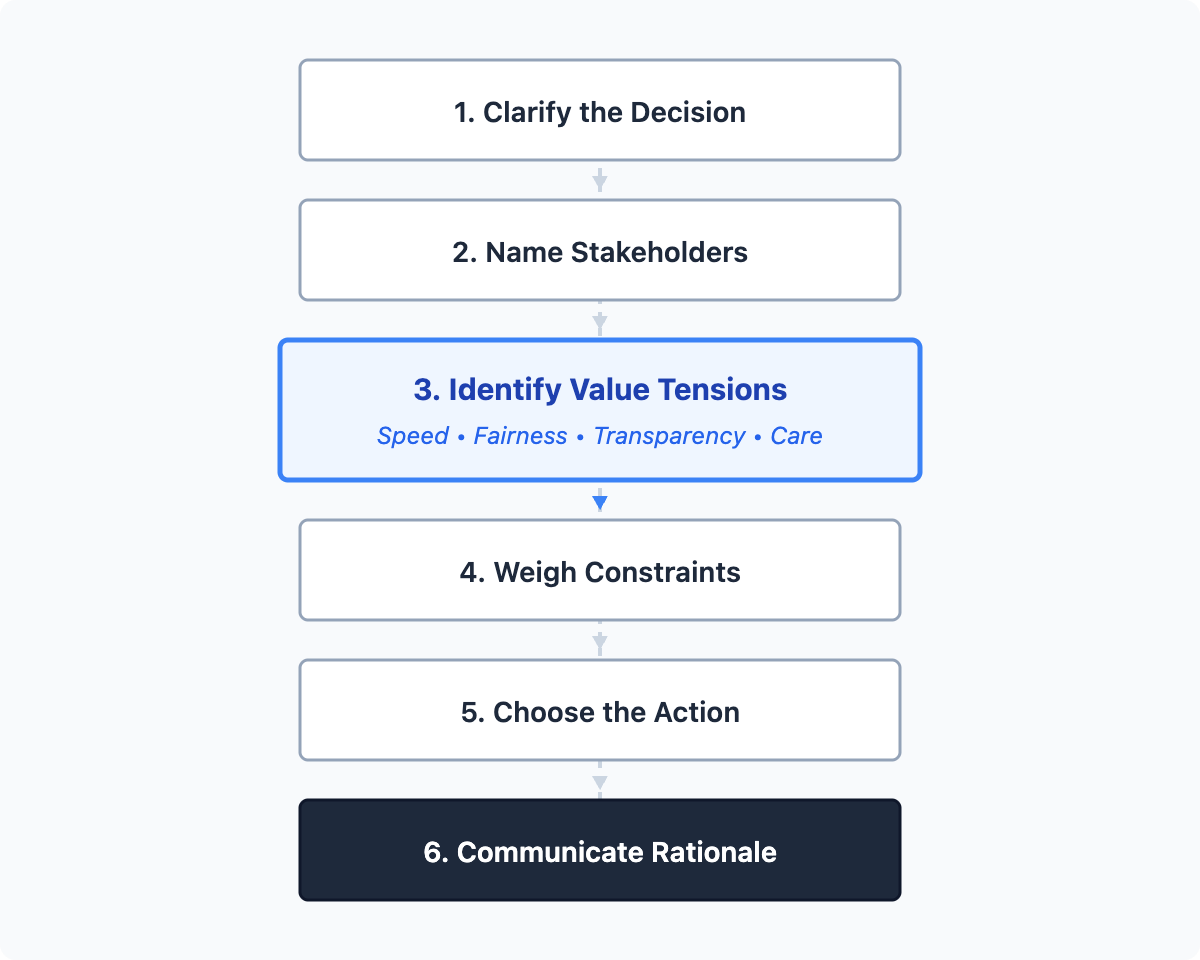
The filter only works if you push hard on step three. That's where most managers shortcut: they jump from "we have to absorb this work" straight to "pull Person A," skipping the moment where they could have noticed that the speed-versus-fairness tension was the actual decision. Slowing down at the tension is what makes the recommendation defensible later.
- Victoria: I have to give the director a name by tomorrow morning. We need someone on the migration starting Friday. Milo is the only one with the bandwidth.
- Jake: Okay, what's the tension you're sitting with?
- Victoria: Speed. The Friday start is real. But Milo just got the customer feature as his stretch, and I committed to him on it three weeks ago.
- Jake: So it's speed against fairness to a commitment you already made. Both real. Which one are you choosing, and what does the other one cost?
- Victoria: I think I'm choosing speed, because the migration blocks two other teams. The cost is Milo's stretch, and I owe him a protected return date and a substitute visibility moment.
- Jake: Now you have a recommendation. Before, you had a default.
Notice that Jake doesn't tell Victoria what to do. He makes her name the trade before she chooses. That's the whole move.
Explaining the Decision Without Spin or Cover
Once you've made the call, the conversation with the person carrying the cost is where your filter either earns trust or burns it. Lead with the decision: don't bury it under three minutes of context. Name the value tension honestly, in your own words, not corporate cover. Own that the choice costs them something real, and be specific about what. Lay out the mitigations you can actually deliver, not the ones that sound good. Then stay present through their reaction (silence, disappointment, sharp questions) without retreating into "the business needed it" or over-apologizing your way out of the discomfort.
The failure modes are predictable. Hiding behind hierarchy ("leadership decided") tells your direct report you didn't fight for them. Pretending the decision was easy ("I think this is actually a great opportunity") tells them you don't see the cost they see. Over-apologizing turns the conversation into one where they have to comfort you. The cleanest move is the hardest one: be honest about what you chose, what it costs, and what you're doing about the cost.
The single most important takeaway: a values-based decision isn't the one that feels best, it's the one you can name the trade-off on and still defend tomorrow.
Before this becomes real, you'll work through a quick pattern-spotting exercise on pressure-cooker scenarios, picking the option that best names and balances the trade-off. Treat it as calibration for the writing and the live conversation that follow, because if you can't spot the trade-off cleanly on paper, you won't spot it in the room.
