Regulating Heated Moments
Welcome to the Course
The hardest moments to lead from are the ones where you most need to. A public challenge from a peer, an escalation that lands on a Friday afternoon, a skip-level question that hits a sore spot: these are the moments your team is actually watching. This course builds the self-regulation, communication, and recovery skills that let you stay grounded when the room is hot, instead of waking up at 2am replaying what you said.
By the end of this course, you'll be able to:
- Recognize the early-warning signals that precede reactive leadership and run a personalized de-escalation protocol in real time
- Apply a values-based filter to high-stakes decisions where speed, fairness, transparency, and care are in tension
- Communicate honestly with your team during uncertainty without spinning, oversharing, or going dark
- Conduct a clean repair conversation after a misstep and follow through visibly enough that credibility actually rebuilds
- Stay non-defensive in escalation moments where the easy move is to match heat or capitulate
This first unit focuses on the foundation everything else sits on: noticing your own activation early enough to choose a response, instead of finding out what you said after you've already said it.
Reading Your Early Warning Signals
Reactive leadership rarely arrives without notice. By the time you've snapped at a peer or talked over a direct report, your body has already been telling you for ten or fifteen seconds. The work is to catch that signal earlier each time.
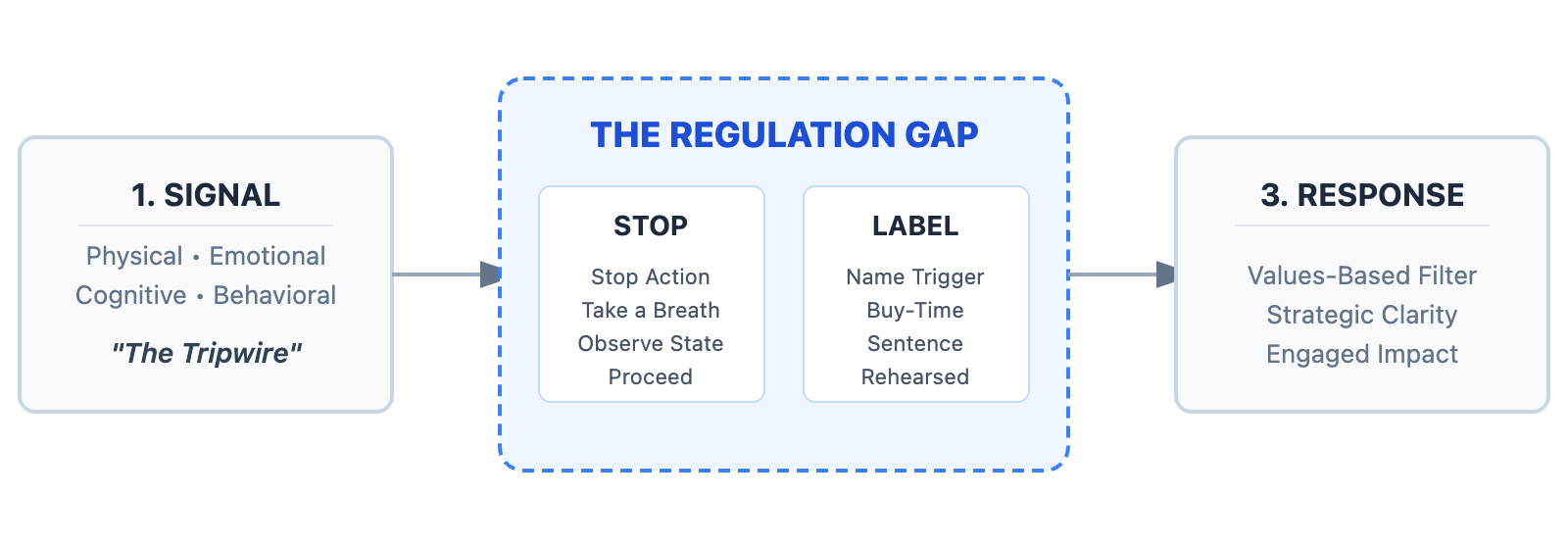
Signals come in four categories, and you need to know your own profile across all of them. Physical signals show up as tight chest, shallow breath, clipped voice, heat in your face, leaning forward in your chair. Emotional signals are a flash of shame, defensiveness, anger, or the urge to be right. Cognitive signals look like this: you stop hearing the other person and start drafting your rebuttal, your focus narrows to one point, you catastrophize ("this is going to land me with the VP"). Behavioral signals are the visible tells: you interrupt, your typing gets faster, you go silent in a way that means contempt rather than thought.
Most managers know one or two of these about themselves. The ones who regulate well know all four, and they know which signal shows up first. That's your tripwire.
- Jake: I watched myself in the leadership review yesterday. The second the director said "I'm not sure the data supports that," I felt my jaw lock and I was already writing the comeback in my head.
- Nova: That's two signals at once. Physical and cognitive. Which one showed up first?
- Jake: Honestly? The jaw. The rebuttal came maybe two seconds later.
- Nova: Then the jaw is your tripwire. That's the one you train yourself to catch.
Notice that Jake doesn't need a new vocabulary; he needs a known sequence in his own body.
Building Your De-Escalation Protocol
Once you can spot the signal, you need a move. Two frameworks pair well here.
The STOP Technique runs in seconds: Stop whatever you were about to say, Take a breath, Observe what's happening in your body, emotion, and thought, and Proceed with intention. It buys you the four to six seconds that separate a reaction from a response.
The Pause-Label-Choose Routine runs on top of that. Pause to create space (this is what STOP does mechanically). Label the trigger or the emotion: "I'm activated because this feels like a public credibility hit." Labeling drops the temperature, because the part of your brain that names a feeling is not the same part that's flooding. Then Choose your next response based on your values and the impact you want, not the impulse you have.
A personal protocol turns this from theory into something you can actually run. It has three parts. First, your top two earliest signals, the ones you've trained yourself to catch. Second, a specific STOP move that's physical enough to work under load: a sip of water, a slow exhale through the nose, a deliberate pause before unmuting. Third, a single buy-time sentence you've rehearsed so you don't have to invent it in the moment. Something like Let me think about that for a second before I respond or Say more about what you're seeing works because it's neutral, honest, and gives you four more seconds. The protocol has to be yours; generic versions don't fire under pressure.
Responding Without Defending or Dismissing
The point of the protocol isn't to go quiet or to suppress what you feel. It's to stay engaged without going reactive. When a peer escalates hard at you on a call or in a meeting, your job is not to win and not to absorb. It's to acknowledge the impact on them, ask one or two clarifying questions about what's actually broken, name what you'll own and what you don't yet know, and commit to a specific next step with a time on it. That sequence is impossible if you're flooded; it's straightforward if you've created the four-second gap.
The single most important takeaway from this unit: regulation is not calm, it's the gap between signal and response that lets you choose what kind of leader shows up in the next ten seconds.
This is where it gets concrete. A quick pattern-spotting exercise comes next, sorting a set of internal experiences into the four signal categories. Treat it as the first rep of training your own tripwires, because sharp categorization is what makes the protocol portable into the moment you'll actually need it.
