Communicate Truth Through Uncertainty
Communicating Truth Through Uncertainty
The last unit gave you a filter for deciding under pressure. This one is about what you say to your team when you've made the call, when you haven't, or when the call isn't yours to make and people are still looking at you for signal. Uncertainty is the test most managers fail by accident: not by lying, but by reaching for comfort, polish, or quiet when the moment needed truth.
Four Modes of Speaking Under Pressure
Under pressure, leader communication falls into one of four modes, and only one of them earns trust. Transparency is naming what you know, what you don't know, and the line between them, in your own voice. Oversharing is releasing information that isn't yours to share, or speculating out loud about outcomes you can't actually predict.
Spin is shaping the truth to make it easier to swallow, including the corporate move of relabeling a hit as "an opportunity." Silence is going dark, deferring everything upstream, or hiding behind "I can't comment on that."
Most managers default to spin or silence when stakes rise. Spin feels like care; it actually reads as a lack of respect for your team's intelligence. Silence feels like discretion; it actually reads as either ignorance or self-protection. Oversharing feels like candor; it usually means you couldn't tolerate sitting with not-knowing and traded your team's stability for your own relief.
- Jessica: So what does the leadership team actually think is going to happen?
- Milo: Honestly, I don't know. I know the merger conversation is real and I know no role decisions have been made yet. I don't know the timeline, and if I did know specifics about roles I couldn't share them today.
- Jessica: That's not super reassuring.
- Milo: It's not meant to be. It's meant to be straight. I'd rather you be anxious with accurate information than calm with something I made up.
Notice what Milo doesn't do: he doesn't reassure, he doesn't speculate, and he doesn't disappear behind hierarchy. He names the line between what he knows, what he doesn't, and what he can't share. That distinction is the whole game.
The Pressure Communication Frame
When you have to write or speak under uncertainty, the Pressure Communication Frame gives you a structure that resists all three failure modes.
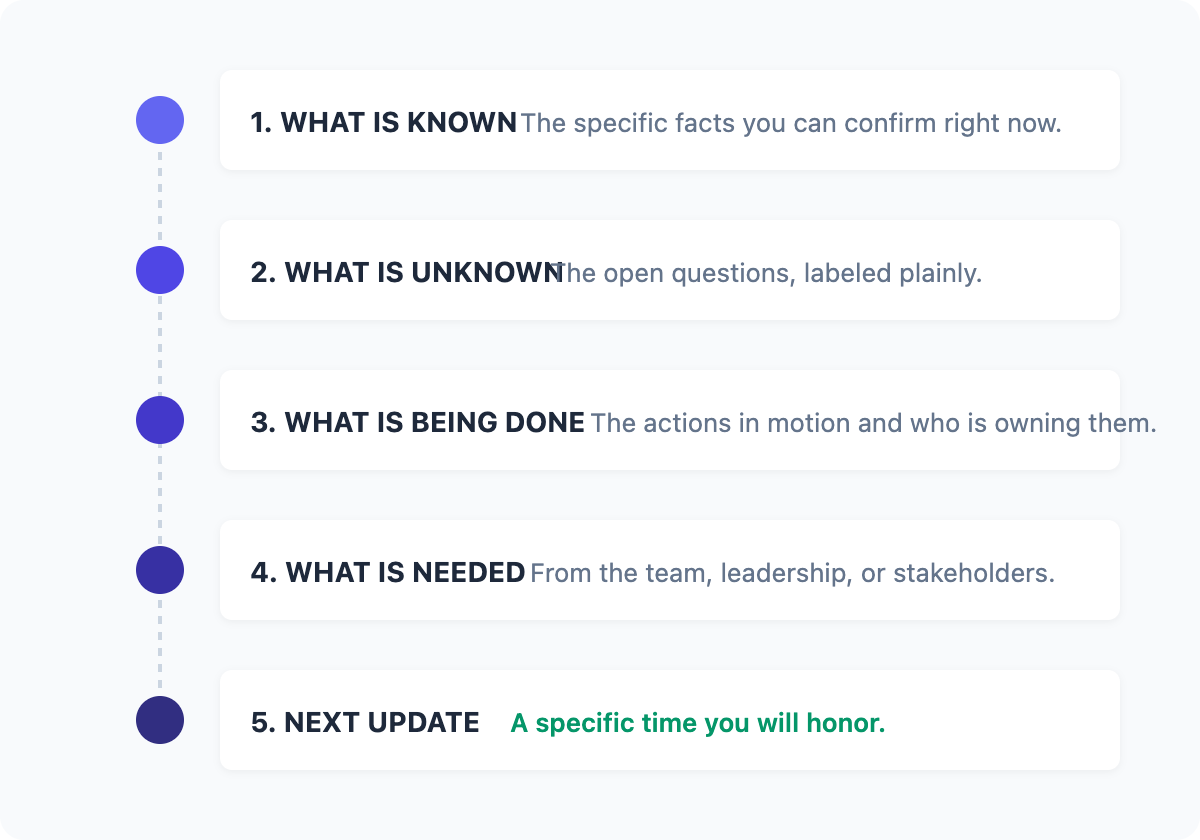
Lead with what is known: the specific facts you can confirm. Then what is unknown: the open questions, including the ones you'd rather not name. Then what is being done: the actions in motion, by whom. Then what is needed: from your team, from leadership, or from you. Then when the next update will come: a specific time you'll honor whether or not new information has surfaced.
The frame works because it forces you to label your epistemic position before you speak. If you can't say what's known versus unknown, you don't have a message yet, you have a feeling. The biggest mistake managers make with this frame is collapsing the "unknown" section into vague reassurance. Resist that. Name the unknowns plainly, and label the difference between what you genuinely don't know and what you know but can't share yet. Your senior ICs can tell the difference; pretending otherwise costs you credibility you'll need later.
The other discipline is the next-update commitment. A specific time ("end of day Thursday") is a contract. A vague one ("when we know more") is permission to go dark.
Holding the Line When People Want More
The frame survives a written update. The harder test is the 1:1 where someone you care about pushes for certainty you can't give. Their stakes are real (a mortgage, a relocation, a family conversation), and that's exactly when managers slip into false comfort, just to relieve the discomfort in the room.
Holding the line under that pressure has four moves. Acknowledge the stakes specifically, in their language, not yours. Tell them exactly what you know that's relevant to their situation, including "I don't know" when that's the truth. Refuse to reassure beyond what's true: "I can't promise you that" is sometimes the most respectful sentence you can say. Then name one concrete thing you'll do on their behalf (a specific question you'll ask up the chain, a faster signal you'll try to surface) and a specific time you'll come back to them.
The single most important takeaway: under uncertainty, your team doesn't need you to know everything. They need you to name what you know, what you don't, and what you're doing about it, and to come back when you said you would.
This is where it gets concrete. You'll first spot-check the four modes against real leader phrasing, then draft a team update that has to survive senior ICs reading it for spin, and finally hold the line in a live conversation with someone whose stakes are personal. Treat each one as rehearsal for the next reorg or outage, because the frame only helps if you can run it when your own footing feels uncertain.
