Repairing Leadership Impact
Repairing Impact After Missteps
The last unit gave you a frame for staying honest under uncertainty. This one assumes the harder thing has already happened: the protocol didn't catch you in time, the heat got through, and someone on your team is now carrying the cost of how you showed up. Repair is what separates managers who lose a relationship in one bad meeting from managers who lose ground temporarily and earn it back through visible work. The skill isn't avoiding missteps. It's running a clean recovery when one lands.
The Anatomy of a Real Apology
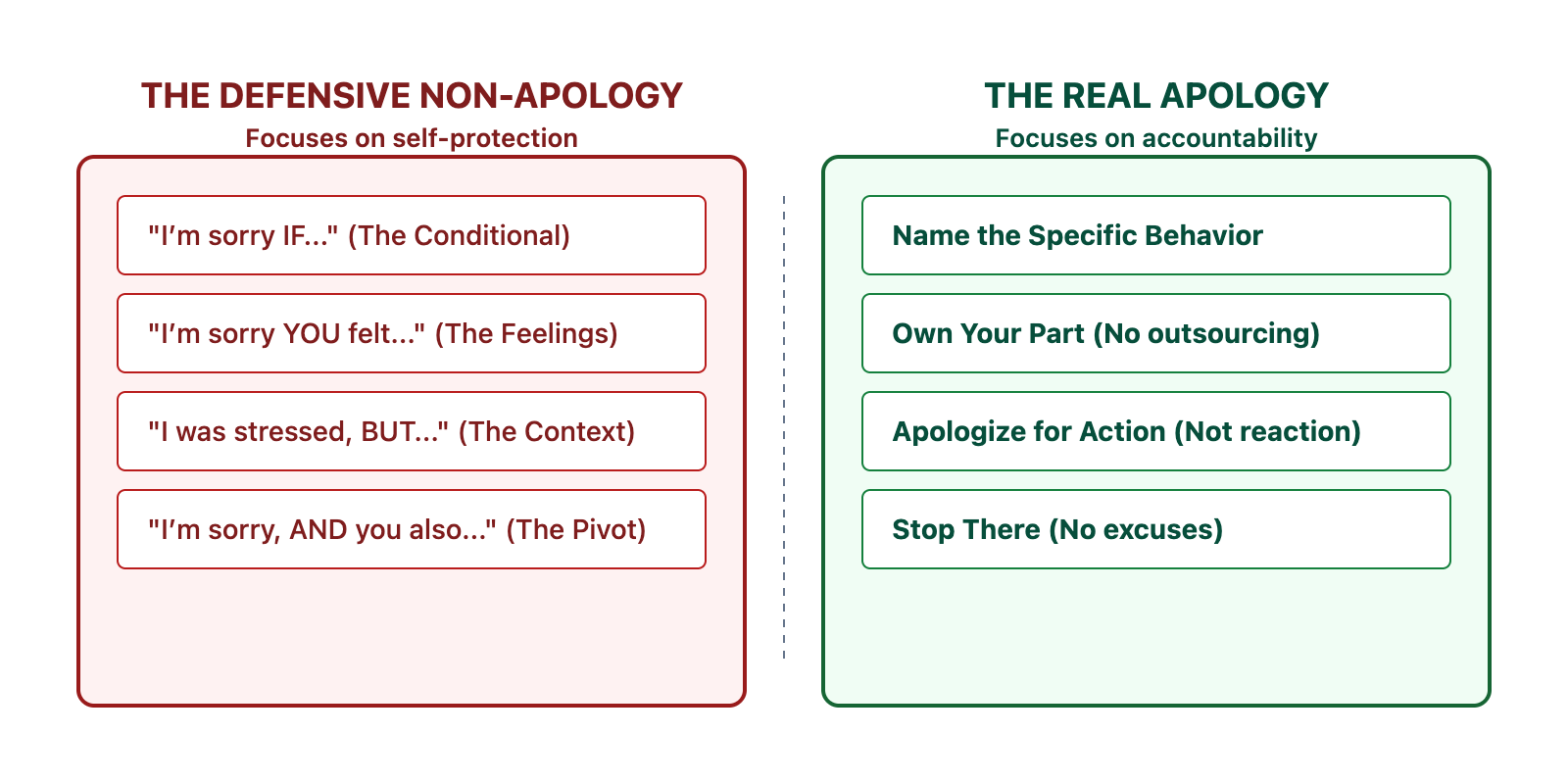
Most manager apologies fail in predictable ways, and the failure modes are worth naming because they feel like apologies from the inside. The defensive non-apology has four classic shapes. The conditional ("I'm sorry if that came across wrong") shifts the question from your behavior to their interpretation. The feelings-apology ("I'm sorry you felt dismissed") locates the problem in their reaction, not your action. The context-first apology leads with the reason ("I was under a lot of pressure, but I'm sorry") which trains the listener to discount the apology and remember the excuse. And the pivot ("I'm sorry I cut you off, and you also could have...") turns repair into a counter-charge.
A real apology has the opposite shape. You name the specific behavior, not a vague category. You own your part before you offer context. You apologize for what you did, not for how they felt. You stop there. Context, if it belongs, comes after ownership, and only if it serves their understanding rather than your defense.
The five-step Repair Conversation Sequence gives you the structure: Name the impact, Own your part, Apologize without excuses, Ask or offer repair, Commit to visible follow-through. Each step has a job. Naming the impact proves you saw it. Owning your part proves you're not outsourcing the cause. The apology proves you mean it. Asking what repair looks like prevents you from imposing your version of "fixed." The follow-through commitment is what makes the whole thing more than theater.
Running the Repair Conversation
The hardest part of running the sequence live is resisting the urge to skip steps in the name of being efficient. You want to get to "what can I do to make it right" because that feels productive. Doing that before naming the impact specifically reads as managed. The person across from you can tell the difference between a manager who saw what happened and a manager who is trying to close a ticket.
Lead with the specific moment, in their language, not yours. "I cut you off in Tuesday's review when you were walking through the latency data, and I said the framing wasn't the point. In front of three layers of leadership." That sentence does more work than ten minutes of generalized regret.
- Ryan: I cut you off on Tuesday when you were presenting the latency numbers, and I dismissed the framing in front of the VP and the skip-level. That likely undercut your credibility in a room where you'd done the work to earn it.
- Victoria: Yeah. It did.
- Ryan: I'm sorry. That's on me, not on the pressure I was under in the room.
- Victoria: I appreciate you naming it. I wasn't sure if you'd noticed.
- Ryan: I noticed. What would actually help you feel that repaired, from where you're sitting?
Notice what's missing: no "I want you to know that's not who I am," no "in fairness I was getting hammered by leadership," no immediate pivot to a fix. The space after the apology is where you find out what repair actually needs to look like, and it's almost never what you would have guessed.
Making Repair Real in 30 Days
An apology without follow-through is worse than no apology, because it teaches the person you can produce the words without changing the behavior. The 30-day plan is where credibility actually gets rebuilt, and it lives or dies on specificity. "I'll be more mindful in meetings" is rhetoric. "In the next architecture review on the 14th, I'll open by attributing the reliability framing to her by name before the discussion starts" is a commitment you can be graded on.
A strong plan names three things. First, the visible behaviors you'll demonstrate in specific upcoming meetings, with dates. Second, the upstream signal you'll send to the people who witnessed the original misstep, since reputational damage in front of leadership doesn't repair itself privately. Third, the check-in points where the affected person gets to tell you, candidly, whether the change has shown up or not. Day 14 and day 30 are useful because they're far enough out to test a pattern and close enough to course-correct.
The test of the plan is portability: could someone else read it and grade you against it at day 30? If yes, you've written a plan. If it's full of intent words ("more present," "better listener," "more aware"), you've written a wish.
Everything above is theory until you run it on someone whose trust you've actually dented. You'll first sort real leader phrasing into apology and non-apology patterns to sharpen your ear, then run the full Repair Conversation Sequence live with a direct report you've hurt, then write the 30-day plan that turns the words into observable behavior. Treat the writing as something you could hand to the person on the other side: that's the bar that keeps it honest.
