Manage Quick Pivots in Crisis Situations
Manage Quick Pivots in Crisis Situations
In the previous unit, you built frameworks for handling objections and de-escalating conflict. These tools work well when you have at least a few moments to think. However, when a crisis lands with zero warning, your composure becomes the message. Before anyone processes your words, they process your tone, your pace, and your stillness. This unit provides a repeatable structure for responding to negative scenarios within 90 seconds.
You will learn a vocal technique called Low-Tone Mirroring that prevents emotional contagion from pulling you off center. This approach ensures you remain grounded even when the stakes are high. Additionally, you will master a three-part crisis pitch format. This format ensures every urgent response covers the facts, the feelings, and the way forward. Mastery of these tools allows you to lead effectively through any sudden disruption.
When a crisis hits, the first instinct is often to freeze or to rush into over-explanations. Both responses erode trust and can make you look either unprepared or panicked. The goal is to land in a narrow band between those extremes. You need a brief, composed, and structured response that buys you credibility. This approach allows you to regain control of the situation immediately.
Your response should start by acknowledging the situation so others know you are aware. Next, signal ownership rather than deflecting or assigning blame for the issue. Finally, name a concrete next step with a clear timeline for the next update. You do not need to diagnose the root cause or announce a full recovery plan yet. You simply need to demonstrate awareness, ownership, and forward motion.
Maintaining Calm Under Pressure with "Low-Tone Mirroring"
When someone speaks in an agitated and fast-paced voice, your nervous system often matches that energy involuntarily. This is called emotional contagion, and it is a major threat to composure during a crisis. If you allow this to happen, the conversation usually spirals into a loud and unproductive exchange. Low-Tone Mirroring is a deliberate vocal technique designed to break this cycle. It allows you to maintain control of the emotional climate.
Instead of matching the other person’s pitch, you consciously drop your voice and slow your speaking rate. You still reflect their words and concerns to maintain rapport, but you do so in a calm register. This signals stability rather than panic to everyone in the room. When others hear their concerns repeated back steadily, their own nervous systems begin to regulate. You are gently leading the conversation back to a productive baseline.
Anchor your breath before you speak by taking one full exhale. This gives your vocal cords a chance to settle into a lower register. You should also slow down your first sentence intentionally, even if it feels unnaturally slow. Under stress, your perception of time distorts, so what feels slow to you sounds normal to others. Staying low and steady ensures that those around you remain calm as well.
The "90-Second Crisis Pitch": Data, Empathy, and Action
The 90-Second Crisis Pitch is a structure built around Data, Empathy, and Action:
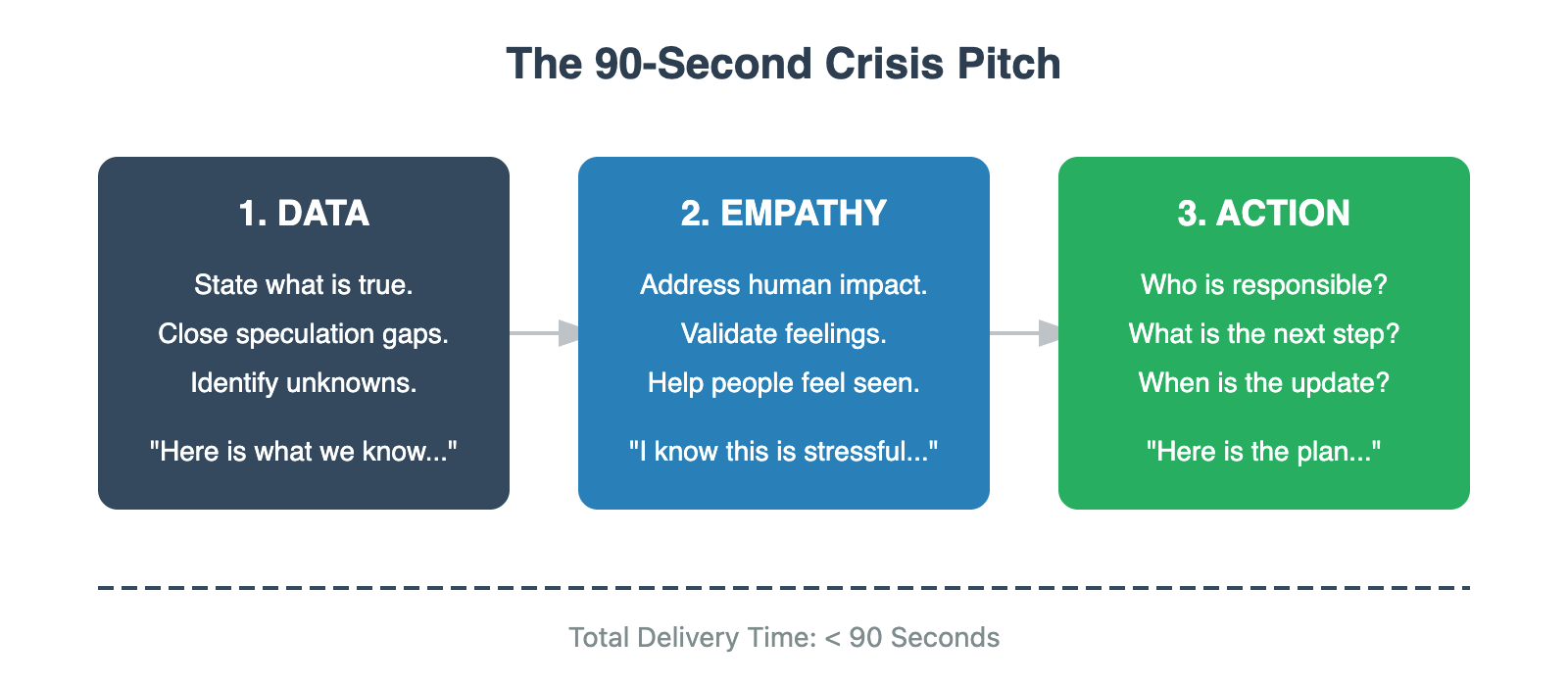 Start with Data to close the gaps where speculation and rumor usually grow by stating what you know to be true. People can often tolerate uncertainty, but they cannot tolerate being misled. Following the facts, use
Empathy to acknowledge the human impact of the situation. This step is essential because people need to feel seen before they can focus on a solution.
Start with Data to close the gaps where speculation and rumor usually grow by stating what you know to be true. People can often tolerate uncertainty, but they cannot tolerate being misled. Following the facts, use
Empathy to acknowledge the human impact of the situation. This step is essential because people need to feel seen before they can focus on a solution.
The final step is Action, which answers the question of what is being done. Your action statement should include what is happening now, who is responsible, and when the next update will come. Specificity provides relief because it removes the mystery of what happens next. This structure works effectively whether you are speaking to colleagues, leadership, or external stakeholders. Practice assembling this structure under time pressure because you will not have the luxury of drafting in a real crisis.
To see how Low-Tone Mirroring and the Data-Empathy-Action framework work together in real time, consider this exchange between a team lead and a supervisor:
- Jessica: Dan, the reporting platform just crashed and three of our biggest clients can't access their dashboards. They're already emailing us — this is a disaster!
- Dan: Okay, let me make sure I have this right. The reporting platform is down, and three major clients are affected. Do we know when it went down?
- Jessica: About twenty minutes ago. I don't know what caused it yet.
- Dan: Got it. So here's what we know: the platform went down roughly twenty minutes ago, three key clients are impacted, and root cause is still under investigation. I know this is stressful, especially since your team has been working hard to build trust with those accounts. Here's what we're going to do — I need you to loop in engineering right now for diagnostics, and I'll draft a client communication acknowledging the issue. Let's regroup in thirty minutes with an update.
- Jessica: Okay. That helps. I'll get engineering on it now.
Notice how Dan begins by slowing the pace and paraphrasing Jessica's concern back to her in a calm, measured tone. This is a textbook Low-Tone Mirror that immediately pulls the conversation out of panic mode. He then moves through Data by summarizing the known facts and acknowledging the unknown cause. He offers Empathy by naming the stress the team is feeling and closes with Action by assigning clear next steps. This shift from alarm to clarity in a matter of seconds is exactly the outcome you want when a crisis arises.
Your ability to move through these steps fluidly with a steady voice is what separates survival from leadership. This is where the frameworks stop being theory and start becoming reflex. Up next, you will practice what to do when a crisis lands on you in real time. These exercises will help you turn these structured responses into an automatic professional habit.
