Handling Objections and Feedback
Handling Objections and Tough Feedback
In the previous unit, you learned how to build a persuasive case using the three pillars of Ethos, Pathos, and Logos. But here is the reality of professional life: even the most well-crafted pitch will meet resistance. Someone will push back on your timeline, question your data, or flat-out tell you they disagree. Beyond pitching, you will regularly find yourself on both sides of difficult feedback conversations, delivering tough news to a colleague and receiving it from your own leadership. These moments are not obstacles to persuasion; they are persuasion. How you respond when things get uncomfortable determines whether trust deepens or erodes.
This unit gives you two practical frameworks that work together. First, you will learn a four-step ladder for handling objections without becoming defensive. Then, you will pick up a structured method for delivering feedback that is specific, respectful, and actionable. By the end, you will have a toolkit that transforms friction into forward motion.
The "Objection-Handling Ladder": Listen, Validate, Reframe, Respond
When someone pushes back on your idea, your instinct is to defend it immediately. That instinct is natural and almost always counterproductive. Jumping straight to a rebuttal signals that you were not really listening, which makes the other person dig in harder. The Objection-Handling Ladder slows you down just enough to turn resistance into a productive exchange. It has four rungs, and the order matters:
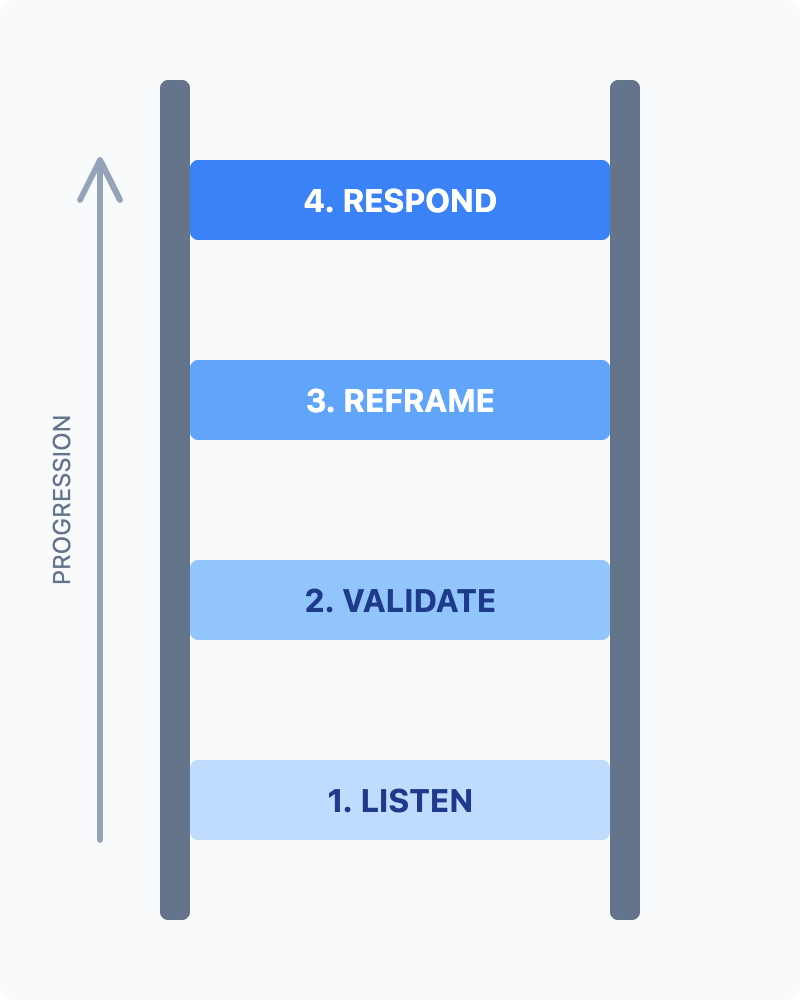
The first rung is Listen. This means genuinely absorbing what the other person is saying without mentally rehearsing your comeback. Let them finish completely. If you are unsure you understood, paraphrase it back: "So what I'm hearing is that you're concerned about the timeline being too aggressive. Is that right?" This small act of repetition does two things at once: it proves you were paying attention, and it gives the other person a chance to clarify or even soften their own position.
The second rung, Validate, is the one most people skip entirely. Validating does not mean agreeing. It means acknowledging that the other person's concern is reasonable given their perspective. A phrase like "That's a fair concern, especially with the other priorities your team is juggling" costs you nothing and earns you enormous credibility. When someone feels heard, their emotional guard drops, and they become far more open to what you say next.
From there, you move to Reframe, where you gently shift the lens. Instead of arguing against the objection, you place it in a new context. If someone says "We don't have the budget for this," a reframe might sound like: "I understand the budget is tight. What if we looked at this as a way to reduce the $12,000 we're currently spending on manual workarounds?" Notice how the objection about cost is redirected as an opportunity for savings. You are not dismissing the concern; you are helping the other person see it from a different angle.
The final rung is Respond, where you offer your solution, counter-proposal, or next step. By the time you reach this point, the other person has been heard, validated, and shown a new perspective. Your response now lands on receptive ground rather than defensive walls. A strong response is concrete and brief: "I'd suggest we run a 30-day pilot with the existing discretionary budget and review the results together before committing further."
To see all four rungs in action, consider this exchange during a resource planning discussion:
- Ryan: I'd like to send two of my team members to the analytics conference next month. I think the skills they'd bring back would directly accelerate our Q3 reporting goals.
- Victoria: Honestly, Ryan, I don't think we can afford to have two people out of pocket for three days right now. We're already stretched thin.
- Ryan: That makes sense. So the main concern is losing capacity during an already busy period, is that right?
- Victoria: Exactly. We've got two major deliverables landing that same week.
- Ryan: That's a completely fair concern, and I wouldn't want to put the team in a tough spot either. What if we staggered it? One person attends the first day and the other attends the final day so we never lose both at once. The sessions they'd each cover map directly to the bottlenecks slowing down those deliverables.
- Victoria: That could work. Put together the schedule overlap and let me see it tomorrow.
Notice how Ryan resists the urge to argue immediately. He listens by paraphrasing Victoria's concern back to her, validates by calling it a fair concern and aligning with her priority, reframes the time-away objection as a staggered approach that actually supports the deliverables, and responds with a concrete proposal. Victoria moves from a flat "no" to an open "let me see it" in just a few exchanges. Walking the four rungs demonstrates the kind of leadership that builds loyalty and engagement over time.
Using the SBI-Ask-Offer Method for Feedback
Giving tough feedback is one of the most avoided responsibilities in professional life and one of the most important. Vague feedback like "You need to be more proactive" leaves people confused and sometimes resentful. The SBI-Ask-Offer method gives you a structure that is direct without being harsh, and specific without being nitpicky.
The method begins with three core components that form the acronym SBI. The Situation anchors the feedback to a specific moment in time and place so the receiver knows exactly what you are referencing. For example: "In yesterday's client call at around the 15-minute mark." This prevents the conversation from feeling like a general character judgment and keeps it grounded in observable reality.
Next, the Behavior describes what the person actually did, not what you assume they intended. You stick to actions that anyone in the room could have witnessed. Instead of saying "You seemed checked out," you say "You were looking at your phone and didn't respond when the client asked a follow-up question." The distinction is critical: one is an interpretation, the other is a fact, and facts are far easier to discuss without defensiveness.
The Impact then explains what happened as a result of that behavior, bridging the gap between action and consequence: "The client paused and then redirected the question to me, which may have signaled that we weren't fully prepared as a team." Impact is what makes feedback meaningful because without it, people hear what they did wrong but not why it matters.
Once you have delivered the SBI portion, you transition to the collaborative half of the method. Ask is a genuine question that invites the other person's perspective: "What was going on for you in that moment?" Maybe they were checking a time-sensitive message. Maybe they genuinely did not realize the effect. Either way, asking transforms the conversation from a monologue into a dialogue and often reveals context you simply did not have.
Following that, Offer is where you propose support, resources, or a specific next step: "Would it help if we set a 'phones off' norm for client calls, or is there something else I can do to support you?" The Offer step is what separates feedback that motivates from feedback that deflates. Ending with an offer signals that your goal is growth, not punishment. When your colleagues know that tough conversations always end with genuine support, they stop dreading feedback and start seeking it. Up next you will practice receiving tough feedback and responding without defensiveness.
