Skill Development and Branding
Skill Development and Professional Branding
In the previous lesson, you built a transition roadmap complete with milestones, a gap analysis, and a realistic timeline. Now it's time to tackle the two engines that will power that roadmap forward: closing your skill gaps and building a professional brand that makes your career change feel intentional rather than accidental. These two activities work in tandem — every new skill you acquire becomes raw material for the story you tell about yourself, and a compelling brand creates the motivation to keep learning. Throughout your career, you've likely navigated development plans and articulated your value to stakeholders. Throughout this unit, you'll turn that same expertise inward. By the end, you'll know how to design a focused learning plan, craft a brand that resonates with your target field, and frame your existing experience as a strategic asset rather than an unrelated footnote.
Creating Targeted Learning Plans for Technical Gaps
Your gap analysis from the previous lesson gave you a prioritized list of what you need to learn. Now you need to turn that list into an actual learning plan — a structured approach that tells you what to study, how to study it, and by when. Without this structure, most career changers fall into one of two traps: they either scatter their energy across too many courses and certifications simultaneously, or they endlessly research learning options without ever starting one.
The first step is to rank your technical gaps by impact and urgency. Impact asks "How much does closing this gap improve my candidacy?" while urgency asks "Do I need this before I can even apply, or can I develop it on the job?" A gap that is both high-impact and high-urgency — such as a required certification or a core tool proficiency — goes to the top of your plan. Conversely, a gap that's low-impact and low-urgency, like familiarity with a niche software mentioned in only one out of ten job postings, can wait or be dropped entirely. This prioritization prevents you from pouring weeks into marginal credentials while the essential ones sit untouched.
Once you've ranked your gaps, match each one to the most efficient learning resource. Not every gap requires a formal course. Some technical skills are best learned through a structured online certification, while others are better addressed through a short project, volunteer work, or even a few hours of guided practice.
A practical learning plan should specify four elements for each gap: the skill to develop, the resource you'll use, the time commitment per week, and a completion date. An entry might read something like "Skill: Data visualization. Resource: Tableau Desktop Specialist certification on Coursera. Time: 3 hours/week. Complete by: End of Month 3." This level of specificity transforms vague intentions into scheduled commitments. It also allows you to spot conflicts early — if you've allocated 15 hours per week to learning activities but only have 5 hours available, you know immediately that you need to mistake you need to sequence your gaps rather than pursue them in parallel.
Finally, build in a simple way to validate that you've actually closed each gap. Completing a course is not the same as acquiring a skill. Look for ways to demonstrate competence, whether that's earning a credential, completing a portfolio project, or being able to discuss the topic confidently in an interview setting. The goal is not to collect certificates — it's to be genuinely prepared for the work your target role demands.
Principles of Professional Branding for Career Changers
Once you start closing gaps, you need a professional brand that communicates your new direction clearly and credibly. For career changers, branding is especially critical because without it, hiring managers will default to seeing you through the lens of your most recent title. If your professional profile headline still says "Senior Account Manager at XYZ Corp" but you're targeting data analytics roles, you're sending a mixed signal before anyone reads a word of your profile.
Professional branding for career changers rests on three core principles:
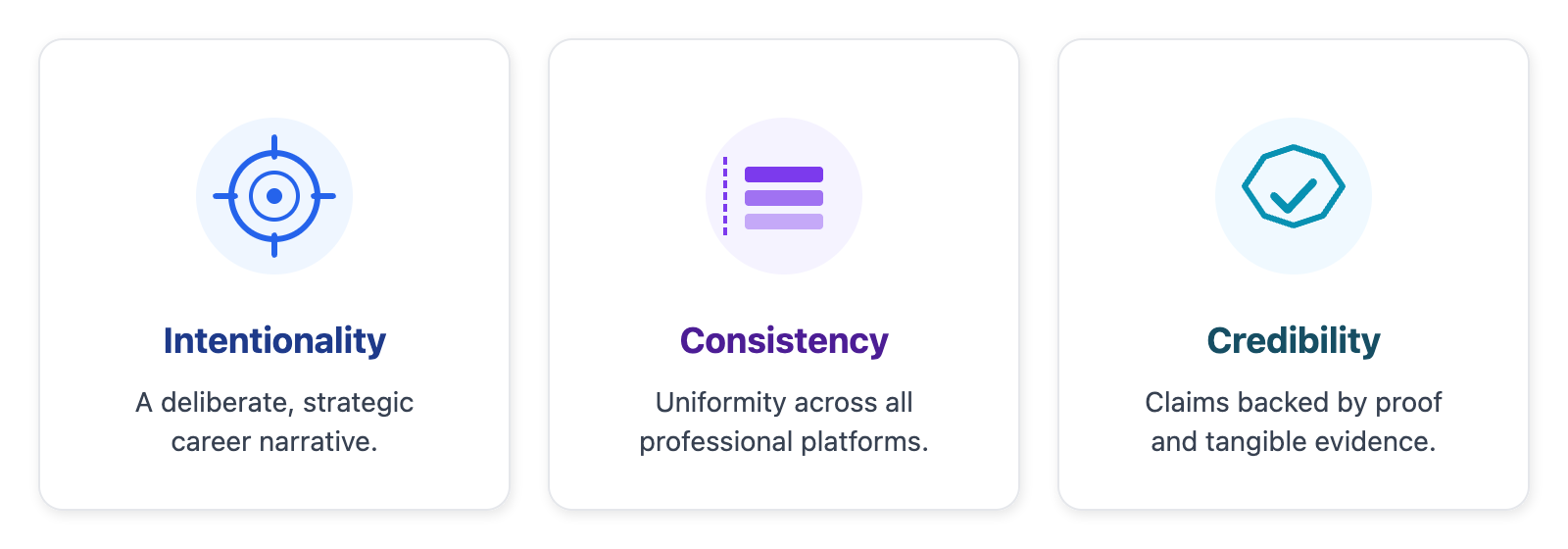
- Intentionality: Your brand should present your career shift as a deliberate and strategic choice, ensuring your narrative feels like a logical progression rather than an accidental change.
- Consistency: All professional touchpoints—including your resume, LinkedIn, and portfolio—must present a unified identity and message to build a clear, recognizable image.
- Credibility: You must back up your claims with tangible evidence, such as certifications, projects, or quantified results, to demonstrate that you possess the skills you claim to have.
Moreover, your brand should evolve as your transition progresses. Early on, it might lean more heavily on your transferable skills and your why for the transition. As you close technical gaps and gain new credentials, you can update your brand to reflect those achievements. Think of your professional brand as a living document, not a one-time exercise — revisit it every time you hit a major milestone on your transition roadmap.
Framing Your "Transferable Skills" Narrative
The concept of transferable skills is familiar to most career changers, but framing them effectively is where most people struggle. Simply listing skills like "leadership, communication, and problem-solving" on a resume does very little because those words are so generic they could apply to anyone. The key is to translate your transferable skills into the language and context of your target field so that a hiring manager immediately sees relevance.
Start by identifying the specific skills from your previous experience that directly serve the needs of your target role. Don't think in abstractions — think in actions and outcomes. Instead of saying "I have strong communication skills," reframe it as "I translated complex quarterly financial reports into actionable insights for the executive team, resulting in a 10% budget reallocation." The second version tells a concrete story that a hiring manager in your target field can immediately connect to their own needs.
A useful formula for crafting these statements is Skill + Context + Result. The skill is what you did, the context is where and how you did it, and the result is the measurable impact you achieved. For example: "Optimized the inventory tracking system for a regional warehouse, reducing manual entry errors by 25%." This formula works because it takes an abstract capability and grounds it in evidence that your target audience cares about. The more specific and quantified you can be, the more credible your narrative becomes.
To see this formula in action, consider the following conversation between two professionals preparing for a career transition:
- Natalie: I've been trying to rewrite my professional summary, but everything I come up with sounds so generic. I keep writing things like
"detailed-oriented professional with strong project management skills."- Dan: That's the trap everyone falls into. Try the Skill + Context + Result formula. Pick one specific thing you did in your last role and describe the impact.
- Natalie: Okay, well... I automated our monthly client reporting process using a new software suite last year.
- Dan: Great — now add the context and the result. How many reports? How much time did it save?
- Natalie: We were doing about 40 reports manually every month. The automation saved the team about 60 hours of work per month.
- Dan: So instead of
"detailed-oriented,"you say"Automated a monthly reporting workflow for 40 clients, reducing team workload by 60 hours per month."See how different that feels?
Notice how Dan guides Natalie from a vague self-description to a specific, evidence-backed statement. The shift from abstract to concrete is exactly what makes the Skill + Context + Result formula so powerful — it forces you to stop claiming your skills and start proving them. It's equally important to acknowledge what doesn't transfer and address it proactively. If a hiring manager can see an obvious gap in your background, pretending it doesn't exist only erodes trust. A stronger approach is to name the gap and then immediately pivot to how you're closing it.
As you refine your transferable skills narrative, test it out loud. Say it to a trusted colleague, record yourself delivering it, or write it out and read it back. If it sounds like a list of buzzwords, rewrite it. If it sounds like a specific, compelling story about someone with a clear direction and relevant experience, you're on the right track. In the upcoming role-play session, you'll get to put this into practice by delivering a concise elevator pitch that brings your new brand and transferable skills together in a real-time conversation. It's one thing to write it — it's another to say it with conviction.
