Networking and Job Search
Strategic Networking and Job Search
In the previous lesson, you developed a targeted learning plan and crafted a professional brand that communicates your new direction with clarity and credibility. Now you need to put that brand to work in the real world. Skills and branding are essential, but they don't create opportunities on their own — relationships do. This is where many career changers stall. You may have a strong network in your current field, but when you're pivoting into unfamiliar territory, your existing contacts may not know the right people, speak the right language, or open the right doors. You already understand that professional trust is built through genuine connection, not transactional exchanges. Throughout this unit, you'll learn how to extend that instinct into new industries, deploy job search strategies that actually work for career changers, and manage the referral process so that your new contacts become active advocates for your candidacy.
Building Relationships in Unfamiliar Industries
Walking into a new industry where nobody knows your name can feel like starting from zero, but it's not. You have something most entry-level candidates don't: years of professional experience, a track record of delivering results and managing projects, and the interpersonal skills to build rapport quickly. The challenge isn't whether you can network — it's knowing where and how to start when you don't yet belong to the community you're trying to join.
The first step is to identify the ecosystem of your target industry. Every field has its own constellation of professional associations, online communities, conferences, Slack groups, LinkedIn communities, and thought leaders. Before you reach out to anyone individually, spend time mapping this ecosystem by subscribing to industry newsletters, following key voices on social media, and joining at least one or two communities where practitioners gather.
Once you've oriented yourself in the ecosystem, begin with informational conversations, not asks. Your goal in these early interactions is to learn, not to land a job. Asking questions like "What surprised you most when you entered this field?" or "What skills do you wish you'd developed earlier in your career?" yields practical intelligence you can't get from job postings, and it also positions you as thoughtful and curious.
A common mistake career changers make is treating networking as a numbers game, blasting connection requests to hundreds of strangers. Resist this urge. Depth beats breadth in career transition networking. Five meaningful conversations with people who understand your story and believe in your potential will generate more opportunities than fifty superficial social media connections. After each conversation, send a personalized thank-you message within 24 hours, reference something specific you discussed, and look for ways to add value back. This could be sharing an article, making an introduction, or offering a perspective from your previous professional experience that's relevant to a challenge they mentioned. Networking is a relationship, not a transaction, and the career changers who internalize this principle are the ones who build lasting bridges into their new fields.
Advanced Job Search Strategies for Career Changers
If you're relying solely on submitting applications through job boards, you're playing a game that's stacked against you. Applicant tracking systems are designed to filter for keywords and linear career progressions. These are two areas where your profile, no matter how strong, may not compete well against candidates with traditional backgrounds. This doesn't mean you should abandon job boards entirely, but it does mean you need to diversify your approach and prioritize high-yield activities over low-yield ones. You can do this in the following ways:
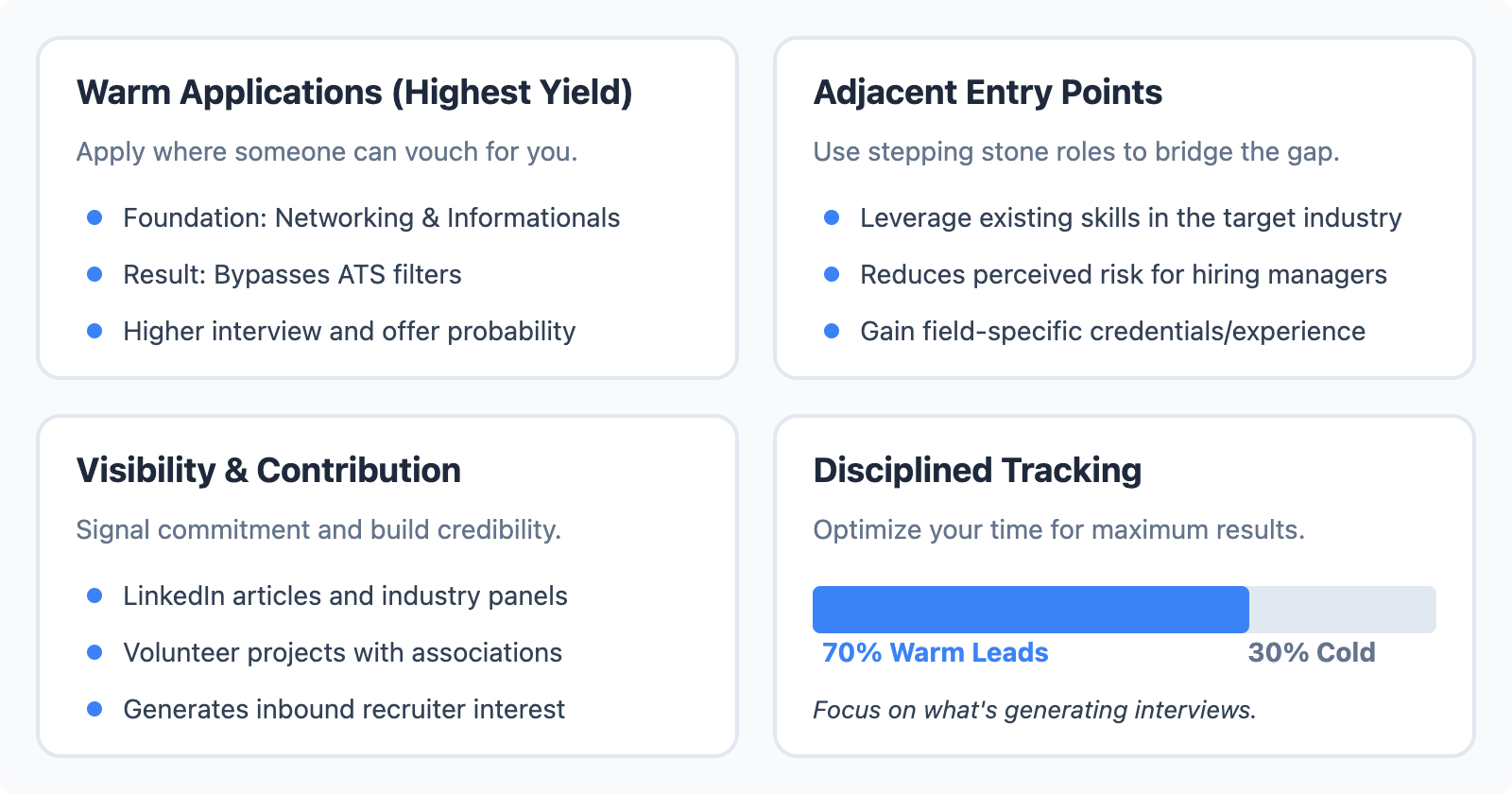
To maximize your efficiency during a pivot, focus your efforts on these four strategic pillars:
- Warm Applications: This is your highest-yield activity. Instead of cold-applying, focus on roles where you have a direct or indirect connection. By using informational interviews to secure an internal referral, you often bypass the automated filters that would otherwise reject a non-traditional resume, significantly increasing your probability of landing an interview.
- Adjacent Entry Points: Look for "stepping stone" roles. This involves identifying positions that bridge your current expertise with your target field. By moving into an adjacent role, you reduce the perceived risk for the hiring manager while gaining the industry-specific credentials and context needed for your ultimate target position.
- Visibility & Contribution: Shift from being a consumer to a contributor. Build credibility in your new field by publishing LinkedIn articles, participating in industry panels, or volunteering for relevant projects. This creates a "proof of work" portfolio that generates inbound interest and validates your brand to recruiters who may be scanning your profile.
- Disciplined Tracking (The 70/30 Rule): Optimize your time based on conversion rates. Career changers should typically allocate 70% of their time to warm leads (networking and referral-based outreach) and only 30% to cold applications. While cold applications provide volume, the warm leads are where your non-linear background is most likely to be understood and valued.
Managing the Referral Process
Referrals are the single most powerful currency in a career transition, but asking for one is where many people stumble. The discomfort is understandable — you're essentially asking someone to put their professional reputation on the line for you. That's why managing the referral process well requires timing, preparation, and respect for the person you're asking.
The first rule is that you should never ask for a referral in your first interaction with someone. A referral is an act of trust, and trust takes time to build. If you meet someone at an event and immediately ask them to refer you to their company, you've turned a potential relationship into an awkward transaction. Instead, invest in the relationship first. Have a genuine informational conversation, follow up with value, and demonstrate over the course of two or three interactions that you're serious, capable, and easy to recommend.
When the time is right to ask, be specific and make it easy. A vague request like "Let me know if you hear of anything" puts the entire burden on the other person and almost never leads to action. A strong referral request sounds more like "I saw that your company posted a Project Coordinator role last week. Based on our conversations, I believe my background in operations and project delivery is a strong fit. Would you be comfortable referring me or introducing me to the hiring manager?" This version tells the person exactly what you need, which role you're targeting, and why you think you're qualified, making it simple for them to say yes and act quickly. To see the difference specificity makes, consider the following exchange between two professionals navigating their transitions:
- Jessica: I had another networking coffee chat yesterday, and at the end I said,
"Just let me know if you hear of anything that might be a fit."It's the third time I've said that to someone, and nothing ever comes of it.- Ryan: That's because you're making them do all the work. They'd have to remember you, figure out what you're looking for, and then match you to a role. That's a lot to ask of someone you've met once or twice.
- Jessica: So what would you say instead?
- Ryan: I'd name the exact role. Last week I told a contact,
"I noticed your company just posted an Analyst position. I've spent five years managing complex data sets and I'd love to be considered. Would you be open to connecting me with the hiring manager?"She said yes on the spot and made the intro that afternoon.- Jessica: That does feel different. It's so specific that all she had to do was forward an email.
- Ryan: Exactly. You're not asking someone to search for opportunities on your behalf — you're handing them a clear, easy action they can take right now.
Notice how Ryan's approach removes ambiguity entirely. By naming the specific role, connecting it to his relevant experience, and making a direct but respectful request, he transformed the ask from a vague favor into a simple, one-step action. Jessica's original phrasing was well-intentioned, but it left her contact without a clear path to help. The lesson here is that the easier you make it for someone to advocate for you, the more likely they are to actually do it.
Equally important is providing your contact with the materials they need to advocate for you. After they agree to refer you, send a brief email that includes your updated resume, a two-to-three sentence summary of why you're a strong fit for the specific role, and any relevant context about your transition that they can share with the hiring manager. Think of this as an advocacy kit. You're not asking your contact to figure out how to sell you — you're giving them the exact language to use.
After the referral is made, follow up and close the loop. Let your contact know when you've applied, when you hear back, and what the outcome is — regardless of whether it's positive or negative. If you get the interview, thank them. If you get the offer, thank them again and find a meaningful way to reciprocate. If you don't get the role, let them know you appreciate their support and that you'll keep them updated on your search.
In the upcoming role-play session, you'll practice navigating the delicate moment when a great informational conversation reaches the point where you can ask for a referral or an introduction. You'll work on transitioning the discussion naturally, making a specific and confident request, and handling the response with professionalism — skills that will serve you throughout your entire career transition and beyond.
