Create a Career Transition Roadmap
Welcome to the Course
You've done the hard work of assessing yourself, researching the market, and making a career decision. Now it's time for the part that separates daydreamers from doers: implementation. Throughout this course, you will learn how to transform your chosen career path into a structured, actionable plan that you can execute with confidence. In any professional setting, vision without execution is just wishful thinking — the same principle applies to your own career.
This course covers four critical areas designed to carry you from decision to action. First, you'll learn how to plan your transition by identifying gaps and building a realistic timeline. From there, you'll develop the specific skills you need while crafting a professional brand that tells your new story. You'll then master strategic networking and job search tactics designed specifically for career changers. Finally, you'll build the accountability systems and emotional resilience that keep your transition on track when things don't go as planned. Once you master the skills in this course, you will have a concrete, personalized roadmap that turns your career decision into reality. Let's start building that plan.
Breaking Down Goals into Milestones and Timelines
A career transition can feel overwhelming when you look at it as one massive leap. The key is to break it into smaller, sequenced milestones — discrete achievements that move you progressively closer to your target role. Think of milestones not as vague aspirations but as specific, time-bound deliverables. For instance, instead of saying "Learn about data analysis," a proper milestone would be "Complete the Google Data Analytics Professional Certificate by March 15." The difference is clarity: one is a wish, the other is a commitment.
Apply the same discipline to your transition that you would to a major project at work. Start by identifying your end-state goal — the role you want to land — and then work backward. Ask yourself what needs to be true six months before you get that offer, then three months before, and then one month before. This reverse-engineering approach naturally produces a sequence of milestones that build on one another logically.
A practical structure many career changers use is to organize milestones into three overlapping phases. The first phase, Research and Preparation, typically covers months one and two and focuses on finalizing your gap analysis and laying the groundwork. The second phase, Skill Building and Branding, spans months two through four and centers on closing critical gaps and updating your professional narrative. The third phase, Active Job Search, runs from months four through six and involves targeted applications, networking, and interviews. These phases can overlap, but they provide a logical sequence that prevents you from, say, applying for jobs before you've updated your resume or closed critical skill gaps.
Identifying the "Experience Gap" Between Current and Target Roles
The Experience Gap is the distance between what your current professional profile demonstrates and what your target role demands. Identifying this gap honestly is the most important analytical step in your transition — without it, you're guessing at what to learn and hoping for the best.
Start by pulling three to five job descriptions for your target role and highlighting every requirement, including technical skills, soft skills, certifications, tools, and years of experience. Then create two columns: What I Already Have and What I Need. Be ruthlessly honest with yourself. If a role asks for "experience with SQL" and you've only used basic spreadsheets, that belongs in the gap column.
Gaps generally fall into two categories. Technical gaps involve specific tools, certifications, or domain knowledge — things like "proficiency in Salesforce" or "CAPM certification." These are often the most straightforward to close because they have clear learning paths. Soft skill or experience gaps, on the other hand, are harder to address quickly and involve requirements like "experience managing complex projects" or "stakeholder management." Most professionals already have a rich set of soft skills — communication, problem-solving, time management — that are highly transferable. The trick is recognizing which of those skills directly map to your target role and where genuine gaps remain.
To see how this plays out in practice, consider the following conversation between two professionals discussing a career transition:
- Natalie: I've been looking at Project Manager roles, and honestly, I feel like I'm missing everything they're asking for.
- Ryan: Have you actually mapped it out? When I did mine, I realized I already had about 70% of what they wanted. The gap felt huge until I wrote it down.
- Natalie: Not formally. They keep mentioning Agile certification and experience with Jira. I don't have either.
- Ryan: Okay, but those are technical gaps — you can close those with a course and some hands-on practice. What about the soft skill side? You've been coordinating cross-departmental product launches for three years. That is project management.
- Natalie: I never thought of it that way. I kept reading
"track record of managing complex projects"and assuming it meant something different than what I've done in Marketing.- Ryan: That's exactly why the two-column exercise matters. You separate what you genuinely need to learn from what you already have but haven't learned to articulate yet.
Notice how Ryan's advice illustrates the core method of this section: by separating gaps into technical versus soft skill categories and mapping them against what's already there, Natalie moves from feeling overwhelmed to seeing a clear, manageable path forward. Much of what feels like a gap is often a framing problem rather than a skills problem.
Not all gaps carry equal weight, so prioritization matters enormously. Ask two guiding questions about each gap: How frequently does this requirement appear across job postings? and Is this a "must-have" or a "nice-to-have"? A skill that shows up in every listing as a core requirement is a gap you must close before applying. Conversely, a skill mentioned once as preferred can often be addressed after you land the role. This prioritization prevents you from spending months chasing marginal credentials while ignoring the critical ones.
Creating a Realistic Transition Roadmap
Now it's time to stitch your milestones and gap analysis together into a single, living document: your transition roadmap. Think of it as a project plan for the most important project you'll ever manage — your career.
A strong roadmap weaves together four components into one cohesive plan. It starts with a timeline that spans at least three to six months, segmented into the phases you defined earlier. Within that timeline, you place specific milestones assigned to each phase, ensuring a logical progression. Alongside each milestone, you note the resources needed to achieve it — courses, mentors, networking events, or budget. Finally, you build in regular checkpoints where you pause and evaluate whether the plan needs adjustment. For example, a professional pivoting into a new field might structure their roadmap like this:
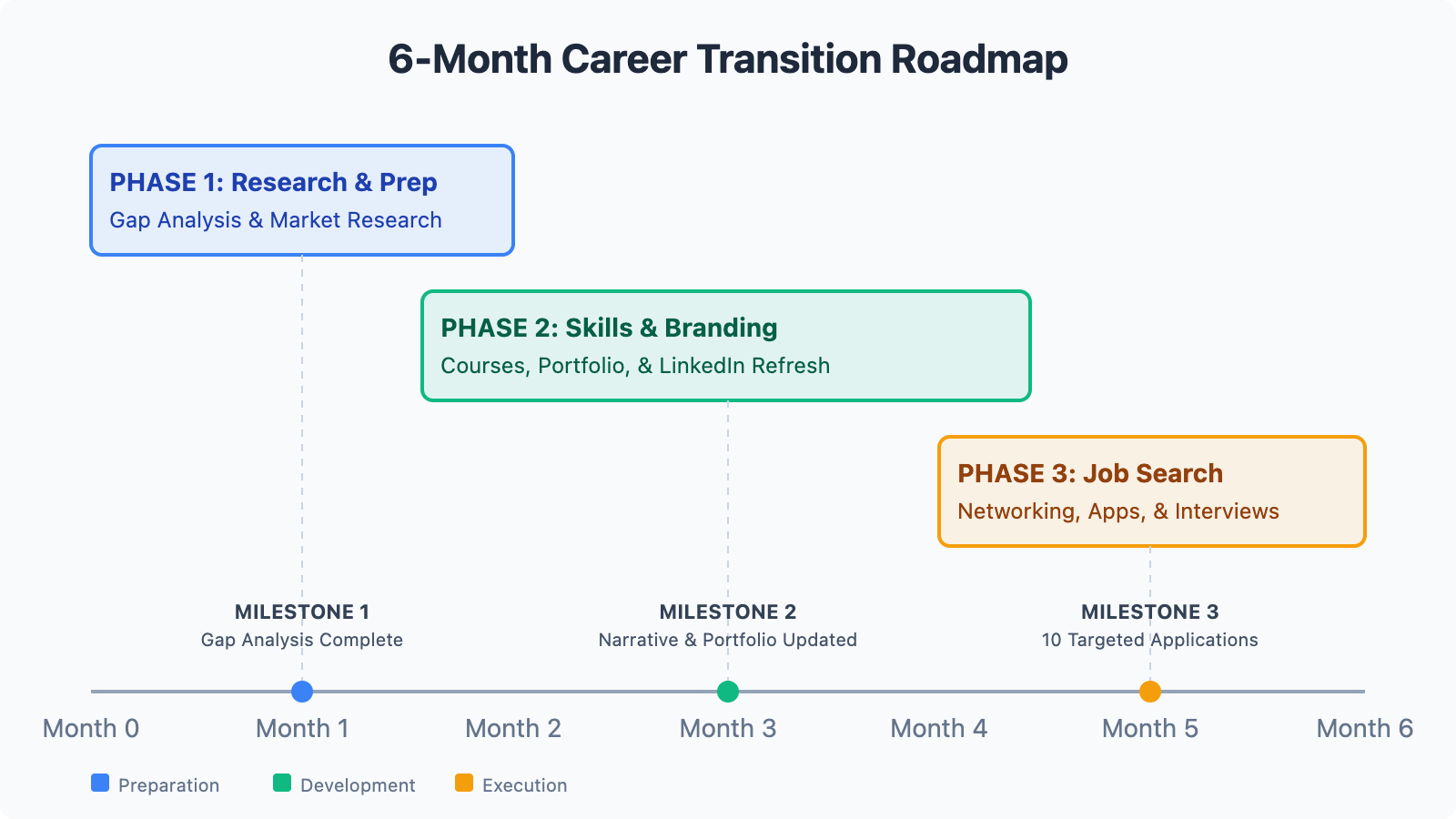
Realism is what separates a useful roadmap from a fantasy document. Be honest about your available time. If you're still working in your current role full-time, you probably can't dedicate 20 hours a week to transition activities. Build your plan around the time you actually have — even if that's just five focused hours per week. A slower plan that you execute consistently will always beat an ambitious plan that collapses in week three.
Furthermore, building in flexibility is essential. Your roadmap is a guide, not a contract. Market conditions shift, unexpected opportunities appear, and some skill gaps take longer to close than you anticipated. Schedule a brief self-review every two weeks where you ask yourself: "Am I on track? What's changed? What do I need to adjust?" This habit keeps you accountable without making the plan feel rigid or punishing.
With your roadmap drafted, you're ready to put these concepts into practice. In the upcoming role-play session, you'll practice explaining your career pivot to a peer in a way that highlights your transferable skills and reframes your experience gap as a strength. It's a conversation every career changer needs to master — and it starts now.
