Write a Better Problem Statement
Choose the Right Subject 🎯
Experts emphasize that the way you frame a problem has a major impact on the solutions you find, according to Daniel Markovitz in the HBR Guide to Critical Thinking. It often comes down to two overlooked details: how you phrase the subject of your problem statement, and how you measure the problem itself. Even a small change in either can send your problem-solving efforts in dramatically different directions. Throughout this lesson, you'll learn to analyze how the subject of a problem statement shapes accountability, explore how different measurements can lead to entirely different diagnoses, and practice rewriting problem statements to deliberately shift perspective and unlock better solutions.
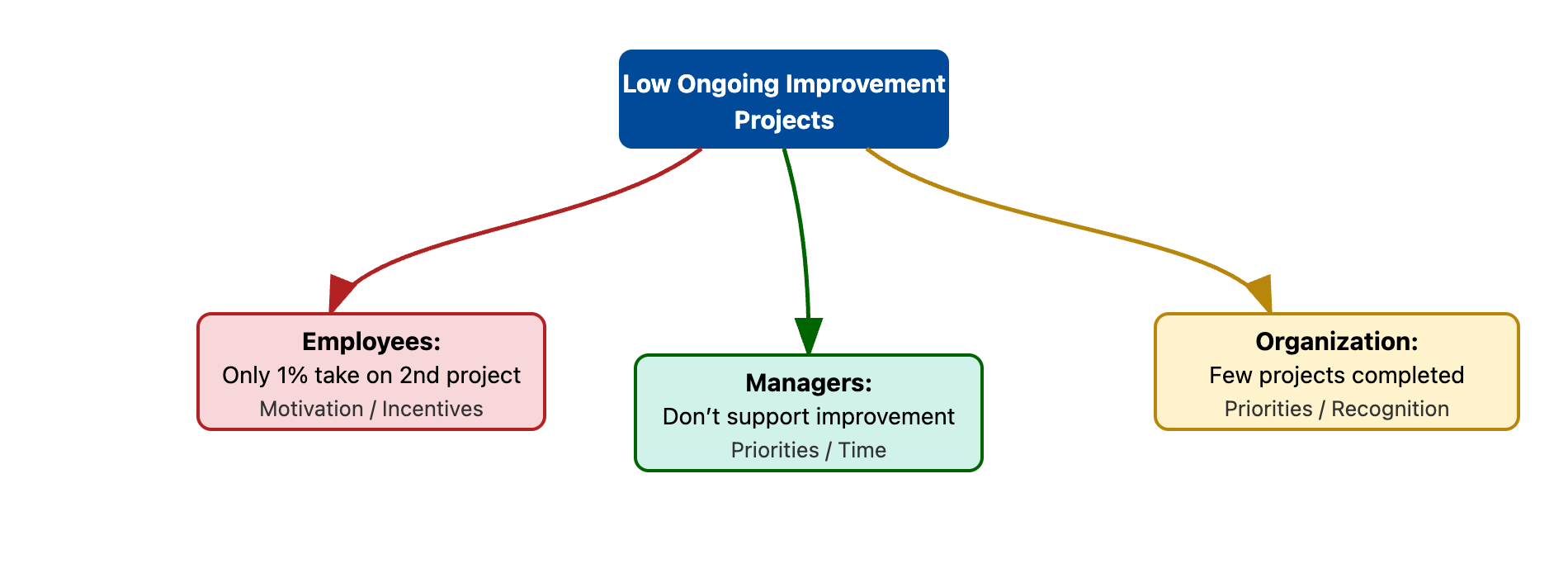
The subject of your problem statement—who or what you place at the center of it—determines where you focus your attention and what kinds of solutions you'll consider. For example, imagine a company that wants employees to keep improving their work processes, but most people only complete one improvement project and then stop. You could frame this problem in different ways:
- If you focus on employees, you might say, "Only 1% of our staff takes on a second improvement project," which leads you to investigate their motivation or incentives.
- If you focus on managers, you might say, "Our managers don't support ongoing improvement," which prompts you to look at how managers set priorities or make time for these projects.
- If you focus on the company as a whole, you might say, "Our company completes only a handful of improvement projects each year," which raises questions about company-wide priorities and recognition.
Each version points to a different group as the main subject—employees, managers, or the organization—and each one leads to different solutions. By deliberately changing the subject of your problem statement, you can uncover new ways to address the issue and avoid getting stuck on just one perspective.
Rethink Measurements to Reveal New Insights 📏
Just as the subject of your problem statement determines your focus, the way you measure the problem shapes your understanding of it. Consider the challenge of a business that feels it isn’t innovating enough—how you define and measure that shortfall can lead to very different conclusions:
-
"We're not as innovative as our competitors."
This broad framing immediately raises important questions: What does “innovative” actually mean here? How do you and your competitors define or measure innovation? Are you counting the number of new products and services, or the revenue they generate? If you launch only one new product a year but it’s a major success, does that count as innovative? Is quality more important than quantity? Before you can address the problem, you need to clarify what innovation means for your organization, and this process may reveal hidden assumptions. -
"We bring only one new product or service to market each year."
This approach measures output directly and draws your attention to the innovation process itself. You might start asking how many ideas are generated, how many make it through approval, and what criteria are used to select them. It also leads you to consider company culture: Are people hesitant to take risks, or does the environment encourage experimentation? Who is recognized for innovative ideas—the originator or someone higher up? This measurement steers you toward examining processes and culture rather than just results. -
"Only 5% of our revenue comes from products developed in the past three years."
This framing focuses on financial impact and shifts your attention to what happens after a product is launched. Perhaps your organization is good at developing new ideas, but struggles to market or sell them effectively. For example, a sales team might prefer established products and overlook new offerings, so the real issue is not innovation itself, but the ability to commercialize new products.
Each of these measurements highlights a different aspect of the same broad concern. When you consider how a problem is being measured, ask yourself what the chosen metric actually reveals, what it might miss, and how using a different measurement could lead to a new understanding of the issue. The goal isn’t to find a single “correct” metric, but to recognize that the data you choose will shape your perspective and the solutions you pursue.
Rewrite Problem Statements ✍️
Now that you see how the subject and measurement of a problem statement can shape your approach, you can use this insight intentionally. When you’re dealing with a tough issue, try rewriting your problem statement on purpose by switching the subject to explore who else might be responsible or what other factors could be involved, and adjusting the measurement to highlight different aspects of the problem.
Take a typical challenge: your organization feels that “our teams lack innovation.” You can reframe this by changing the subject. For example, “our leadership team doesn’t set aside time for experimentation” shifts the focus to senior leaders. Or, “our incentive structure encourages risk avoidance” draws attention to how the organization is designed. You can also reframe the problem by changing how you measure it. For instance, “we haven’t launched any products in new market segments this year” focuses on strategic direction. “Our employees submit fewer than five new ideas per quarter” highlights participation and engagement. Each measurement brings a different part of the innovation challenge into focus and suggests different questions to explore.
Let’s look at how this plays out in a real conversation:
- Ryan: I'm stuck on this problem with my team. They just aren't motivated anymore, and productivity has dropped significantly.
- Jessica: How are you framing the problem exactly?
- Ryan: I've been thinking of it as "My team isn't motivated enough to meet our goals."
- Jessica: What if you changed the subject? Instead of focusing on the team, what if the problem was framed around you or the organization?
- Ryan: What do you mean?
- Jessica: Try rewriting it as "I'm not providing enough clarity on priorities" or "Our recognition system doesn't reward the behaviors we need."
- Ryan: That completely changes what I'd do about it. If it's about clarity, I'd look at how I communicate goals. If it's about recognition, I'd look at our reward structure.
Notice how Jessica doesn't argue with Ryan's initial framing—she simply asks him to try different subjects. By shifting from "the team" to "me" or "our systems," Ryan immediately sees new levers he can pull. All three statements describe the same underlying issue—low motivation and productivity—but the shift in subject completely changes who is held accountable and what interventions make sense. When you write a problem statement, you're not just describing reality; you're directing attention.
The goal isn't to find the perfect problem statement on the first try. Rather, it's to generate multiple framings so you can see the issue from different angles before committing to a solution path. Deliberately rewriting your problem statement helps you break out of the tunnel vision that comes from sticking with your initial framing. It also makes it easier to communicate with stakeholders who may see the issue differently. When you can express a problem in multiple ways, you show a deeper understanding and create more opportunities for creative, effective solutions.
By learning to intentionally shift both the subject and the measurement in your problem statements, you can uncover new insights and expand the range of possible solutions. In the upcoming activities, you'll practice analyzing how different subjects and measurements change the nature of a problem, and you'll work on communicating these shifts to help others see issues from new perspectives.
