How to Stop Overthinking
Distinguish Intuition from Fear and Perfectionism 🧭
Critical thinking is essential, but there comes a point when more analysis just gets in your way. In a world obsessed with data and rationality, gut instincts are often dismissed as vague or mystical—yet research cited by Melody Wilding in the HBR Guide to Critical Thinking shows that combining intuition with structured analysis leads to quicker, more accurate decisions, especially in complex situations. This is particularly important when you're stuck in overthinking or when there is no obviously "correct" answer.
Before you can trust your gut, you need to know whether what you're feeling is actually intuition—or something else masquerading as insight. Fear and perfectionism are the two most common impostors that lead to overthinking, and learning to distinguish them from genuine intuition is a critical skill for any leader. Let's look at the differences between fear, intuition, and perfectionism:
| Fear | Intuition | Perfectionism | |
|---|---|---|---|
| Energy | Pushing—feels forced, urgent, or desperate | Pulling—feels steady, encouraging, and natural | Paralyzing—stuck in endless analysis |
| Physical Sensation | Tension, tightness, or shrinking | Relaxation, ease, anticipation | Overwhelm, mental fatigue |
| Inner Voice | Self-critical, urges you to hold back or avoid risk | Steady, supportive, grounded | Insists on knowing everything, demands the "perfect" answer |
| Thought Patterns | Worried about making mistakes or missing out | Drawn toward what feels meaningful or right | Believes there's only one right choice and fears any option is insufficient |
Consider how these mindsets might sound when you’re deciding whether to bring up a concern in a leadership meeting. Fear might tell you that speaking up will make you look unprepared if you’re mistaken. Perfectionism suggests you should wait until you have all the supporting facts and an airtight case. Meanwhile, intuition nudges you to speak up because the issue feels important, even if you don’t have every detail resolved. The difference is clear: fear discourages you from taking any risk, perfectionism stalls you with impossible standards, while intuition draws you toward action that fits your values.
Use Rapid, Low-Risk Experiments 🧪
When you're first learning to trust your intuition, decisions may not come quickly—and that's okay. Rather than spinning in circles trying to analyze your way to clarity, you can "try on" your options through quick, low-risk experiments that help you hear what your gut is really saying.
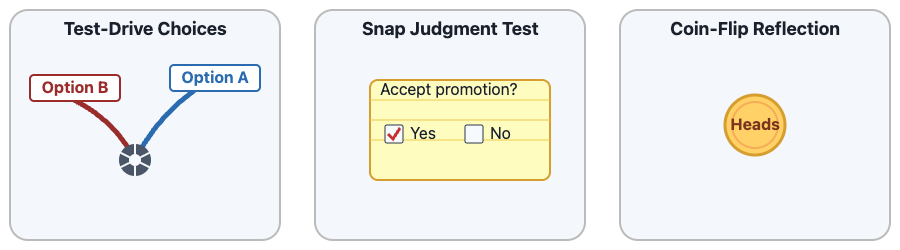
One effective technique is to temporarily test-drive your choices. For a couple of days, behave as if you've picked Option A. For example, if you’re thinking about changing jobs, spend those days picturing yourself in the new role as you go about your daily routine. Pay attention: Do you notice a sense of excitement, or do you feel an underlying sense of dread? Next, dedicate another block of days to imagining you’ve committed to Option B—maybe staying in your current position. At the end of both periods, reflect on your thoughts and emotions. This type of real-life simulation can surface your true preferences, even if the logical arguments for each choice seem equally strong.
Another powerful approach is the snap judgment test, which relies on rapid cognition to bypass overthinking. Write down your question—something like "Will accepting this promotion make me happy?"—with space for a "yes" or "no." Step away and return after some time has passed, then circle your answer immediately, before your mind starts analyzing. Your first reaction might surprise you, but it often reveals what you really feel beneath the surface. Over time, this quick-response practice can help you get better at tuning into your true intuition.
For a simple but revealing experiment, flip a coin—assign each outcome to an option you’re choosing between. The key isn’t to let fate decide for you, but rather to pay attention to your gut reaction when you see the result. Relief or disappointment in response to the outcome provides valuable feedback about your deepest preferences.
These low-pressure experiments are useful because intuition is simply your brain rapidly sorting through past experiences and personal needs in tandem with your emotional cues. By giving yourself a playground to simulate your options, you allow those hidden insights to surface before your rational mind buries them under too much analysis.
Apply Values-Based Gut Checks 💡
Once you've separated true intuition from fear and perfectionism and tested your options with small experiments, you’ll still sometimes find yourself stuck when the facts aren't clear or the stakes feel high. In these moments, your core values can become a powerful guide to making decisions that feel right for you, even in ambiguity.
Your values are the things that matter most to you. When you’re grappling with a tough choice, often the anxiety or second-guessing comes from a conflict between your options and one of your key values. Being able to recognize this link helps cut through overthinking and gets you closer to an answer that genuinely fits who you are.
To apply a values-based gut check:
- Start by identifying your top one to three core values—not what you wish you valued, but the principles that consistently shape your best decisions.
- When you catch yourself endlessly analyzing, ask yourself: Which option brings me closer to what I value most?
- This reframing helps reduce mental noise and indecision, replacing the question "What is the objectively correct choice?" with "What is the right choice for my values and circumstances?"
By narrowing your field of view to what truly matters, it becomes much easier to take concrete action without the need to anticipate every possible outcome.
Let’s see how a values-based gut check plays out in a real-world conversation between two managers:
- Milo: I've been putting off a performance conversation with someone on my team. I keep telling myself I need more documentation first.
- Victoria: Let's pause. What is most important to you in your role as a manager—your core values?
- Milo: I really value honesty and helping people grow.
- Victoria: When you weigh your options, which one brings you closer to those values?
- Milo: Having the conversation, even if it’s uncomfortable.
- Victoria: Sometimes our values are the clearest guide, even when it’s hard.
By grounding his decision in his core values, Milo can see that taking action—though uncomfortable—best reflects what matters most to him as a manager.
Finally, keep in mind that intuition and values need breathing room. If you're constantly busy or under stress, it’s easy for gut instincts to get drowned out. Give yourself moments of quiet or space to step away from the issue.
While intuition isn’t infallible, combining it with honest reflection on your values gives you both a compass and the confidence to move forward, even when everything isn’t certain. In the upcoming roleplay and writing activities, you'll practice identifying the difference between fear-driven and intuition-driven responses, designing low-risk experiments to test your options, and communicating values-based decisions confidently.
