Are you Solving the Right Problems?
Clarify the Real Problem 🧭
When organizations struggle to solve problems effectively, it’s rarely because leaders lack intelligence or problem-solving skills. Instead, the real issue is that people often jump too quickly into solution mode without pausing to check whether they truly understand the problem at hand. Thomas Wedell-Wedellsborg, featured in the HBR Guide to Critical Thinking, found that 85% of C-suite executives agreed their organizations were bad at problem diagnosis—and 87% said this flaw carried significant costs. In this lesson, you’ll learn how to resist that pull toward premature solutions, discover how reframing can unlock dramatically better outcomes, and practice seven specific techniques you can use in everyday conversations to ensure you’re working on the right challenge.
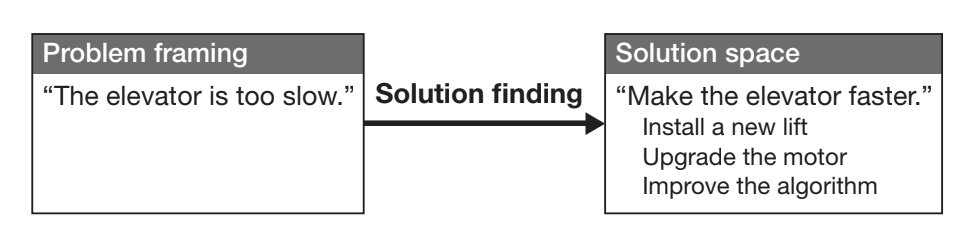
Consider this scenario, often called the slow elevator problem: You own an office building, and tenants are complaining that the elevator is too slow. Several are threatening to break their leases. What would you do?
Most people immediately suggest solutions like "replace the elevator," "install a stronger motor," or "upgrade the algorithm." These are reasonable ideas, but they all share the same underlying assumption: that the problem is the elevator’s speed.
But building managers sometimes take a completely different approach: "Put up mirrors next to the elevator." This simple step has been surprisingly effective at reducing complaints. Why? Because people tend to lose track of time when they have something interesting to look at—like their own reflection. The mirror doesn’t make the elevator faster; it changes the problem from one of speed to one of how people experience waiting.
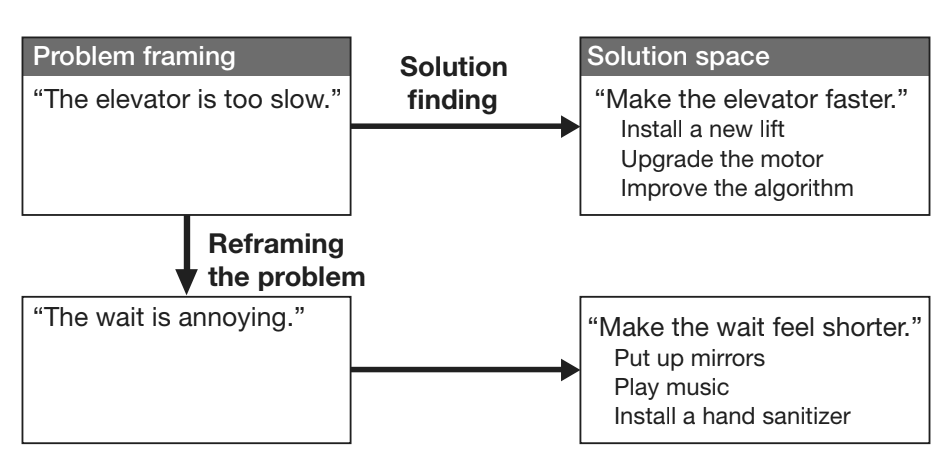
This is the trap of jumping straight to solutions. When you do this, you get stuck in a single way of seeing the problem and may miss better options. Instead of asking, "How do we fix this?" it’s often more useful to pause and ask, "Is there a different problem we could be solving?" Problems usually have multiple causes and can be addressed in many ways—the slow elevator could also be seen as a peak demand issue, leading to ideas like staggering lunch breaks. Pausing before acting doesn’t mean avoiding action; it means making sure your efforts are aimed at the right target.
Reframe Problems to Unlock Better Solutions 🔄
Reframing is not the same as root cause analysis or digging deeper into an existing diagnosis. It's about stepping back and asking whether a completely different definition of the problem might lead to better outcomes.
For example, consider this conversation between two managers:
- Nina: I think we need to sign the whole team up for time management training. They keep missing deadlines.
- Jake: Before we do that, can I ask—what's actually happening when deadlines get missed?
- Nina: Well, people say they're overwhelmed. There's too much on their plates.
- Jake: So the problem might not be that they lack time management skills. What if the problem is actually unclear prioritization or too many competing demands?
- Nina: I hadn't thought of it that way. If that's the case, training wouldn't help at all.
- Jake: Exactly. It might be worth exploring what's really driving the missed deadlines before we commit to a solution.
In this exchange, Jake doesn’t reject Nina's idea or argue against training. Instead, he asks a clarifying question that encourages Nina to reconsider her assumptions. This shift opens up a different set of possible solutions—ones that are more likely to address the real challenge.
Sometimes, what looks like a skills gap is actually a motivation or engagement issue. Other times, what appears to be a usability problem is really an emotional barrier. When teams pause to question their initial assumptions and reframe the problem, they often discover more effective and targeted solutions. Reframing isn’t about digging deeper into the first answer—it’s about stepping back and asking if a different definition of the problem might lead to better results.
Apply Seven Practices for Effective Reframing 🧠
Reframing sounds powerful in theory, but how do you actually do it? Here are seven practices you can use, either methodically in about 30 minutes or selectively when you only have five minutes to help someone rethink a challenge:
-
Establish legitimacy. Before slowing down a conversation, make sure others understand why you’re pausing to examine the problem. People may see your questions as a distraction, so briefly explain the value of reframing. Sharing a story like the slow elevator example can help illustrate your point. Once people see the benefit, they’re more open to stepping back from solution mode.
-
Bring in outsiders. Invite people who understand your context but aren’t fully embedded in your team or group. Outsiders can offer fresh perspectives and challenge assumptions. Ask them to help the group see things differently, not to provide ready-made solutions.
-
Get definitions in writing. Before discussing the problem, have each person write down their definition in a sentence or two. Differences in wording can reveal hidden assumptions about ownership and accountability, and help clarify who sees the problem as theirs to solve.
-
Ask what’s missing. Explicitly ask what hasn’t been captured or mentioned in the current problem framing. This can surface overlooked factors or blind spots that might offer new ways forward.
-
Consider multiple categories. Ask the group to identify what type of problem they think they’re facing—such as incentives, expectations, skills, or something else. Then suggest alternative categories. Simply naming the type of problem can help people see new possibilities.
-
Analyze positive exceptions. Look for times when the problem didn’t occur and ask what was different in those situations. Studying successes can reveal practical levers for improvement and make the conversation less threatening.
-
Question the objective. Sometimes the best reframe comes from challenging the stated goal itself. Ask, “What are we really trying to achieve here?” Surfacing different stakeholders’ true objectives can reveal new solutions that satisfy everyone’s needs.
These practices won’t always produce an immediate breakthrough, but they reliably help generate fresh perspectives. When you’re close to a problem, it’s easy to get stuck in the details and miss alternative explanations. Sometimes, all it takes is someone asking a simple, unexpected question to help you see the situation differently. Even a few minutes spent reframing can be enough to change your entire approach.
Reframing problems is a powerful way to avoid wasted effort and unlock better solutions. Next, you’ll have the opportunity to apply what you’ve learned. You’ll practice slowing down the rush to solutions, experiment with reframing problems from different angles, and use the seven techniques to uncover more effective ways to define and address challenges—both for yourself and with your team.
