To Change the Way You Think, Change the Way You See
Welcome to the Course 🎉
Welcome to Framing the Right Problem! Critical thinking is one of the most valuable skills you can develop as a leader. But before you can analyze data, weigh options, or make sound decisions, you need to make sure you're working on the right problem in the first place. Drawing on insights from the HBR Guide to Critical Thinking and the work of leading experts like Adam Brandenburger, you will build the foundation of critical thinking by learning how to define problems clearly, frame them effectively, and ensure you're solving the right issue—not just the most obvious one.
In this lesson, you'll learn how to sharpen your critical thinking by changing the way you see problems before you try to solve them. You'll practice distinguishing between pure observation and interpretation, discover techniques for defamiliarizing the familiar to uncover hidden opportunities, and learn how to counter mental habituation so you can spot issues others overlook.
See Before You Conclude 👀
The first step in thinking critically is learning to separate what you see from what you conclude. This sounds simple, but it's surprisingly difficult. Our brains are wired to interpret instantly—we don't just notice that a colleague was quiet in a meeting, we decide they're disengaged or upset. We don't just observe that a project is behind schedule, we assume someone dropped the ball. These interpretations happen so quickly that we often mistake them for facts.
So what does observation without interpretation actually look like? It means describing only what you can actually see or hear, without making assumptions, judgments, or adding any backstory. If you walked into a room and saw papers scattered across a desk, the observation is simply: "papers are scattered on the desk." The interpretation, on the other hand, might be "this person is disorganized" or "they're overwhelmed with work." Those are conclusions, not facts, and treating them as facts can lead you to solve the wrong problem entirely.
Consider this conversation between two managers discussing a team member:
- Nova: I noticed Ryan hasn't been participating much in our team meetings lately. He's clearly checked out and probably looking for another job.
- Marcus: What specifically have you observed in the meetings?
- Nova: Well, he hasn't spoken up in the last three meetings and he's been looking at his laptop instead of engaging.
- Marcus: So the observation is that he hasn't spoken and has been on his laptop. The "checked out" and "job hunting" parts are interpretations, right?
- Nova: I guess you're right. There could be other explanations—maybe he's overwhelmed with a project or dealing with something personal.
- Marcus: Exactly. Separating what you see from what you conclude opens up different ways to approach the conversation with him.
Notice how Marcus helped Nova distinguish between what she actually observed—silence and laptop use—and the conclusions she jumped to about Ryan's motivations. This simple shift creates space for curiosity rather than judgment and opens up entirely different paths forward.
One practical technique is to describe a situation out loud or in writing to another person. Talking through your observations with someone else often reveals key points you might have otherwise missed. When you articulate only what you observe, you slow down your thinking and create space to notice what's actually there rather than what you expect to find. This discipline becomes the foundation for everything else in critical thinking.
Defamiliarize the Familiar 🔍
Great innovators don’t just think differently—they see differently. They view the ordinary world in unfamiliar ways and, as a result, notice opportunities that others overlook. This practice is known as defamiliarization: the deliberate act of making the familiar strange.
Take the story behind Velcro. Swiss engineer George de Mestral became curious about the burrs that stuck to his clothes after a walk in the woods. Examining them under a microscope, he discovered they had tiny hooks that latched onto fabric loops. While most people would have ignored this everyday annoyance, his close observation led to the invention of Velcro. By looking at what was right in front of him with fresh eyes, he uncovered a solution others missed.
You can build this same skill using the Defamiliarization Three-Step Method:

- Shift Your Perspective: Intentionally look at an object, process, or situation from an unusual angle. Imagine how someone unfamiliar with it might describe what they see.
- Rename and Reframe: Avoid using the usual names or labels. Give things new, descriptive names based on what they actually do or how they function. This helps you reconsider their purpose and role.
- Break Down the Familiar: Divide a familiar situation into its smallest parts and examine each one as if you’re seeing it for the first time. Ask yourself what stands out, what seems odd, or what questions arise.
By following these steps, you can break free from default thinking and uncover insights that are often hidden in plain sight.
Make the Invisible Visible 🫥➡️💡
There's a reason we stop noticing things that are familiar: our brains are built to tune out what doesn’t change. Once we’ve seen or experienced something enough times, we start to overlook it. This helps us focus on what’s new or important, but it also means we can miss problems or opportunities that are right in front of us. This is called habituation.
We often overlook problems that have become part of the background. Take a look at these two office scenes—can you spot what’s being missed? Just like in this picture, hidden issues in our daily routines can go unnoticed unless we make a conscious effort to see them with fresh eyes.
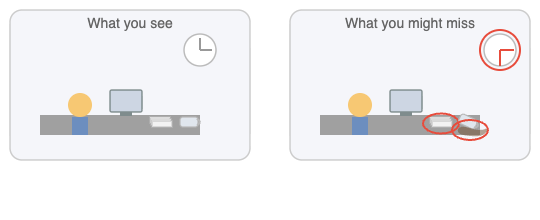
A striking demonstration of this phenomenon is called Troxler fading. If you stare at a fixed point while a steady image sits in your peripheral vision, that image will actually disappear after a while. Your brain simply stops registering it. The same thing happens in our work lives. A bottleneck in a process, a recurring frustration in meetings, an assumption everyone shares—these things can become so familiar that we stop seeing them altogether. They become invisible, and invisible problems are impossible to solve.
To counter habituation in your own work, actively question what has become invisible. Ask yourself what you and your team have stopped noticing, and what you accept as "just the way things are." When you catch yourself or your colleagues treating something as fixed or obvious, pause and examine it with fresh eyes. This is how you begin to see problems more clearly, and how you build the foundation for solving the right ones.
Ready to practice these skills? In the upcoming activities, you'll work on interrupting habitual thinking and separating observation from explanation in real time—turning these concepts into practical leadership skills.
