Measure Shapes by Counting Units
Introduction 🎉
Welcome back to Foundations of Geometric Measurement! Last time, the difference between perimeter, area, and volume was identified by asking one simple question: Am I going around an edge, covering a surface, or filling a space? That gave a reliable way to identify what to measure. Now it is time to answer a follow-up question: how is it actually measured? In this lesson, you will learn:
- How perimeter is built from linear units by counting individual edge lengths along a shape's boundary.
- How area is built from square units by counting the flat squares that cover a shape's surface.
- How volume is built from cubic units by counting the cubes that fill a solid's interior.
Every type of measurement has a unit that matches its dimension. A boundary is one-dimensional — it only has length — so it is measured with a one-dimensional unit: a single length. A surface is two-dimensional, stretching across both length and width, so it is measured with a two-dimensional unit: a small square. A filled space is three-dimensional, extending through length, width, and height, so it is measured with a three-dimensional unit: a small cube.
This is the core principle behind today's lesson. Once the target of measurement (boundary, surface, or space) is known, the matching unit follows naturally. The rest of this lesson puts that principle into action with concrete counting examples to show exactly how each unit type works.
Linear Units: Counting Boundary Lengths 📏
When measuring perimeter, the focus is on the outer edge of a flat shape. The units being counted are linear units — individual length segments along that edge. Think of each linear unit as one step an ant takes while walking the border.
Consider a rectangle on a grid. To find its perimeter, track the distance along the boundary and count every unit-length segment. Imagine counting each segment one by one along the top, right, bottom, and left edges until the path returns to the start.
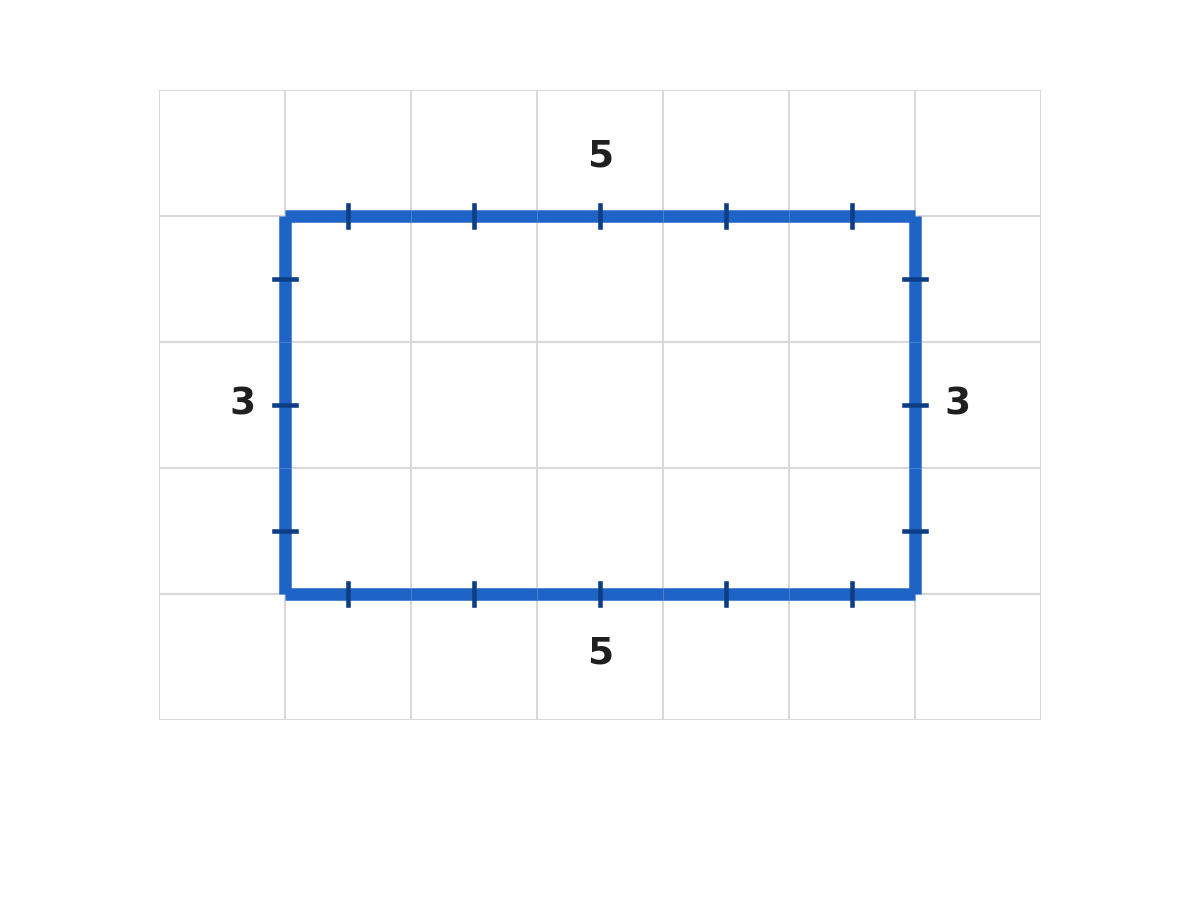
Notice that the inside of the rectangle never comes into play here. Only the segments along the border get counted. Each segment is a single straight length, which is why perimeter is measured in linear (one-dimensional) units. Picture that ant from before: it can only crawl forward or backward along the edge — never sideways into the shape or up off the page. That single line of travel is what "one-dimensional" means. So as the ant counts its steps around the border, it is only ever adding up lengths, and the perimeter it ends up with is itself just a length: the total distance all the way around.
Square Units: Counting Covered Squares 🔲
When measuring area, the focus shifts from the boundary to the flat surface inside the shape. The unit that fits this job is a square unit: a small square whose sides are each one unit long.
Picture the same rectangle, but this time imagine laying tiny square tiles across its surface until every bit is covered. Counting the tiles row by row reveals the total surface covered.
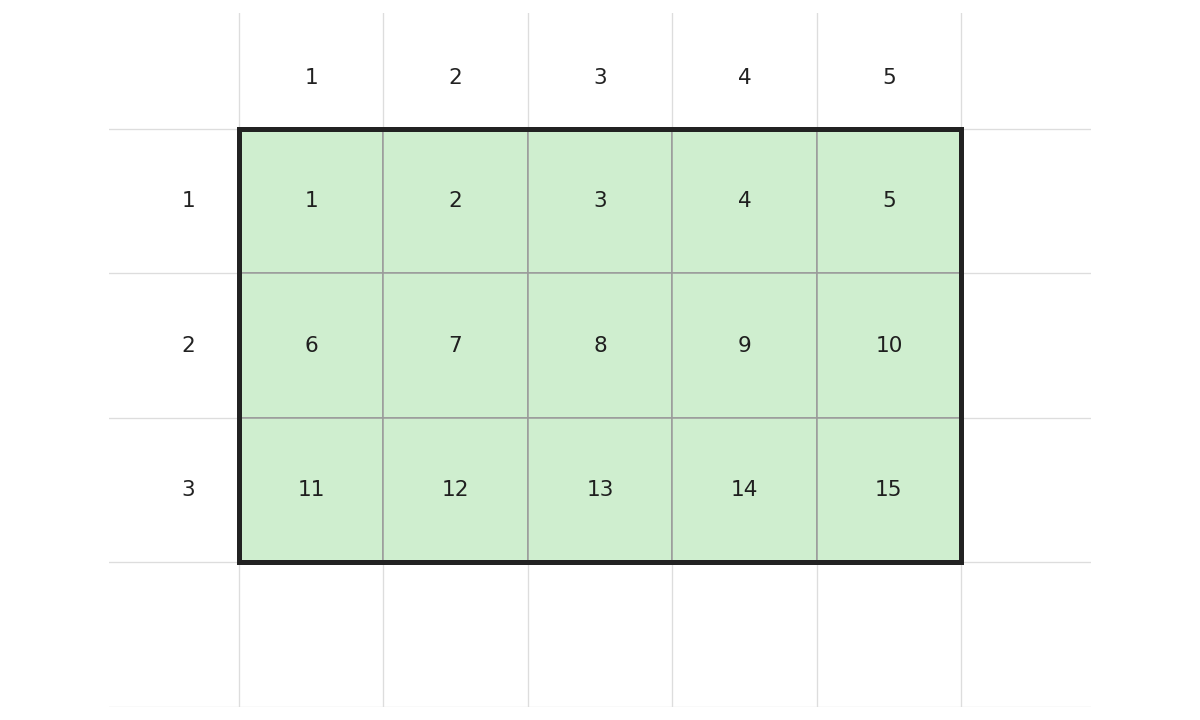
Each tile has two dimensions (length and width), which is why they are called square units. A single square unit is often written as because it takes two lengths — one across and one down — to define it. Think back to our ant: walking in one straight line only traces an edge. To cover a whole tile, the ant needs to move in two directions — across and down. That second direction is the extra dimension, which is why area is "two-dimensional." So instead of counting steps along an edge, flat tiles are counted across the surface, and the total number of squares that fit inside the shape is the area.
Cubic Units: Counting Filled Cubes 📦
Volume adds one more dimension. Instead of flat tiles, the measurement uses cubic units: tiny cubes whose edges are each one unit long. Stacking these cubes inside a three-dimensional solid fills every bit of space.
Imagine a box-shaped solid (a rectangular prism). Think of it as being built from layers of cubes. By counting the cubes in one layer and then accounting for how many layers are stacked on top of each other, the total volume is found.
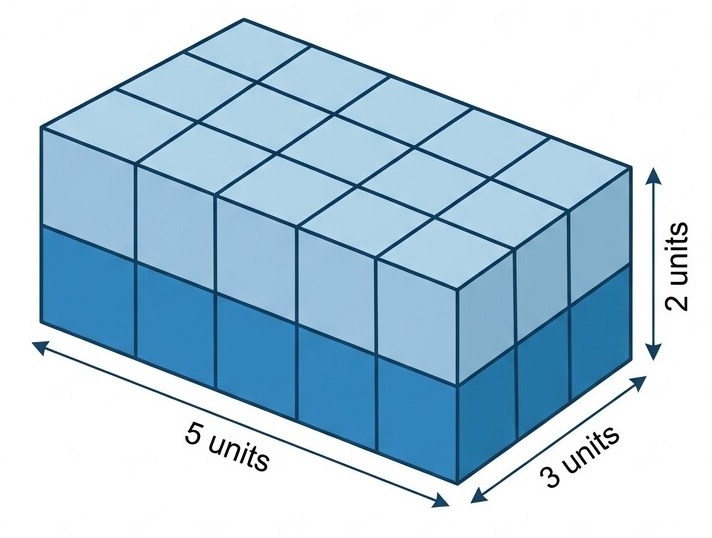
A single cubic unit is written as because it takes three lengths to define it. One more time, picture the ant: to fill a whole cube, it can no longer stay on a flat surface — it also has to climb up. That third direction is the extra dimension, which is why volume is "three-dimensional": length across, width down, and now height up. So instead of counting flat tiles, solid cubes are counted as they are stacked through space, and filling the entire interior with these cubes gives the volume. Notice the pattern building across all three unit types: each new dimension changes the small number—called an exponent—in the unit's label.
The Exponent Tells the Story
The table below puts all three unit types side by side so the pattern is easy to spot:
| Measurement | Unit Type | What is Counted | Dimensions | Notation |
|---|---|---|---|---|
| Perimeter | Linear unit | Edge-length segments around the boundary | 1D (length) | |
| Area | Square unit | Small squares covering the surface | 2D (length × width) | |
| Volume | Cubic unit | Small cubes filling the space | 3D (length × width × height) |
A handy memory trick: that small number at the top right of a unit, the exponent, tells you exactly how many dimensions are involved. No little number (which implies a 1) means perimeter. A little 2 means area. A little 3 means volume. If an answer is given in , it is immediately clear that a surface was measured — no extra context needed.
Counting Units on Irregular Shapes 🧩
So far, the examples have been neat rectangles and boxes, but the counting approach works just as well for irregular shapes. Imagine an L-shaped figure drawn on a grid — like two rectangles joined at a corner. To find its perimeter, trace the outer edge and count every unit-length segment, even where the boundary takes unexpected turns. To find its area, count every square unit sitting inside the shape, whether that region forms a tidy rectangle or not.
The same idea extends to three dimensions. Picture a set of wooden blocks glued into an uneven tower. The volume is simply the total number of unit cubes the tower contains, regardless of its odd outline. This is the real power of counting units: it does not depend on a tidy formula. Whether a shape is perfectly regular or wildly jagged, the right unit type and a careful count will always give the correct measurement.
Conclusion and Next Steps
In this lesson, each type of geometric measurement was connected to its matching unit by seeing how dimensions drive the choice. Perimeter is counted in linear units along the boundary, area is counted in square units across the surface, and volume is counted in cubic units that fill the interior. These counting strategies work for irregular shapes — not just perfect rectangles and boxes.
Up next, you will jump into hands-on practice where you trace boundaries, tile surfaces, and fill solids using the Geometry Explorer. You will also tackle some irregular shapes to prove that counting units works even when the outline is not neat and tidy. Get ready to count your way to a deeper understanding of measurement!
