Leadership DNA and DISC
Leadership DNA and the DISC Framework
In the previous lesson, you embraced a foundational truth: adaptive leadership means adjusting your approach to meet each person where they are. But here's the natural follow-up question—where do you start? The answer is with yourself. Before you can flex your style for others, you need to understand your own default settings. Every people manager has a built-in tendency toward certain behaviors. Some of us instinctively jump into problem-solving mode and start issuing clear directives, while others default to asking questions and offering emotional support. Neither tendency is wrong, but if you don't know which one is yours, you can't intentionally choose when to use it and when to shift. This unit gives you the tools to map your own Leadership DNA—the behavioral wiring that shapes how you naturally manage—and then introduces the DISC framework so you can recognize the same patterns in the people you lead. By the end, you'll know not only what comes easily to you but also exactly where growth will require deliberate effort.
Assessing Personal Leadership Tendencies Across Directive and Supportive Dimensions
Your leadership behavior, at its core, operates along two dimensions: directive behavior and supportive behavior. Directive behavior is about structure—telling, showing, and organizing. When you're being directive, you're providing clear instructions, setting timelines, defining roles, and monitoring progress. Supportive behavior, on the other hand, is about connection—listening, encouraging, facilitating, and collaborating. When you're being supportive, you're asking for input, acknowledging feelings, praising effort, and building confidence.
Most managers have a natural lean toward one dimension over the other. Think about what happens when a team member comes to you with a problem. Does your first instinct sound more like "Here's what I'd recommend you do—first, second, third" or more like "Tell me more about what's going on—what do you think is causing this?" The first response is high-directive; the second is high-supportive. Neither is inherently better. The key insight is that both dimensions exist on a spectrum, and the most effective leaders can dial each one up or down depending on what the moment requires.
To assess yourself honestly, consider your behavior across several common management situations. When you delegate a task, do you tend to spell out every step, or do you describe the desired outcome and let the person figure out the path? When a team member is frustrated, do you jump to solutions, or do you first validate their experience? When deadlines are tight, do you increase check-ins and oversight, or do you express confidence and offer to help if needed? There are no trick answers here—the goal is pattern recognition. You're building a picture of your baseline profile, the default operating mode you fall into when you're not thinking consciously about your leadership approach.
To see how starkly these defaults can differ between two well-intentioned managers, consider the following exchange:
- Jake: You know what's funny? When Milo came to me about the vendor issue, my first reaction was to map out a plan for him right there—timelines, steps, the whole thing.
- Jessica: Really? When he mentioned it to me, I just asked him how he was feeling about it and what options he'd already considered.
- Jake: And that's exactly why this matters. Neither of us was wrong, but we defaulted to completely different modes without even thinking about it.
- Jessica: Right. I went straight to support, you went straight to direction. The question is whether Milo needed structure or space in that moment.
- Jake: Exactly. If he already had a plan and just needed encouragement, my step-by-step rundown probably felt like I didn't trust him.
- Jessica: And if he was genuinely stuck and needed clear guidance, my open-ended questions might have felt like I was leaving him hanging.
This exchange captures the core challenge of self-awareness. Jake and Jessica both responded with good intentions, yet their instinctive approaches were opposite—and each one would have landed differently depending on what Milo actually needed. The takeaway isn't that one manager is right and the other is wrong. It's that knowing your default is what allows you to pause and ask whether your instinct matches the situation before you act on it.
Here's why this matters for adaptive leadership. If your baseline is heavily directive, you'll find it natural to lead beginners but may unintentionally smother experienced team members. Conversely, if your baseline leans supportive, you'll excel at building trust and morale but might struggle to provide the firm structure a new hire desperately needs. Knowing your baseline is the first step toward expanding your range—it tells you what comes naturally and what will require intentional practice. With this self-awareness as your foundation, you're now ready to learn a framework that maps these tendencies not just in yourself but in every person on your team.
Deep Dive into DISC: Dominance, Influence, Steadiness, and Conscientiousness
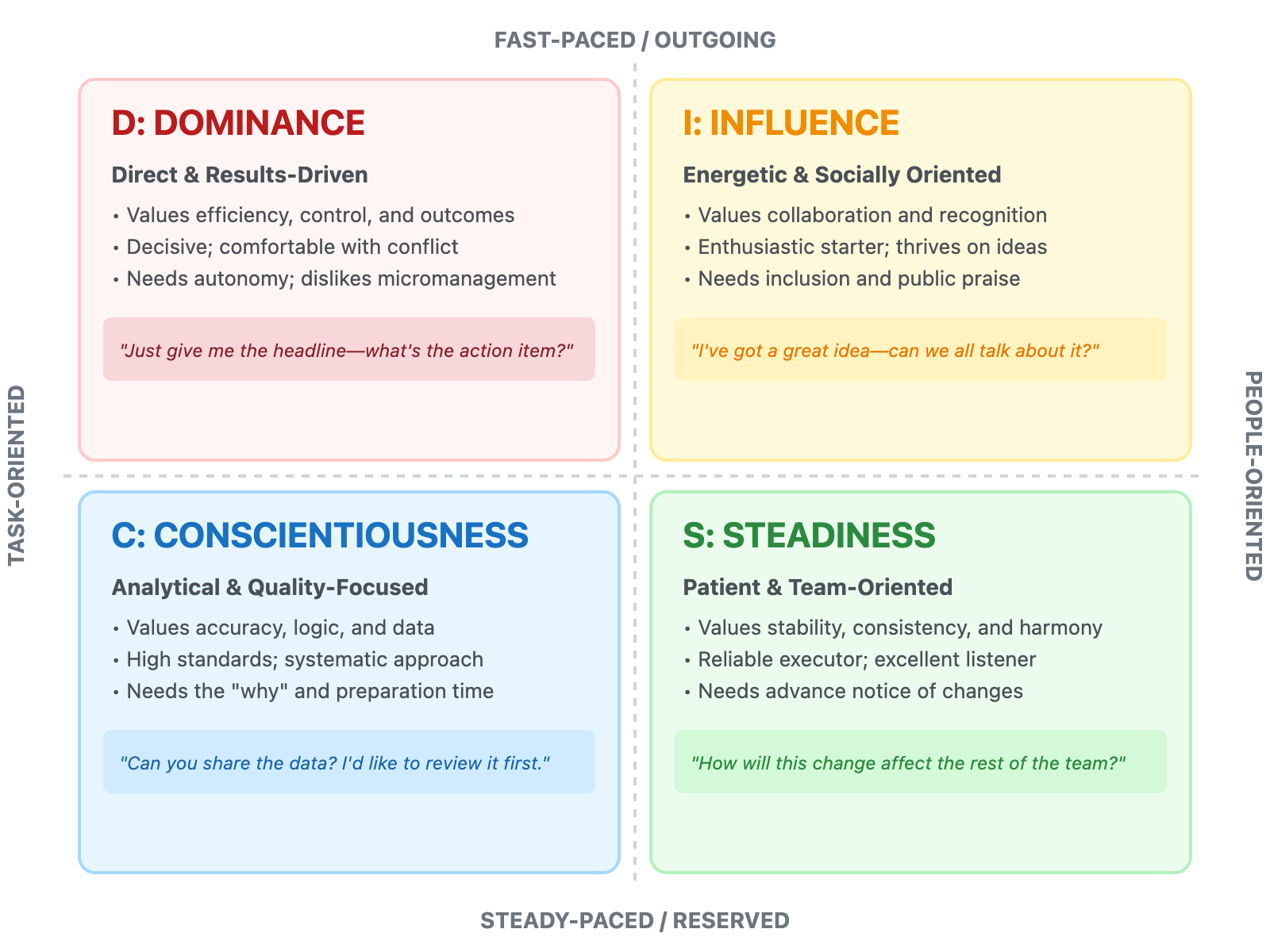
The DISC model is one of the most practical behavioral frameworks available to people managers. It categorizes observable behavior into four primary styles, each reflecting a distinct pattern of priorities, communication preferences, and stress responses:
-
Dominance (D) is characterized by a focus on results, directness, and efficiency. These individuals are often high-will and decisive, prioritizing the "bottom line" to drive progress. In leadership, they excel at providing clear direction and meeting challenges head-on, though they may occasionally overlook the social or emotional nuances of the team in their pursuit of outcomes.
-
Influence (I) centers on social connection, enthusiasm, and collaboration. High-I individuals are energetic communicators who thrive on building morale and generating creative ideas. While they are excellent at persuading and motivating others, their natural lean toward the big picture means they may require structured systems to ensure attention to detail and consistent follow-through.
-
Steadiness (S) represents a focus on reliability, patience, and team harmony. Individuals with this style are dependable executors who value stable environments and consistent processes. They excel as listeners and diplomats within a team; however, their preference for predictability means they typically need advance notice and psychological safety to navigate change effectively.
-
Conscientiousness (C) focuses on accuracy, logic, and systematic quality. These individuals are analytical and detail-oriented, prioritizing data and clear reasoning over social influence. Their commitment to high standards ensures precise work, but they may experience stress when pressured to act quickly without sufficient information or a clear understanding of the "why" behind a decision.
One critical thing to remember is that most people are not purely one style. They're a blend, with one or two dominant tendencies and secondary traits that emerge in different contexts. Your job isn't to label someone as "a D" or "an S" and stop there. Rather, it's to observe their behavioral patterns over time and use DISC as a lens for understanding what kind of direction, support, communication, and recognition will resonate most with them. Think of DISC not as a personality test result carved in stone but as a dynamic map you continually refine through interaction and observation.
Mapping Your Baseline Profile to Identify Comfort Zones and Stretch Zones
Now it's time to turn the lens back on yourself. Once you know your own DISC tendencies and your default lean toward directive or supportive behavior, you can create a clear map of your comfort zones—the leadership situations where your natural style fits perfectly—and your stretch zones—the situations where you'll need to consciously override your instincts.
Here's how this works in practice. If you're a high-D manager, your comfort zone is leading other direct, results-oriented people. You'll naturally sync with them because you share a pace and a priority. Your stretch zone, however, is likely managing a high-S team member who needs patience, reassurance, and time to process change. Your instinct might be to push harder and move faster, but that approach will make a high-S individual shut down rather than step up. Similarly, if you're a high-I manager, you'll feel at home in brainstorming sessions and team celebrations, but you may find it uncomfortable to deliver blunt, data-heavy feedback to a high-C team member who wants specifics, not enthusiasm. Consider two managers reflecting on exactly this dynamic:
- Jessica: I realized I'm naturally high-C. I love structure, I love data, and I love clear plans. Leading my other analytical folks is easy—we speak the same language.
- Ryan: So what's hard for you?
- Jessica: Managing high-I people. They want energy and spontaneity, and my instinct is to redirect them to the spreadsheet. I have to remind myself that they need me to engage with their ideas first and organize later—not the other way around.
- Ryan: That's interesting because I'm the opposite. I'm high-I, so I struggle with my high-C reports. They want all the details upfront, and I just want to brainstorm and figure it out as we go.
- Jessica: So your stretch zone is my comfort zone, and mine is yours.
- Ryan: Exactly. And knowing that means I can prepare for it instead of just winging it.
Notice what's happening here. Neither Jessica nor Ryan is changing who they are. They're identifying the specific interpersonal gaps where their natural style won't land well and preparing to adapt deliberately. This is the essence of mapping your baseline—it transforms vague discomfort into specific, actionable awareness.
To build your own map, start by listing the DISC styles on your team. For each person, ask yourself two questions: "Where does my natural approach align with what this person needs?" and "Where does my natural approach create friction?" The alignment points are your comfort zones—lean into them with confidence. The friction points are your stretch zones—these are where adaptive leadership becomes real work, and where the most meaningful growth happens for both you and your team member. The goal isn't to become equally skilled at all four styles overnight. It's to know the terrain so you can navigate it with intention rather than stumbling through it on autopilot.
Coming up next, you'll put this framework into practice in a role-play session where you'll meet a new team member and, through conversation and observation, work to identify their likely DISC profile. It's your first hands-on opportunity to read behavioral cues in real time and start tailoring your leadership approach accordingly.
