The Adaptive Leadership Mindset
Welcome to the Course
Welcome to Foundations of Adaptive Leadership—a course designed to fundamentally change the way you think about managing people. If you've ever felt the tension between following a consistent management playbook and recognizing that each person on your team responds differently, you're in the right place. Throughout this course, you will build the self-awareness and cognitive frameworks needed to lead with genuine flexibility, moving beyond the "one-size-fits-all" instinct that so many of us default to.
Here's what you can expect. You'll start by exploring the adaptive mindset itself—what it means and why it matters now more than ever. From there, you'll discover your own Leadership DNA through the DISC behavioral framework, uncovering both your comfort zones and the areas where growth feels uncomfortable. You'll then tackle the hidden cognitive biases and emotional intelligence gaps that quietly sabotage even well-intentioned leaders. Finally, you'll learn systematic observation techniques and how to flex your methods without compromising your core values. By the time you finish, you won't just understand adaptive leadership as a concept—you'll have a personal toolkit for practicing it every day. Let's begin with the foundational shift in thinking that makes all of this possible.
Understanding the Adaptive Leadership Mindset
For decades, the dominant model of management was built on a simple premise: the leader decides, and the team executes. This command-and-control approach treats leadership like a dial with one setting. You establish rules, enforce standards uniformly, and expect everyone to conform to the same process. It's efficient on paper, and in highly predictable environments—think assembly lines or military operations—it can work. But modern workplaces are rarely that predictable.
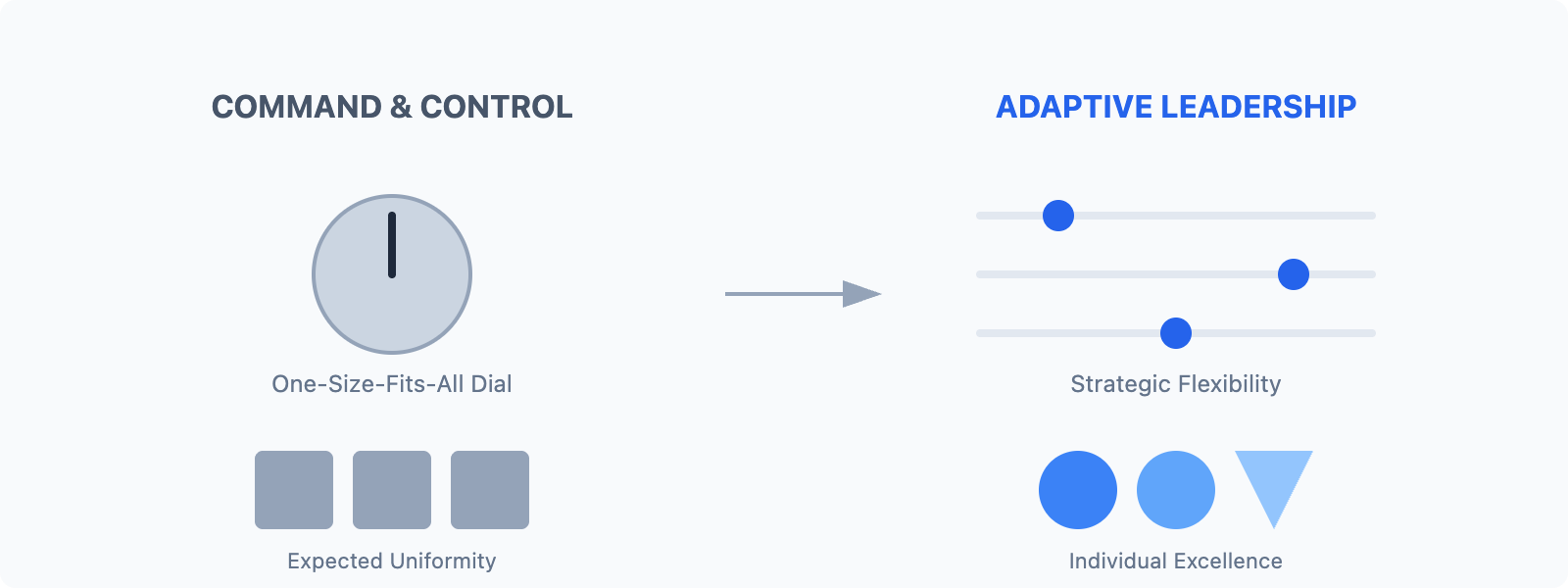
Adaptive leadership flips the script. Instead of asking "How do I get my team to fit my management style?", you start asking "How do I adjust my approach to unlock each person's best performance?" This isn't about being inconsistent or wishy-washy. It's about being strategically flexible. You still set clear expectations, you still hold people accountable, and you still drive results. The difference is in how you get there.
Think about it this way. Imagine you manage two people working on the same type of deliverable. One is a seasoned professional who thrives with autonomy, while the other is brand new and needs structured guidance. Treating them identically—say, by giving both of them a detailed step-by-step checklist—will bore the veteran and may even feel insulting, while skipping that checklist with the newcomer would set them up to fail. The adaptive leader recognizes this and adjusts, not because they favor one person over the other, but because the situation demands it.
This shift requires you to let go of a comforting illusion: that fairness means sameness. True fairness, in leadership, means giving each person what they need to succeed. That distinction is at the heart of everything you'll learn in this course.
The Philosophy of Leadership as a Service
Once you accept that flexibility is not favoritism, you can embrace a more powerful philosophy: leadership as a service. Your role as a people manager is not to be the smartest person in the room or the one with all the answers. Your role is to create the conditions under which each individual can grow, contribute, and perform at their highest level. This means your primary job shifts from directing work to developing people.
In practice, leadership as a service means you invest time in understanding where each person is in their skill development, what drives them emotionally and professionally, and how they best receive direction, feedback, and support. Some people need you to be a clear, structured guide. Others need you to step back and simply be available when they hit a wall. Still others need a blend of both, shifting as the task or context changes.
To see what this looks like in a real conversation, consider this exchange between two managers reflecting on their approaches.
- Natalie: I just had my check-ins with Jake and Ryan about the quarterly report. Completely different conversations.
- Chris: How so? They're working on the same deliverable, right?
- Natalie: Exactly, but Jake's done this five times—he just needed me to confirm the deadline and get out of his way. Ryan's brand new, so I walked him through the format, showed him a past example, and scheduled a mid-week review.
- Chris: Doesn't Ryan feel like you're hovering, though?
- Natalie: Actually, he thanked me. He said he'd been anxious about where to start. Meanwhile, if I'd done that with Jake, he would have felt micromanaged. Same goal, different approach.
- Chris: So the consistency isn't in what you do—it's in why you do it.
- Natalie: Right. I'm equally invested in both of them succeeding. I just show it differently.
Notice how Natalie isn't playing favorites. She's applying the same intent—setting each person up for success—through different methods. She reads where each person is and adjusts her level of direction accordingly. Chris's final observation captures the core philosophy: consistency lives in the purpose behind your leadership, not in identical actions.
Importantly, this doesn't mean you abandon your own standards or personality. You're not a chameleon who becomes a different person for every conversation. You're a leader who serves different needs by adjusting your methods—how much direction you give, how much support you offer, and how you communicate. The intent stays the same; the delivery changes. When you internalize this philosophy, one-on-ones become more productive, feedback lands more effectively, and trust deepens across your team because each person feels genuinely seen.
Identifying the Limitations of Traditional Management in Modern Workplaces
So why doesn't the old way work anymore? It's not that traditional management was always wrong—it's that the context it was designed for has changed dramatically. Today's workplaces are defined by diversity of skill, experience, and expectation in ways that a rigid model simply cannot accommodate.
The first limitation is the talent diversity problem. Your team likely includes people at vastly different stages of their careers. A blanket policy like "Everyone submits a daily status update" may provide useful structure for a junior member, but it signals distrust to a senior contributor who has been delivering autonomously for years. The rule creates friction precisely where you need momentum. Closely related is the motivation gap. Traditional management assumes that the same incentives and pressures work for everyone, yet the person motivated by public recognition is fundamentally different from the one who values quiet mastery and private acknowledgment. When you manage everyone with the same motivational toolkit, you inevitably connect with some people while alienating others.
Furthermore, modern work is increasingly knowledge-based and collaborative, meaning you often manage people whose technical expertise exceeds your own. In that environment, commanding and controlling isn't just ineffective—it actively undermines the value your team brings. Your job becomes less about telling people what to do and more about creating the environment in which they can figure out how to do it brilliantly. On top of all of this, there's the reality of retention. Top performers leave managers, not companies, and they leave fastest when they feel boxed into a management style that ignores who they are. The cost of not adapting isn't just lower engagement—it's losing the people you can least afford to lose.
Recognizing these limitations isn't an indictment of your past leadership. It's an invitation to evolve. The adaptive mindset doesn't ask you to throw out everything you know; it asks you to expand your range so you can meet the real, varied, and constantly shifting needs of the people you lead. Coming up next, you'll put this mindset into action in a role-play session where you'll practice advocating for an adaptive approach with a manager who favors rigid standardization.
