Cognitive Biases and Emotional Intelligence
Cognitive Biases and Emotional Intelligence
In the previous lesson, you mapped your Leadership DNA and learned the DISC framework to understand your own behavioral defaults and those of your team members. You now have a shared language for recognizing how people prefer to work and communicate. But here's the uncomfortable truth: even armed with all that knowledge, your brain will actively work against you. Every people manager carries a set of invisible mental shortcuts—cognitive biases—that distort how you interpret behavior, assign blame, and evaluate performance. These shortcuts aren't a sign of poor character; they're simply how the human brain manages complexity. The problem is that in leadership, unchecked biases lead to unfair judgments, mismatched interventions, and eroded trust. On top of that, even when you know the right leadership move, executing it can feel deeply uncomfortable if it clashes with your natural tendencies. That internal discomfort is where Emotional Intelligence (EQ) becomes essential. This unit equips you with the ability to catch your biases before they cause damage and to manage the emotional cost of flexing your style so that adaptive leadership becomes sustainable, not exhausting.
As a people manager, you make dozens of judgment calls about your team members every week. Why did someone miss a deadline? Why is a usually quiet person suddenly speaking up? Why did that project go sideways? Your brain answers these questions in milliseconds, often before you've gathered any real evidence—and that speed is precisely where bias creeps in. While many cognitive biases affect decision-making, five are especially dangerous for leaders. We'll focus in depth on the two most pervasive, Fundamental Attribution Error and Confirmation Bias, and then address three others you need to keep on your radar.
Fundamental Attribution Error (FAE) is the tendency to attribute someone else's behavior to their character rather than their circumstances. When a team member shows up late to a meeting, your brain is far more likely to think "They're disorganized and don't respect my time" than "I wonder if something happened this morning." Notice how the first interpretation is about who they are while the second is about what happened to them. FAE is especially damaging for people managers because it turns isolated incidents into fixed labels. Once you decide someone is "lazy" or "careless," every future behavior gets filtered through that label—which leads directly to the second major bias.
Confirmation Bias is the tendency to seek out, remember, and prioritize information that supports what you already believe. If you've decided that a team member is unreliable, you'll notice every missed detail while overlooking the twenty things they handled perfectly. Your brain isn't lying to you—it's just curating the evidence to match its existing story. Together, FAE and Confirmation Bias create a vicious cycle: FAE assigns a character-based label, and Confirmation Bias reinforces it by filtering out contradictory evidence. This is how managers end up with unfairly negative—or unfairly positive—views of their direct reports that have little to do with actual performance.
Beyond these two primary threats, three additional biases deserve your attention. The Halo Effect occurs when one positive trait—like charisma or a strong first impression—causes you to rate someone favorably across unrelated dimensions. You might assume a team member who presents well in meetings is also great at detailed analytical work, even without evidence. Closely related in its distorting power is the Recency Effect, which is the tendency to give disproportionate weight to whatever happened most recently. A strong final quarter can erase a year of inconsistent performance in your mind—and vice versa. Finally, Affinity Bias is your brain's preference for people who are similar to you. If a team member shares your communication style, your background, or even your DISC profile, you're more likely to rate them positively and give them the benefit of the doubt. Recognizing all five of these biases won't eliminate them—they're hardwired into human cognition. But awareness gives you the critical half-second pause you need to ask, "Is this my judgment or my bias?"
Apply EQ When Flexing Your Style
Knowing about biases is a cognitive skill. Managing yourself when you need to act against your instincts is an emotional one. This is where Emotional Intelligence—your capacity to recognize, understand, and regulate your own emotions while being attuned to the emotions of others—becomes the engine that makes adaptive leadership possible.
In the previous lesson, you identified your comfort zones and stretch zones using DISC and the directive-supportive spectrum. Here's what that looks like emotionally: when you operate in your comfort zone, leadership feels fluid and natural. But the moment you step into a stretch zone—say, a high-D manager forcing themselves to slow down and patiently support a high-S team member through a change—you'll experience what we call internal friction. It's that tight, slightly irritated feeling when everything in you wants to say "Just do it this way" but the situation demands that you ask "How are you feeling about this transition?" Internal friction isn't a sign that you're doing something wrong. It's actually a signal that you're doing something right—you're overriding a default to meet someone else's need. However, if you don't manage that friction, one of two things happens: you either snap back to your default style and abandon the adaptation, or you push through with visible frustration that your team member picks up on instantly.
EQ operates through four interconnected capabilities that build on one another. Self-awareness is the foundation—it means recognizing what you're feeling in the moment, noticing the tightness in your chest, the urge to cut someone off, or the flicker of annoyance when a conversation moves slower than you'd like. From there, self-management is what you do with that awareness: choosing to breathe, to pause, to stay in the conversation rather than retreating to your comfort zone. Moving outward, social awareness is your ability to read the emotional landscape of the person in front of you—are they anxious, disengaged, eager, or defensive? And finally, relationship management draws on all three preceding capabilities to navigate the interaction in a way that strengthens rather than strains the connection.
For people managers, the most critical EQ moment is the transition between recognizing internal friction and choosing how to respond. Imagine you're a naturally high-I manager—optimistic, fast-paced, idea-driven—and you're sitting across from a high-C team member who wants to walk through a fifteen-point checklist before making a decision. Your internal experience might sound like "This is taking forever, can we just pick a direction?" That's a valid feeling. But acting on it would shut down the very process that helps your high-C report feel confident and produce their best work. EQ doesn't ask you to not feel the friction. It asks you to feel it, name it, and choose a response that serves the relationship rather than your own comfort.
This is also where biases and emotions intersect dangerously. When you're emotionally depleted—stressed, tired, or frustrated—your bias defenses drop. You're far more likely to commit Fundamental Attribution Error when you're already irritated, and more likely to lean into Confirmation Bias when you don't have the energy to consider alternative explanations. Consequently, emotional regulation isn't just about being a "nice" manager. It's the practical infrastructure that keeps your judgment accurate and your leadership adaptive under pressure.
Techniques for Staying Regulated When Acting Outside Your Natural Tendencies
Understanding that internal friction exists is one thing. Having concrete tools to manage it in the moment is another. Four techniques work especially well for people managers who are stretching beyond their natural style, and they function best when used together as a system.
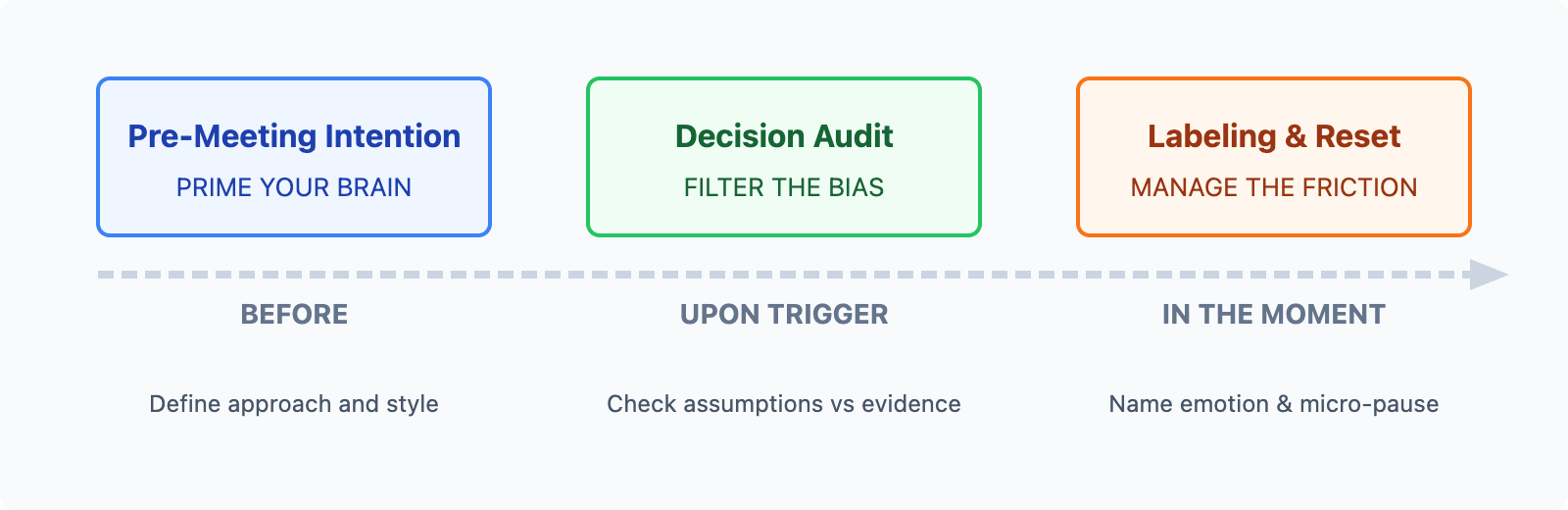
The first is the Decision Audit. Before you respond to a team member's behavior—especially a mistake or a frustrating situation—run through three questions in quick succession: "What am I assuming about why this happened?" followed by "What evidence do I actually have?" and then "What would I think if my favorite team member did the same thing?" That third question is particularly powerful because it exposes Affinity Bias and FAE simultaneously. If you'd give one person the benefit of the doubt but not another, the discrepancy is your bias talking, not the facts. The entire audit takes less than sixty seconds, but it forces your brain out of autopilot and into deliberate analysis.
To see what a Decision Audit sounds like in practice, consider this exchange between two peer managers right after one of them discovers a team member sent an incorrect report to a client:
- Marcus: I'm about to have a serious talk with Taylor. They sent the wrong version of the financials to the client. This is exactly the kind of carelessness I've been seeing from them.
- Jake: Okay, slow down. Let's run a Decision Audit first. What are you assuming about why it happened?
- Marcus: That they rushed through it and didn't double-check. They just don't pay attention to the details.
- Jake: That's a character assumption. What evidence do you actually have about the cause?
- Marcus: I mean… I haven't asked them yet. I just know the wrong file went out.
- Jake: Fair. Last question—if Sam had sent the wrong file, what would you be thinking right now?
- Marcus: Honestly? I'd probably assume it was a system mixup or a one-off mistake. I wouldn't jump to "carelessness."
Notice what happened in that exchange. Marcus entered the conversation ready to confirm an existing narrative about Taylor's character—a textbook combination of Fundamental Attribution Error and Confirmation Bias. But Jake's three audit questions forced him to separate his assumptions from the evidence and to confront the double standard in how he'd treat two different people for the same mistake. The audit didn't tell Marcus what to do next; it simply cleared the bias from his thinking so that whatever conversation he has with Taylor will be grounded in facts rather than a pre-existing label.
The second technique is Labeling the Friction. When you feel internal resistance while adapting your style, silently name what's happening—something like "I'm feeling impatient because this is my stretch zone" or "I'm uncomfortable because this person needs support and my instinct is to direct." Research in emotional regulation consistently shows that the simple act of labeling an emotion reduces its intensity. You're not suppressing the feeling; you're acknowledging it, which paradoxically gives you more control over how you respond. Think of it as a quick internal narration that separates the feeling from the action, creating just enough distance to choose wisely.
Building on that moment of awareness, the third technique is The 10-Second Reset. When friction spikes in real time—during a meeting or in the middle of a tough conversation—give yourself a physical micro-pause. Take a slow breath, shift your posture, or take a sip of water. These small physical actions create a brief gap between stimulus and response, and that gap is where you choose to stay adaptive rather than revert to default. It may sound simple, but in high-pressure moments, the difference between reacting and responding often comes down to those ten seconds.
The fourth technique works before the interaction even begins. A Pre-Meeting Intention is a thirty-second mental setup where you define your approach in advance: "In this meeting, I'm going to listen more than I speak because this person needs support, not direction" or "I'm going to lead with data because this team member trusts evidence, not enthusiasm." Pre-setting your intention primes your brain to operate outside its default, much like programming your GPS before you drive so you're less likely to take the familiar route on autopilot.
Together, these four techniques form a cohesive regulation system. The Decision Audit catches bias before it distorts your judgment. Labeling the Friction keeps your emotions from hijacking your behavior. The 10-Second Reset gives you space in real time. And the Pre-Meeting Intention sets you up for success before the interaction even begins. None of these require you to become a different person—they require you to become a more intentional version of yourself, someone who manages with awareness rather than reflex.
With these tools in hand, you're ready to put them to the test. In the upcoming role-play, you'll practice conducting a Decision Audit in real time. A team member has made a mistake, and before you address it, you'll work through the audit process with a peer to ensure you're responding to facts rather than falling into Fundamental Attribution Error. It's your chance to turn these concepts into muscle memory.
